TOOLNAVIA / BUYING GUIDE
Kit Creator Annual vs Monthly: Does Month 11 Justify $390 Upfront?
The short answer
Affiliate disclosure: Toolnavia is not approved for Kit's affiliate program for this exact offer. This guide contains no commercial CTA or tracking link. Prices and policies were checked on 2026-10-20; live checkout and the account billing page control.
At a glance
- Best for
- Creators deciding between US$39 monthly flexibility and US$390 annual prepayment.
- Price model
- US$39 monthly or US$390 yearly at 1,000 active subscribers
- Check first
- US 1,000-subscriber public pricing only; tax, growth and refund approval can change.
Quick verdict
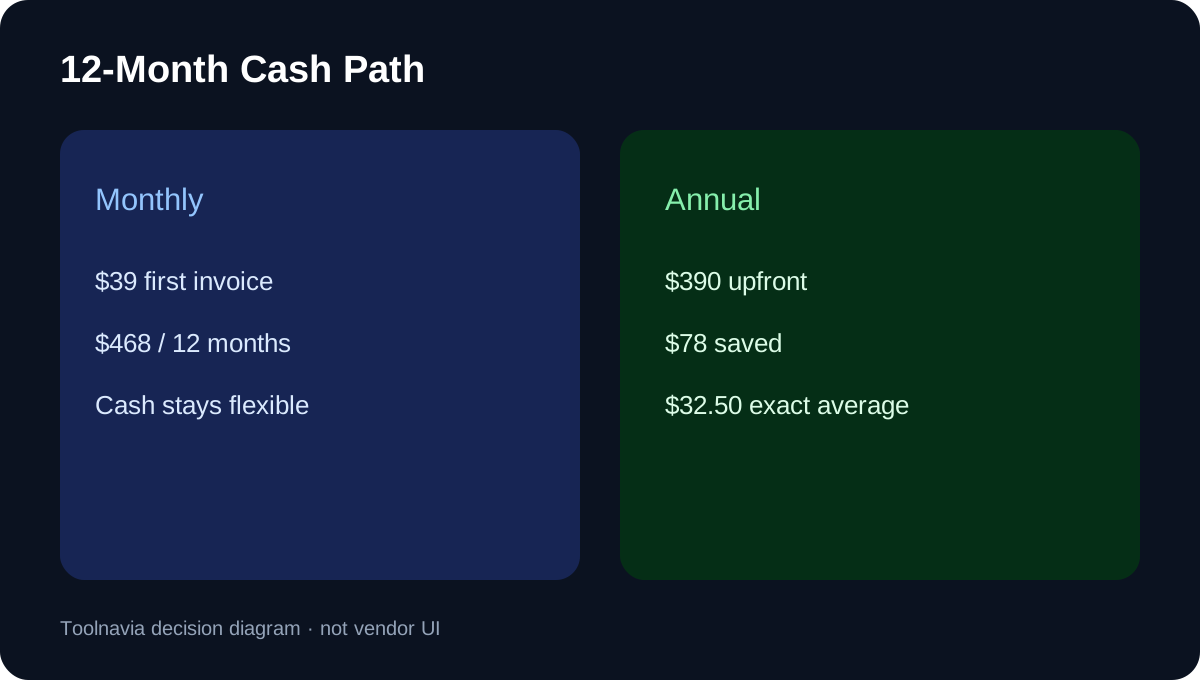
Kit Creator costs US$39 when paid month to month or US$390 for a year at the 1,000-active-subscriber tier. Twelve monthly payments total US$468, so annual billing saves US$78. The decision is not really “17% off or no discount.” It is whether saving US$78 justifies paying US$351 more on day one and accepting a much longer commitment.
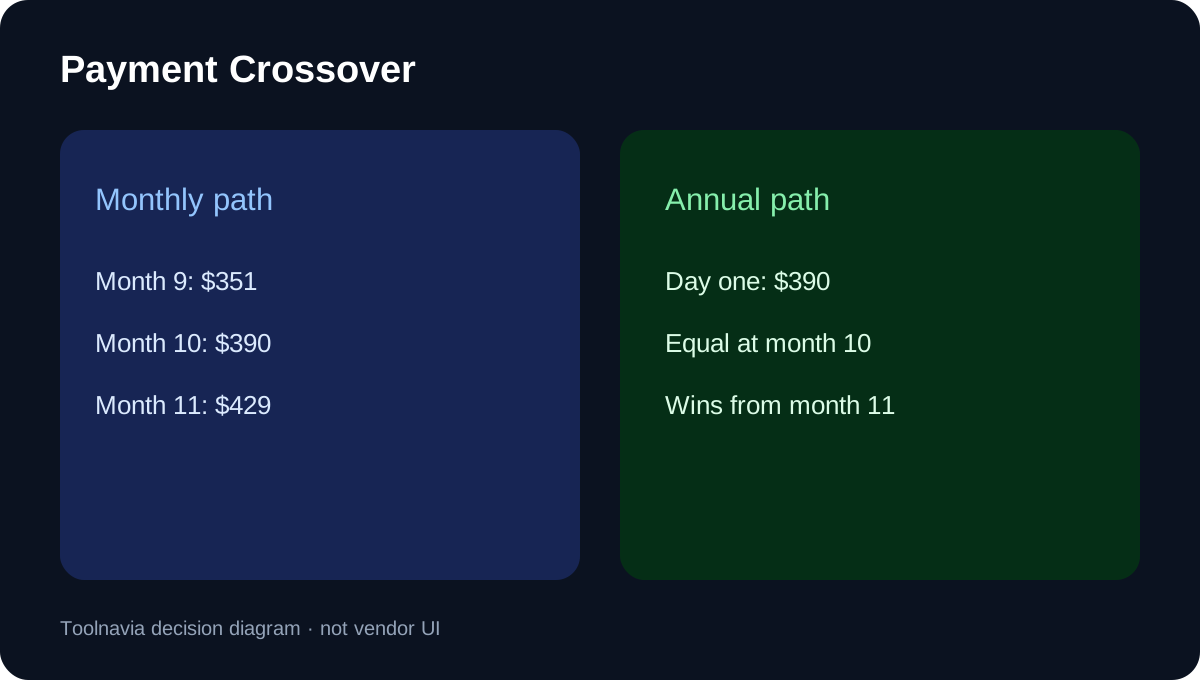
Monthly billing is the safer choice when a creator might pause, switch tools or fall back to Kit's free plan within ten months. Annual billing becomes the lower-cash path only after the tenth monthly payment: ten payments equal US$390; payment eleven takes monthly spending to US$429.
The exact 12-month math
The monthly path is simple: US$39 × 12 = US$468. The annual path is US$390 charged upfront. The difference is US$78, equal to two US$39 payments. Kit's own explanation describes annual service as 12 months for the price of 10.
Kit displays the annual option as about US$33 per month. That is a rounded display, not the exact monthly equivalent: US$390 ÷ 12 = US$32.50. Use US$390—not US$33 × 12—when budgeting the invoice.
The tenth-payment crossover
At the first invoice, US$39 monthly billing preserves US$351 of cash: US$39 leaves the account instead of US$390. After six payments, monthly spending is US$234, still US$156 below the annual charge. After nine payments it is US$351. At payment ten it reaches US$390, exactly matching annual billing.
If a creator expects to leave after nine paid months, monthly billing uses less cash. If the account stays active for eleven or twelve paid months, annual billing wins by US$39 or US$78. This clean crossover is more useful than a generic percentage badge.
The features are the same—subscriber growth is not
This comparison holds the Creator plan and 1,000-subscriber tier constant. Billing cadence does not buy extra automations or support. Creator includes unlimited visual automations, email sequences, branding removal and 24/7 email/chat support on the published pricing page.
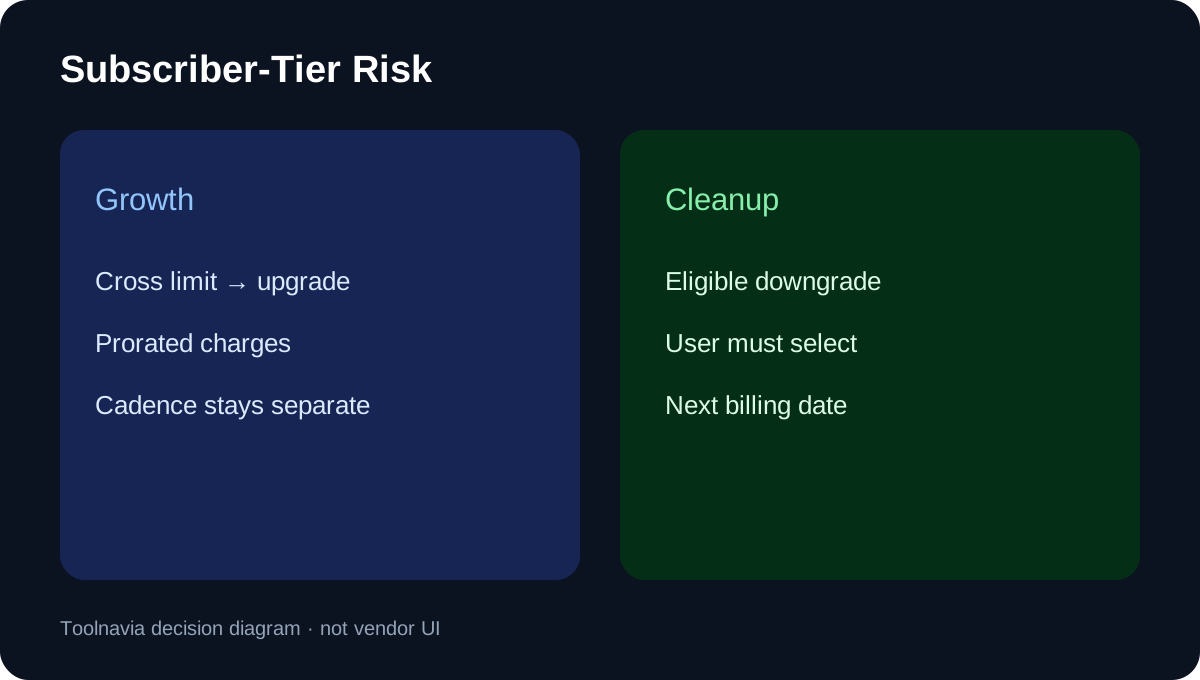
The bill can still change when the active-subscriber tier changes. Kit says paid prices follow active subscribers rather than message volume and that unsubscribed contacts are not charged. Crossing a tier can move the account up automatically; dropping below a tier does not automatically lower the price, because an eligible downgrade must be selected and takes effect on the next billing date.
Annual billing's real risk
Annual billing concentrates US$390 into the first invoice. That matters if revenue is seasonal, the newsletter is experimental, or the creator is evaluating alternatives. The maximum scheduled saving is only US$78, so one unused quarter can easily outweigh it.
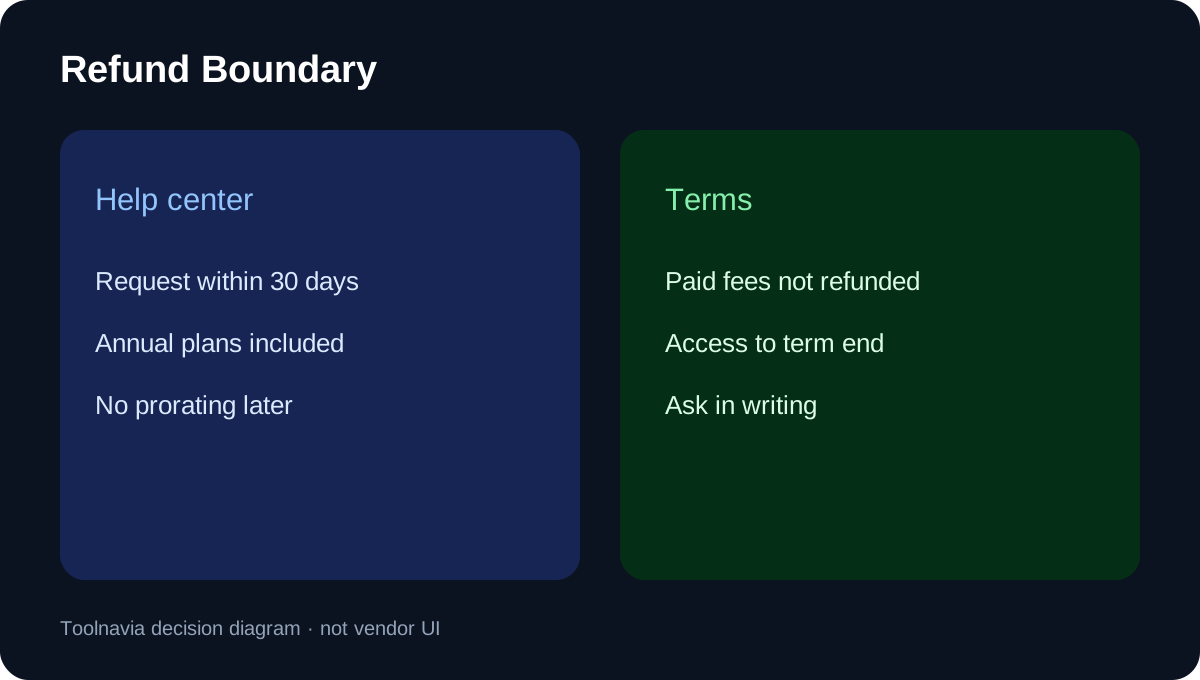
Do not treat “cancel anytime” as “unused months are always refundable.” Kit says cancellation leaves the account active until the end of the paid billing period. Its help center permits a refund request for payments made within 30 days, including annual plans, but says older payments are neither refunded nor prorated.
Refund-policy conflict: ask in writing
Kit's published terms state more strictly that cancelling before the current subscription period ends does not refund paid-service fees. The help center says a refund can be requested for payments within the last 30 days. Those statements are not perfectly aligned.
A buyer should therefore preserve the checkout receipt and ask support in writing before relying on a refund—especially when switching to annual billing. This article does not promise eligibility or approval. The safest assumption after day 30 is that unused annual months carry no cash refund.
Subscriber-tier surprises
A 1,000-subscriber price is only a starting tier. Independent pricing guides consistently record US$39 monthly and US$390 annually at that tier, while noting that costs rise as the active list grows.
The practical prepay question is not only “Will I use Kit for a year?” It is also “Will I remain near this subscriber tier?” Annual billing secures a cadence discount, but it does not freeze every future account cost if the list crosses a higher tier. Kit's billing documentation shows prorated upgrade credits and charges, while eligible downgrades wait until the next billing date.
When monthly billing is worth the extra US$78
Choose monthly billing when the project is younger than ten months, migration testing is unfinished, cash runway matters, or the creator expects a major list cleanup. Paying a maximum US$78 premium over a full year can be reasonable insurance against an early exit.
Monthly is also sensible when the team has not tested Kit's editor, automation organization or reporting depth. TechRadar found the visual automation workflow approachable but called out limited design templates and costs that scale with subscriber count.
When annual billing is rational
Annual Creator keeps the same Creator feature set while charging US$390 upfront.
Choose annual billing when the Creator plan is already validated, the list is stable, US$390 upfront does not constrain operations, and the account is highly likely to remain paid for at least eleven months. At that point the US$78 saving is real and the administrative simplicity of one annual payment may help.
The saving alone should not force the choice. A creator earning far more than US$78 from one retained campaign may value flexibility more; a stable newsletter with predictable revenue may prefer certainty.
Checkout checklist and final recommendation
1. Confirm the live 1,000-active-subscriber price and tax on the billing screen. 2. Multiply monthly price by the expected paid months, not automatically by twelve. 3. Treat ten payments as the crossover: US$390 equals the annual invoice. 4. Ask support how the 30-day refund language interacts with the Terms. 5. Check the current subscriber tier and whether a downgrade is pending. 6. Export critical subscriber and automation data before any cancellation.
Final recommendation: stay monthly until the workflow has survived ten paid months or the team is highly confident it will. Switch to annual when a full year is genuinely likely and US$390 upfront is comfortable. The annual plan saves US$78, but flexibility can be worth more than that. Independent same-intent research reaches the same current US$39/US$390 pair, while older lower prices should not control today's decision.