TOOLNAVIA / BUYING GUIDE
EdrawMax ER Diagrams: Verify SQL Import Before You Pay
The short answer
An ER diagram can look correct while omitting the rule that matters to your database. Before buying EdrawMax for an existing schema, decide whether you need an editable explanation or a repeatable SQL reverse-engineering workflow. Test those jobs separately; an attractive template does not establish parser compatibility.
At a glance
- Best for
- Editable visual ER documentation with verified schema meaning.
- Price model
- Official Annual baseline $99; confirm current checkout, renewal and optional add-ons.
- Check first
- ER shapes and testimonials do not certify SQL dialect import or database enforcement.
Define the deliverable before choosing a tool
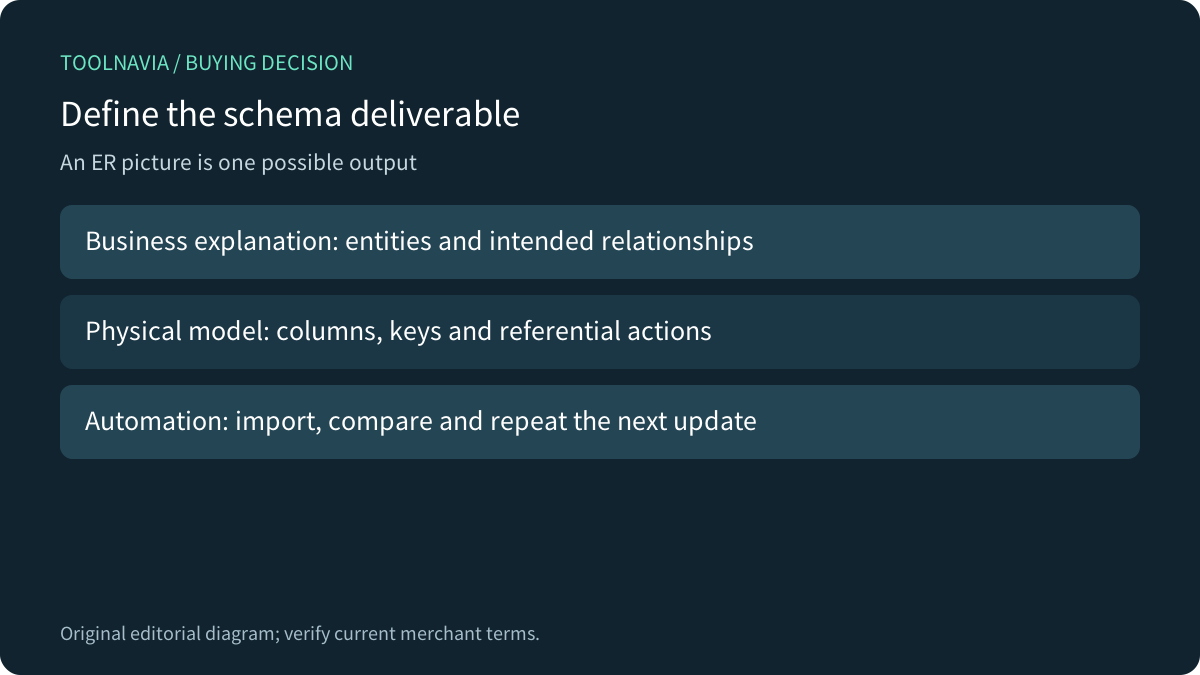
For a requirements workshop, a diagram may show business entities and proposed relationships. For a physical database handoff, the reviewer may need exact columns, composite keys, nullability and referential actions. A conceptual relationship is not automatically a physical foreign key.
Mermaid's ER documentation explicitly distinguishes logical models from relational implementation and supports cardinality and key annotations. Microsoft's SQL Server guidance shows where primary- and foreign-key constraints actually enforce integrity. Drawing “FK” beside a field does not install that constraint in a database.
Write down the required output: a stakeholder PDF, an editable drawing, imported DDL, or a schema-change comparison. This avoids paying for a visual documentation tool while assuming it also replaces your database engineering workflow.

What EdrawMax's current pages establish
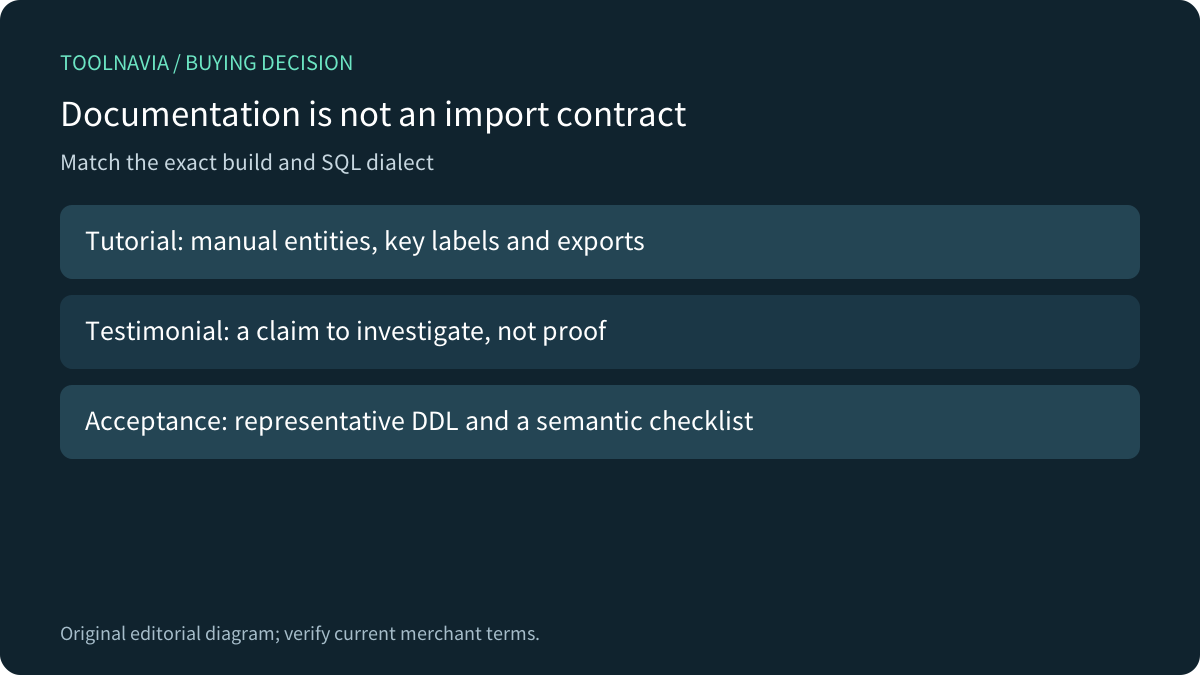
The official ER tutorial explains choosing a template, adding entities and attributes, labelling keys, saving an EDDX drawing and exporting documentation. Its ER feature page adds multiple notation choices and formatting tools. Those are relevant advantages when the main work is preparing a clear, editable explanation.
The marketing ER page also includes a testimonial praising database reverse engineering. A testimonial is not a supported-dialect list, a current import procedure or a test of your schema. The reviewed step-by-step guide demonstrates manual drawing instead.
This evidence gap does not prove that SQL automation is unavailable. It means this guide cannot certify the selected build's SQL import, database connection or synchronization behavior. If those are purchase requirements, obtain the exact procedure and test it before paying.

Test semantics with a small synthetic schema
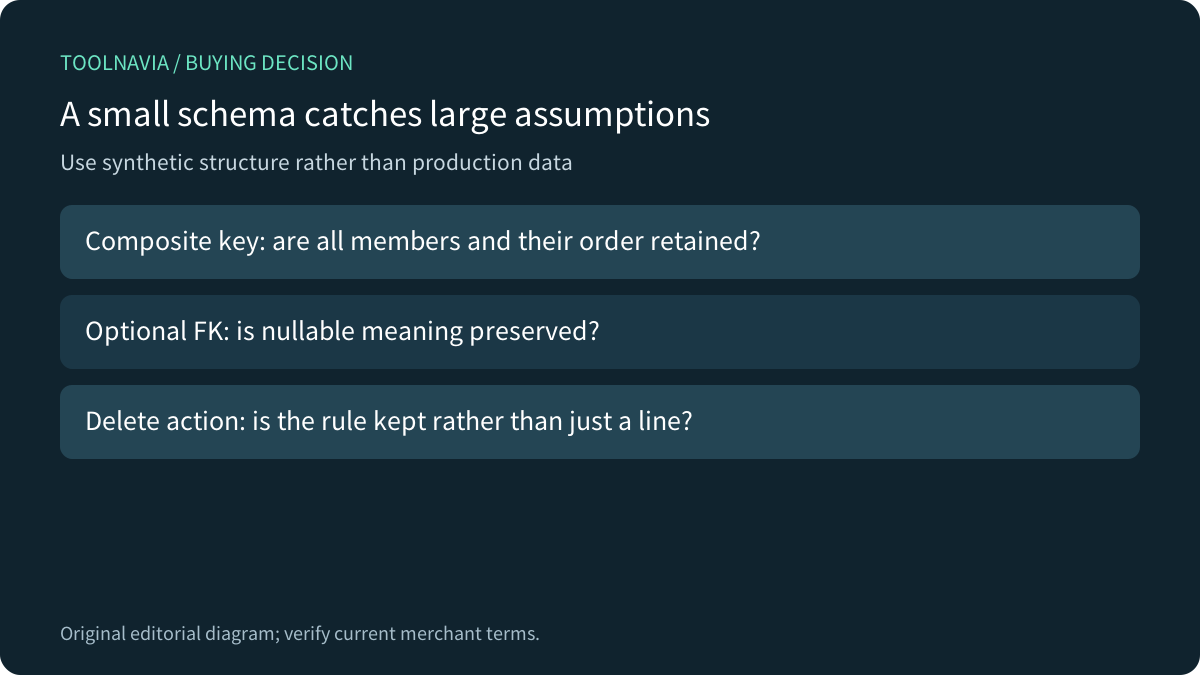
Use a nonconfidential example containing Customer, Order, Product and OrderLine. Give OrderLine a composite key, make one foreign key nullable, and include a deliberately different delete action on another relationship. Record the expected columns, key order, optionality and relationships in a simple checklist.
First create the intended visual model. Can a second person distinguish a mandatory relationship from an optional one without guessing from line placement? Are the composite-key members explicit? Add a legend when a connector represents a business relationship rather than an implemented constraint.
If SQL import is offered in your selected version, try representative DDL in the exact database dialect you use. Compare every checklist item after import. A successful file open or a matching table count is insufficient when column types, composite keys or delete actions are lost.
Do not connect a production database merely to investigate a purchase. Start with sanitized schema-only material and your organization's approved process. These are proposed acceptance steps, not an EdrawMax test performed by Toolnavia.
Compare with a schema-aware baseline
Oracle's MySQL Workbench manual documents reverse engineering from MySQL Create scripts, including imported keys and constraints and optional placement in an EER diagram. That is a concrete MySQL workflow, not a promise to parse every SQL dialect.
SqlDBM documents DDL and Excel reverse engineering and supported-platform connection paths. Its documentation also distinguishes structural import from metadata enrichment. These alternatives illustrate the feature contract to ask for; their presence does not prove either is the right licensed product for your team.
For a diagram maintained in text, Mermaid provides another baseline. Compare the complete job: initial creation, correction, review and the next update. Include time spent repairing an imported model, not just the time needed to generate its first picture.

Budget for the second schema revision
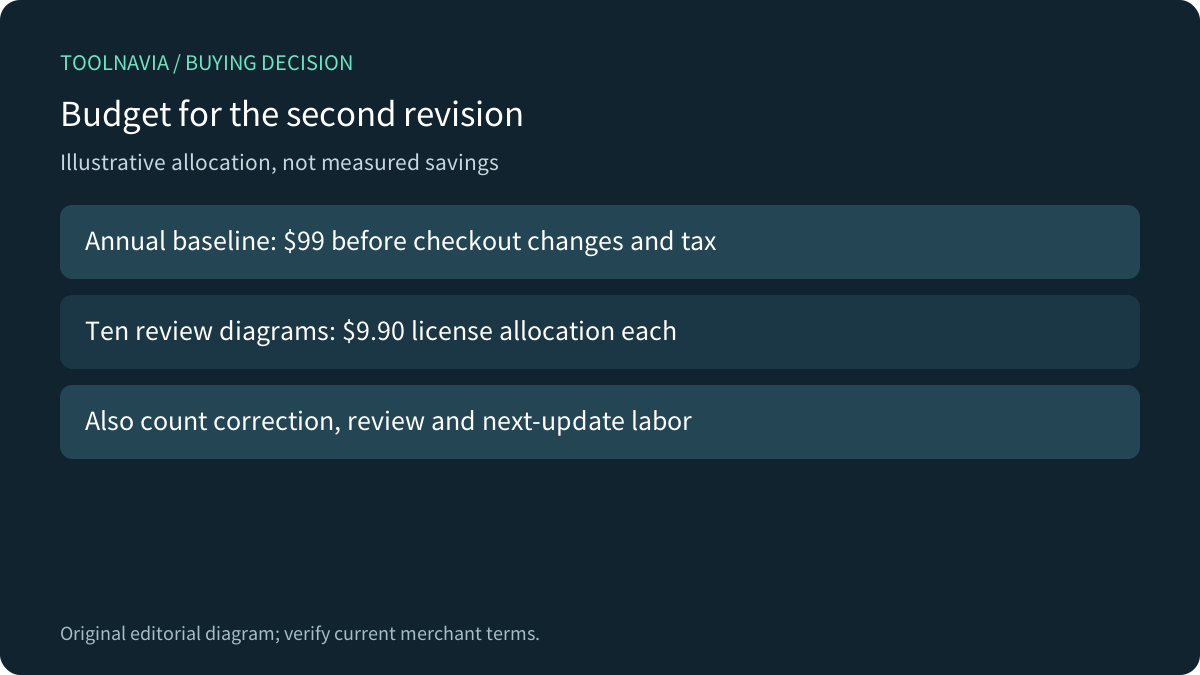
The current official general store shows an EdrawMax Annual baseline of $99 against a $119 reference. Confirm the selected order's renewal, tax, device terms and optional assets before payment. This is an annual diagramming purchase, not a verified database-management license.
Keep the native drawing alongside a schema version or migration reference. Make one controlled change to the synthetic example, then repeat the import or manual update. Check whether relationships duplicate, labels detach or previously reviewed corrections disappear.
For an illustrative budget, ten annual review diagrams would allocate $9.90 of a $99 license to each, before labor and tax. That is arithmetic, not measured savings. If maintaining a second, divergent schema picture takes more time than the baseline, a polished first export may not justify the subscription.

Buy for the workflow you have verified
Consider EdrawMax when editable visual documentation, notation choices and presentation output save demonstrable work and the recipient can use the handoff. Check exported key labels and connector ends rather than assuming all formats preserve meaning.
Pause if automatic database synchronization or exact SQL import is essential but remains unverified. After the acceptance test, inspect the [approved EdrawMax Annual offer](https://www.anrdoezrs.net/click-101895278-14099230) and retain the selected license terms.
*Affiliate disclosure: Toolnavia may earn a commission on eligible purchases. This documentation review includes no current EdrawMax trial, database connection, SQL round-trip or paid checkout.*