TOOLNAVIA / BUYING GUIDE
DemoCreator AI Subtitle Credits: How Many Minutes Does the Yearly Plan Cover?
The short answer
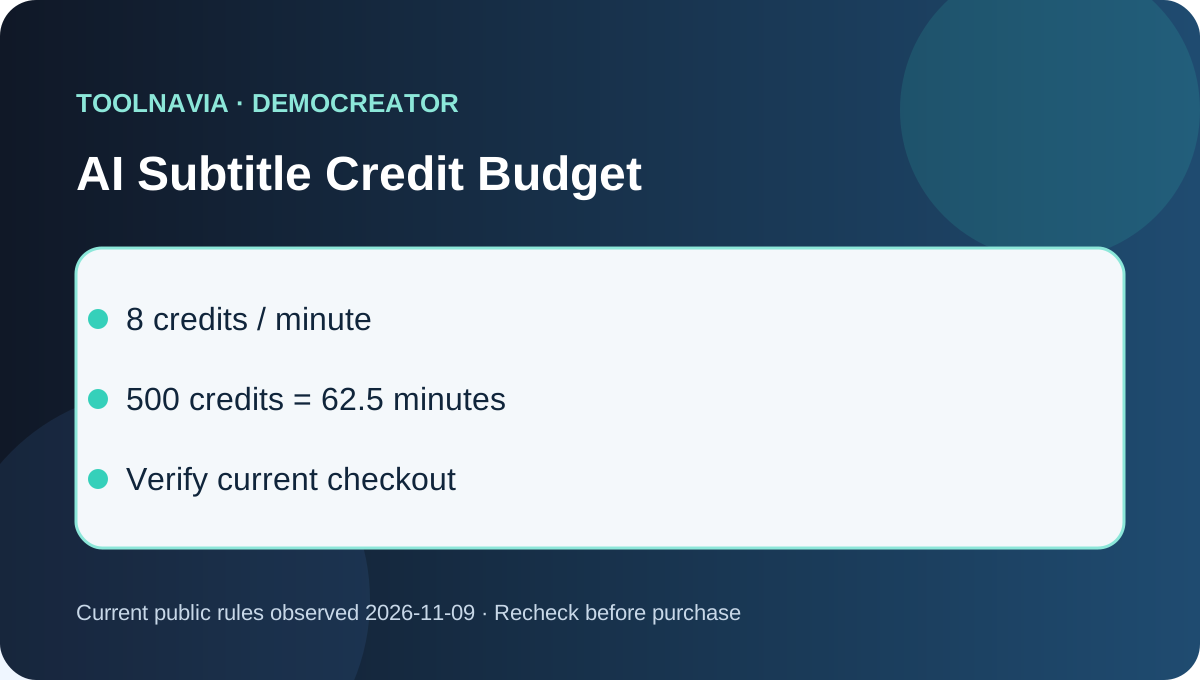
DemoCreator’s current AI-credit page says AI subtitles (Speech-to-Text) consume 8 credits per minute. The same page says recurring plans receive 200 or 500 credits monthly depending on plan, while the current Cross-Platform Yearly comparison maps that plan to 500 credits per month. The purchase question is capacity, not whether automatic captions exist.
This guide does not repeat the existing caption-workflow article. It calculates how many transcript minutes the yearly allowance buys, when peak workloads create a shortfall, and when SRT import or manual captions are better than spending credits.
At a glance
- Best for
- Creators whose peak caption load fits the current allowance.
- Price model
- Live checkout; current yearly comparison shows 500 credits/month
- Check first
- Rules, validity, checkout and accuracy can change.
Short verdict
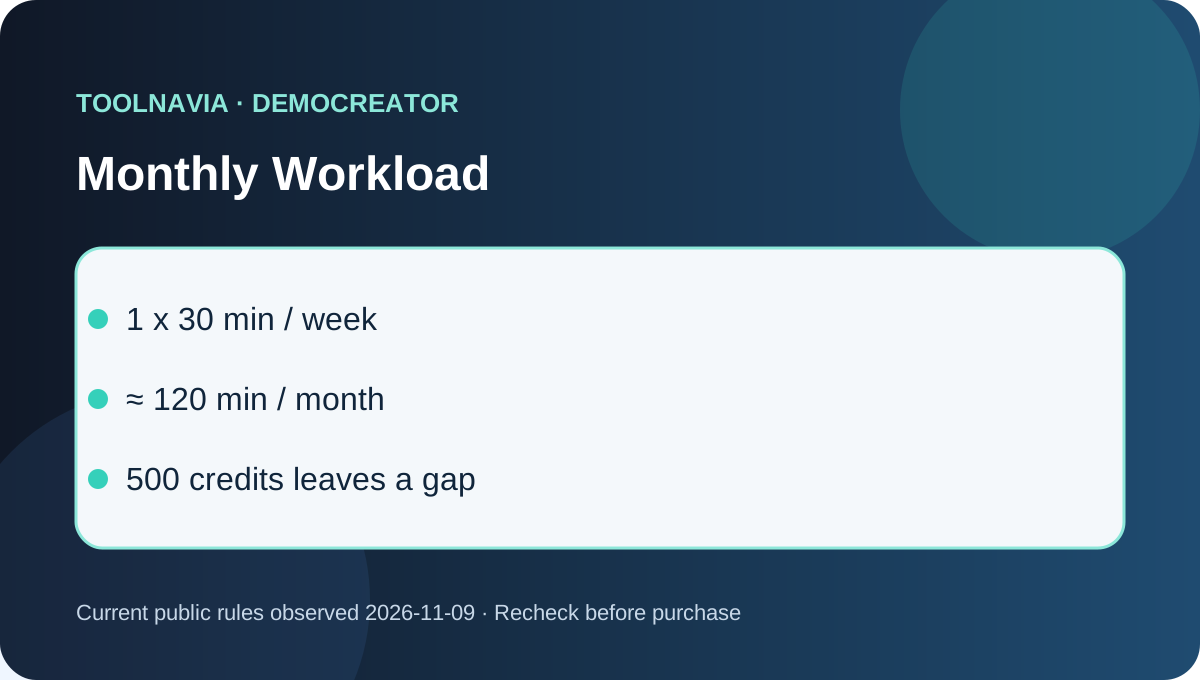
At 8 credits per minute, 500 credits fund 62.5 minutes of automatic subtitles before retries. Four weekly 30-minute shows total about 120 minutes, or 960 credits, so the allowance covers only about half. Four weekly 10-minute tutorials total 40 minutes, or 320 credits, leaving a more useful buffer.
Buy the approved Cross-Platform Yearly plan when DemoCreator already fits your recording and editing workflow and the current checkout still shows enough credits for your measured peak month. If demand is higher, price the shortfall or import a timed SRT. Never read 500 credits as unlimited transcription.
Convert credits into minutes
The current arithmetic is direct: 100 credits equal 12.5 minutes; 200 equal 25 minutes; 500 equal 62.5 minutes; and 1,000 equal 125 minutes. These are calculations from the current 8-credit rule, not permanent promises.
A successful run is not automatically publishable. DemoCreator warns that accents, dialects, pronunciation and background noise can produce errors, so automatic captions require human review. Budget retries after audio changes and do not count the same balance twice for captions and text-based editing, which also begins with transcription.
Test your monthly workload
Before paying, count finished minutes that truly need automatic subtitles, add likely reruns, add a review buffer, then multiply by 8. Compare that figure with the live checkout allowance.
For a 30-minute weekly show, the baseline is about 960 credits per four-week month. One full rerun doubles it. Four 10-minute tutorials need about 320 credits. The current 500-credit yearly allowance may fit the latter, but not the former.
Model the busiest month rather than an annual average. Credits bundled with a paid plan follow the plan validity, while separate paid credits have their own validity. Confirm whether unused credits carry forward before relying on them for a launch month.
Choose the lowest-credit caption path
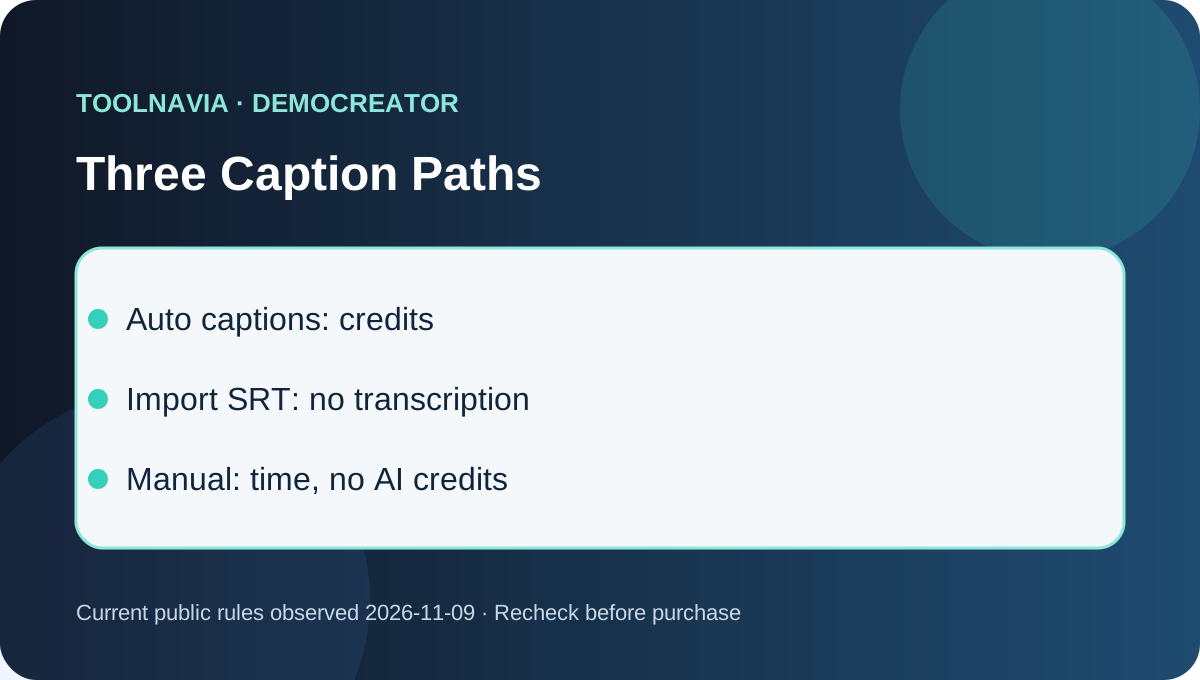
DemoCreator documents Auto Subtitles, importing an existing SRT, and manual subtitles. Auto Subtitles consume AI credits. Import SRT when a human editor, meeting platform or upstream tool already produced timed captions. Use manual subtitles for short clips, sensitive wording or a few corrections.
Manual work still costs time; the choice is which resource is scarce. A reusable SRT can feed video, articles and show notes without consuming DemoCreator transcription credits. Names, figures, legal wording and accessibility-critical text need a second human pass regardless of plan.
Price credits, validity and checkout separately
The AI store lists standalone credit packs and says paid AI credits have one-year validity, while plan credits follow the paid plan. The product store maps current plans to different monthly or one-time quantities. Treat the editor license and AI capacity as separate commercial objects.
At checkout verify the plan name, monthly quantity, billing term, tax, renewal wording and optional assets. The approved affiliate link points to Cross-Platform Yearly, but the live cart controls. Independent reviews reinforce the risk: iTechGuides separates recurring allowances from perpetual access, Ciroapp warns that AI features can consume credits quickly, and ToolGPA calls the combined license/assets/credits model complex. They are context, not checkout authority.
Compare alternatives without false equivalence
An external transcription service may provide more minutes or collaboration but adds a vendor and import step. Local speech-to-text can reduce recurring credit cost but requires setup, hardware and accuracy testing. SRT import avoids DemoCreator transcription credits but does not create or proofread the transcript.
DemoCreator is strongest when recording, editing, text-based work and captions belong in one app and the allowance fits. A separate pipeline is stronger when minutes are high, several editors need the text, or transcripts are reused. Third-party prices and allowances can lag official pages, so resolve quantity and validity on current official pages.
Who should buy, add credits or wait
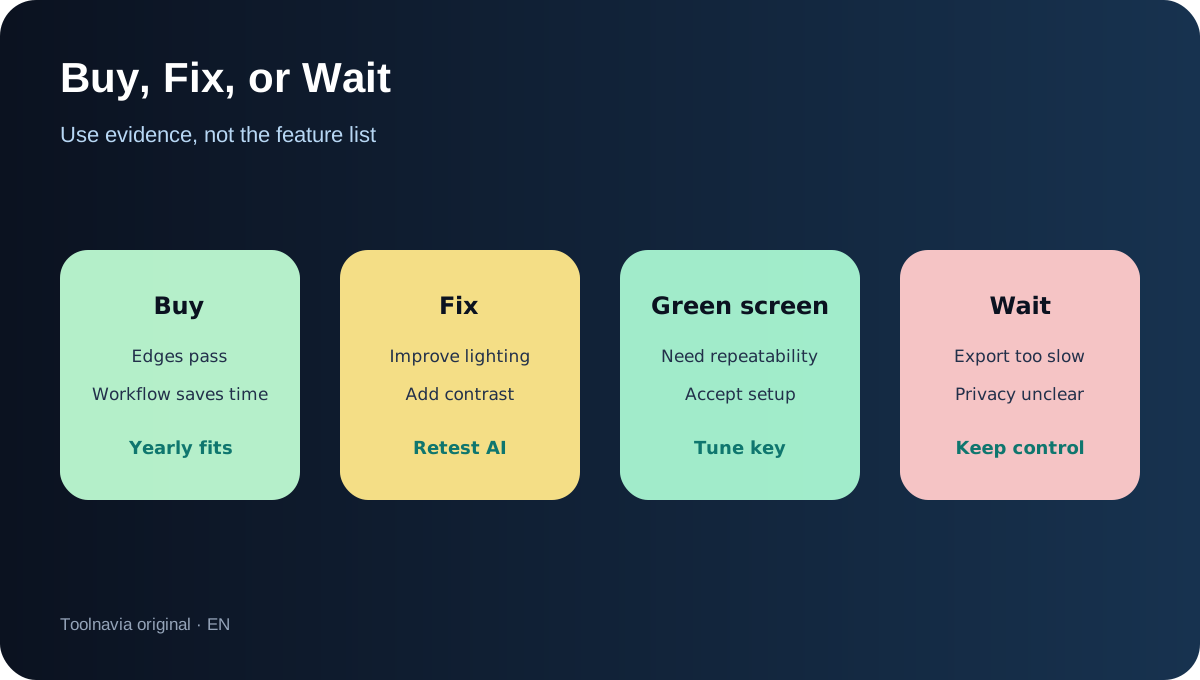
Buy Cross-Platform Yearly if checkout still shows 500 credits per month, your peak automatic-caption demand stays comfortably below 62.5 minutes, and a real sample passes human review.
Add credits only after pricing the shortfall. A 120-minute month needs 960 credits before retries; compare missing capacity with an SRT-first workflow. Wait when plan quantity is unclear, the peak month is unmeasured, or the transcript fails on critical terms. Verify the allowance, divide by the current per-minute rate, test one real file, and buy only when those minutes fit.