TOOLNAVIA / BUYING GUIDE
ClickFunnels Launch Transaction Fees: What Does a $100 Sale Really Cost?
The short answer
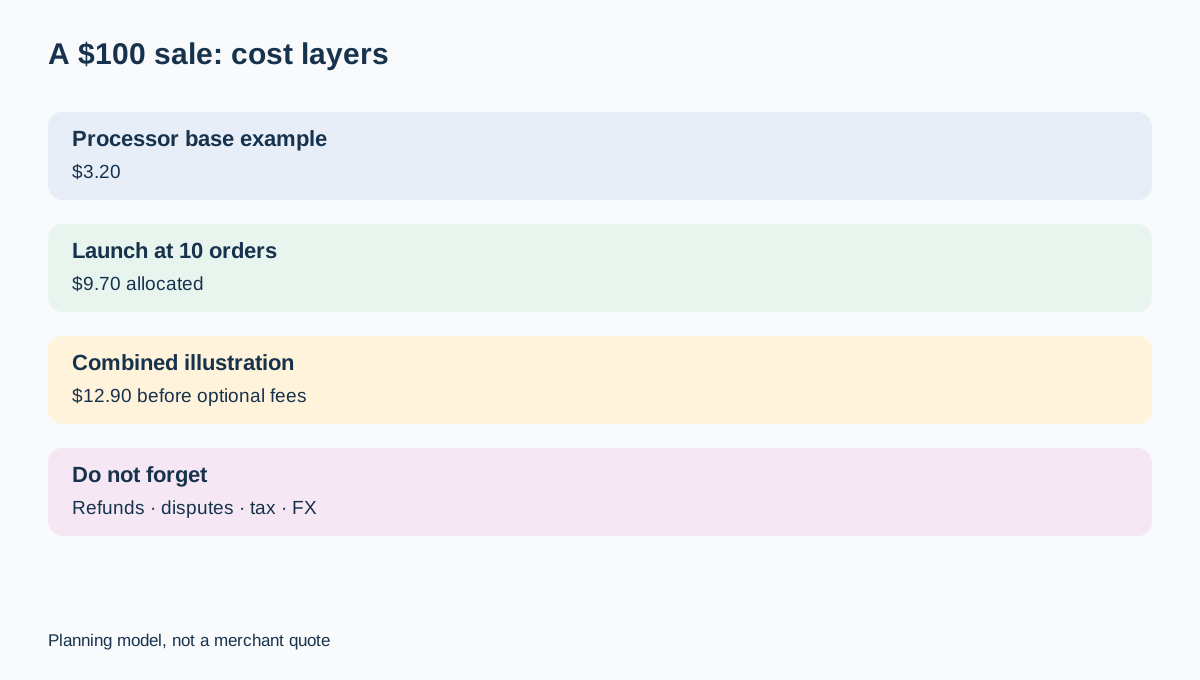
ClickFunnels says it does not take an additional percentage of each sale. That is useful, but it does not make checkout free. A standard U.S. online-card example of 2.9% + $0.30 means a $100 order costs about $3.20 to process before refunds, disputes, taxes, currency conversion or optional payment features. Launch then adds its own fixed subscription: $97 month to month or $970 for a year.
The buying question is therefore not “Are transaction fees zero?” It is “Does the funnel stack create enough value to cover both the processor fee and the allocated Launch subscription?”
At a glance
- Best for
- Sellers who can estimate order volume and average order value before choosing a funnel platform.
- Price model
- Launch $97/month or $970/year; processing illustrated at 2.9% + $0.30 for U.S. domestic online cards
- Check first
- U.S. base examples only; no merchant quote, global rate table or conversion benchmark.
Separate the three cost layers
Layer one is the ClickFunnels platform subscription. Launch currently lists at $97 monthly, while the annual invoice is $970, an effective $80.83 per month before tax. That charge exists even in a month with no sales.
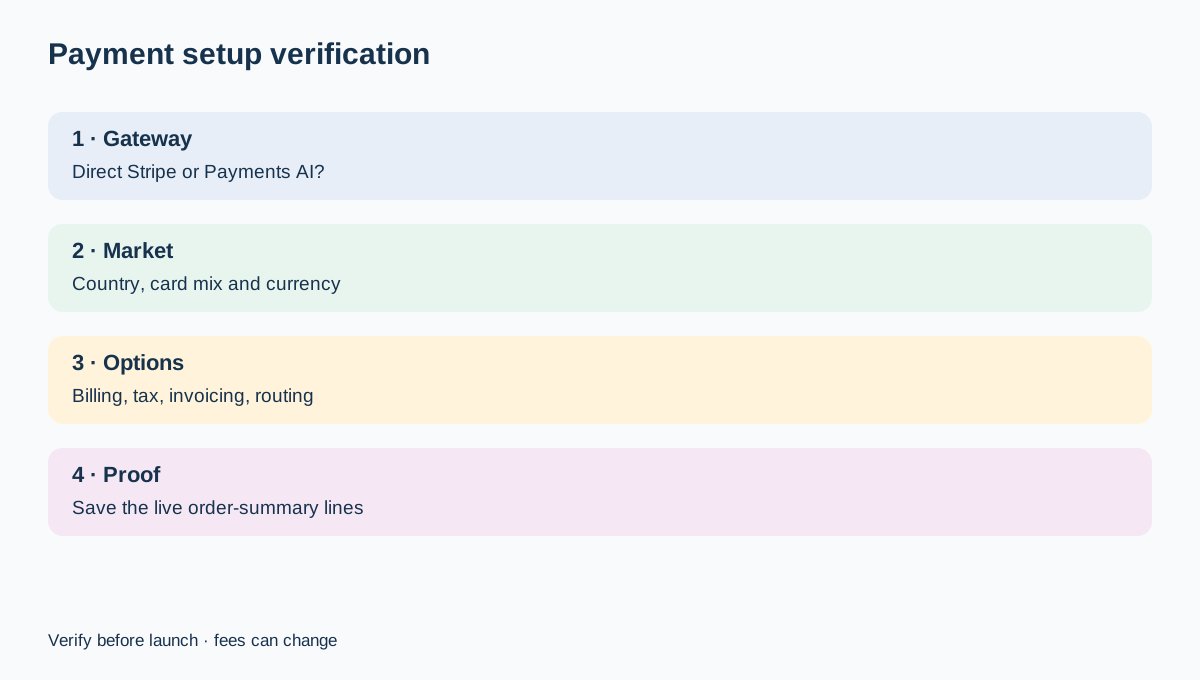
Layer two is payment processing. ClickFunnels’ official payment guide says the platform does not add another transaction fee, but Stripe or Payments AI still charges for processing. Its U.S. examples use a 2.9% + $0.30 base. Stripe publishes the same standard U.S. domestic online-card rate, with additional charges possible for international cards, currency conversion and optional products.
Layer three is optional or situational payment cost. ClickFunnels documentation lists examples such as billing, tax or invoicing services, while Payments AI can add gateway routing and operational features. The exact combination depends on gateway, country, card mix and account configuration. Verify the live order summary; do not infer a universal rate from one U.S. example.
What a sale costs at the base example
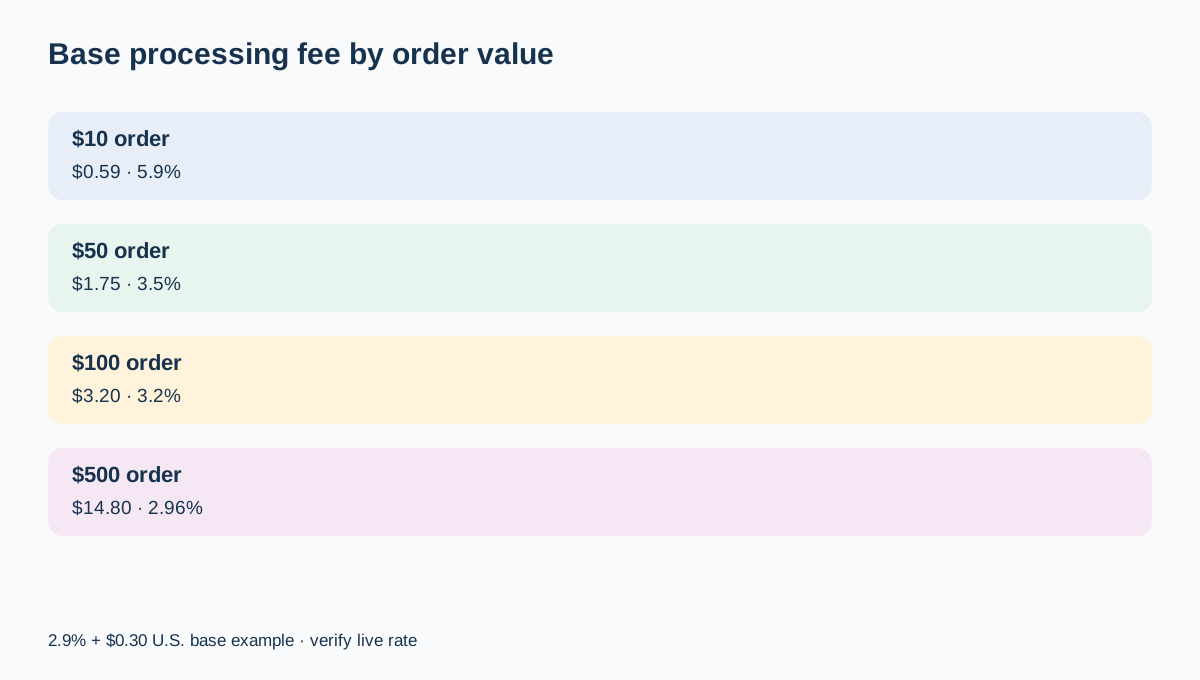
At 2.9% + $0.30, a $10 order costs $0.59, or 5.9% of revenue. A $50 order costs $1.75, or 3.5%. A $100 order costs $3.20, or 3.2%. A $500 order costs $14.80, or 2.96%.
That pattern matters for low-ticket funnels: the fixed $0.30 weighs more heavily on a small order. Average order value, not just headline rate, determines the effective percentage. Independent pricing analyses make the same distinction, but official processor pages control the current fee.
These are arithmetic illustrations, not a quote for your account. They exclude tax, refunds, disputes, cross-border cards, currency conversion and optional services.
Allocate the Launch subscription per order
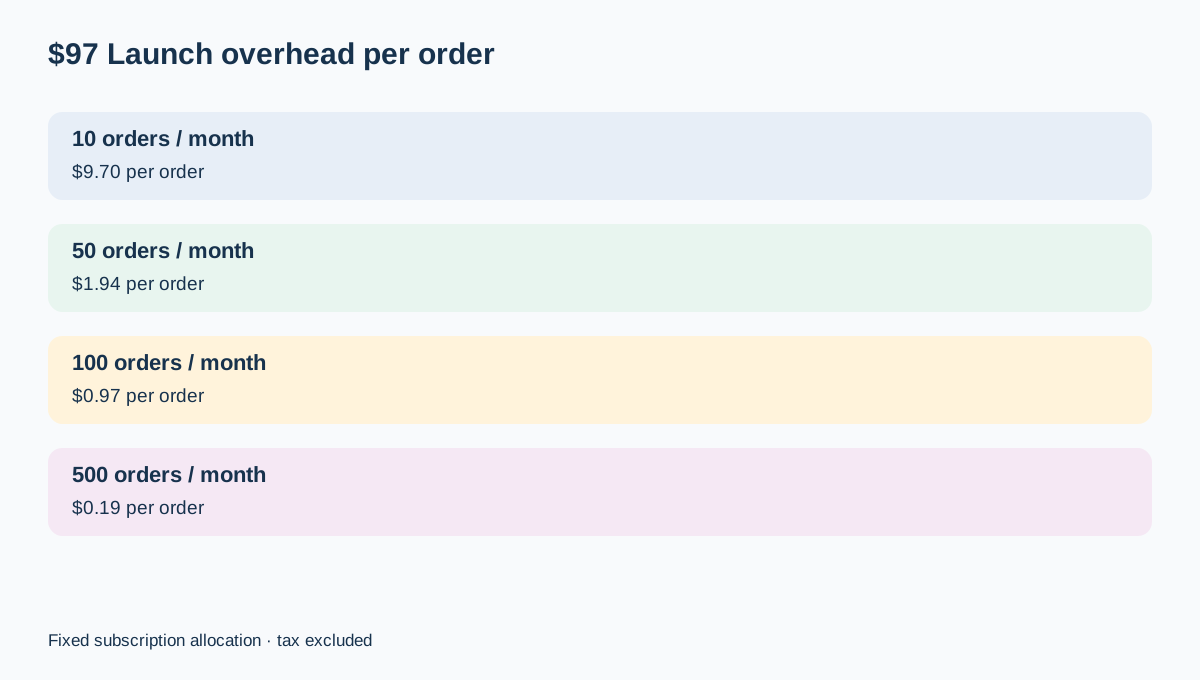
The $97 monthly subscription adds $9.70 to each order at 10 sales per month, $1.94 at 50 sales, $0.97 at 100 sales and about $0.19 at 500 sales. Add the $3.20 base processing example for a $100 order and the combined software-plus-processing cost is about $12.90, $5.14, $4.17 and $3.39 per order at those four volumes.
This is why “0% platform transaction fee” can be accurate while a low-volume seller still feels a high effective cost. The subscription is fixed overhead rather than a sales percentage. Independent checkout reviews flag this low-volume effect, but the decision must use your own contribution margin and sales forecast.
Annual billing reduces the effective monthly overhead to about $80.83, but it also creates a larger upfront commitment. Toolnavia has a separate annual-versus-monthly analysis; this guide uses annual pricing only to show the cost layer, not to repeat that billing-cycle decision.
Model break-even with contribution, not revenue
Suppose a $100 sale leaves $35 after product cost, fulfillment, support and the base $3.20 processing fee. At 10 orders a month, allocating $9.70 of Launch to each order leaves about $25.30 before tax and other overhead. At 100 orders, the allocated subscription falls to $0.97 and the same order leaves about $34.03.
A funnel builder is worthwhile only if its incremental contribution exceeds its fixed and operational cost. If Launch improves conversion, follow-up or course delivery enough to add three $35 contribution sales, the extra $105 covers a $97 monthly subscription in this simplified model. If it adds no measurable value, the absence of a platform percentage does not justify the subscription.
Do not treat that as a conversion forecast. Run a conservative, base and upside case with your own traffic, refund rate, processor quote and contribution margin.
Direct Stripe or Payments AI?
Direct Stripe is the simpler benchmark when you want a familiar processor and can manage the surrounding payment workflow. Payments AI may be relevant when multi-gateway routing, PayPal, dunning or payment operations have value. Those capabilities can change operational risk, but they do not erase processing fees.
Some independent pages describe extra routing or recurring-payment charges in ways that are not fully mirrored by the official pages used here. We therefore do not add an unverified routing surcharge to the base model. Check the gateway and optional-service line items shown in your own account before publishing prices or launching subscriptions.
Use a pre-purchase worksheet
Write down monthly order count, average order value, card geography, refund and dispute assumptions, and the payment features you will enable. Calculate processor cost by order size. Allocate $97 monthly—or the exact annual invoice divided by twelve—across expected orders. Then compare that result with contribution margin and the cost of your current stack.
Stress-test a slow month. Fixed software overhead becomes most visible when volume falls. Also test a low-ticket offer because the $0.30 fixed component raises its effective rate. Finally, confirm whether your tax, invoicing, recurring billing and routing choices add fees.
Verdict
ClickFunnels Launch is not a zero-cost checkout. It is a fixed-price funnel platform that, according to current official documentation, adds no separate ClickFunnels sales percentage while your processor still charges. It fits when the funnel, email, course and automation stack produces more contribution than the $97 monthly overhead plus processing and optional payment services. It is harder to justify for very low volume or low-ticket sales unless those bundled capabilities replace other paid tools.
Toolnavia may earn a commission from qualifying ClickFunnels purchases made through its button. The button uses the approved exact offer route, promises no special discount and does not change the price shown by ClickFunnels.