TOOLNAVIA / BUYING GUIDE
beehiiv Lite vs Pro: When Is the $552 Upgrade Worth It?
The short answer
Affiliate disclosure: beehiiv's affiliate program is open and pays cash commissions, but Toolnavia has not applied and is not approved for either exact plan. This guide therefore has no enabled commercial button or tracking link. Prices and plan limits were checked on October 20, 2026.
At a glance
- Best for
- Newsletter operators deciding whether present workspace limits justify Pro.
- Price model
- $588 vs $1,140 annually (planning model)
- Check first
- Live checkout controls; legacy Scale/Max pages are stale; no conversion or deliverability test.
Quick verdict
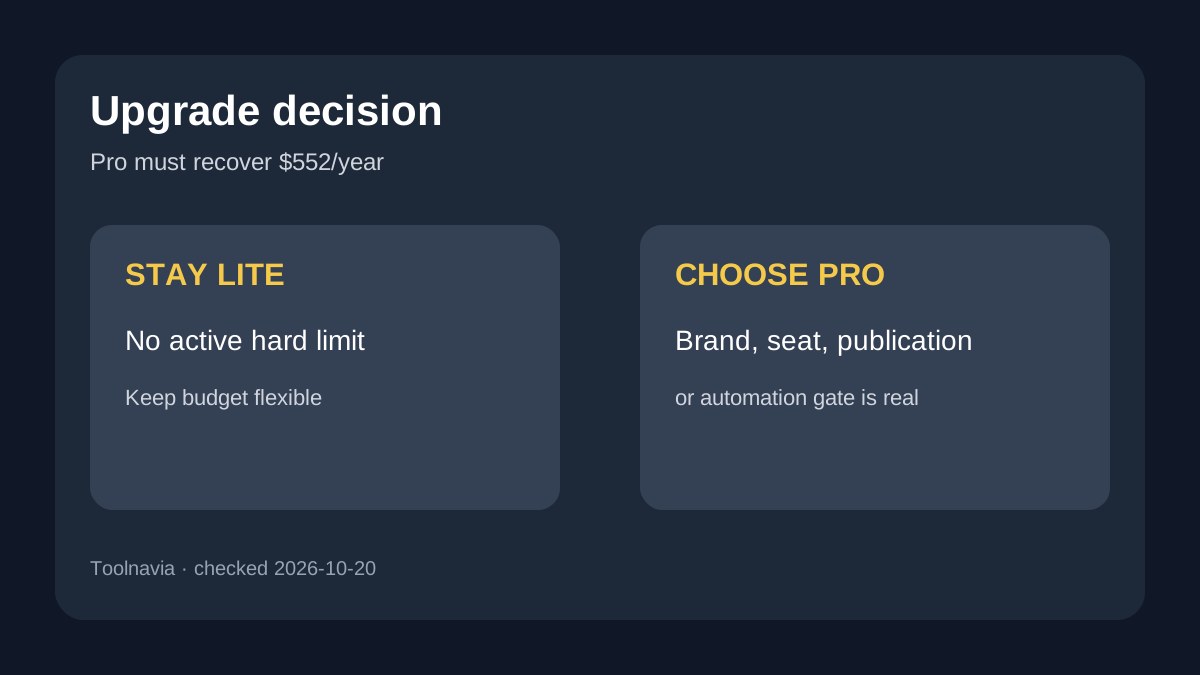
Choose **beehiiv Lite** when one newsletter workspace can stay within three publications, two seats and ten live automations, and visible beehiiv branding is acceptable. Choose **Pro** when removing that branding is a current business requirement, when a fourth publication or third teammate is already scheduled, or when more than ten live automations are necessary in production.
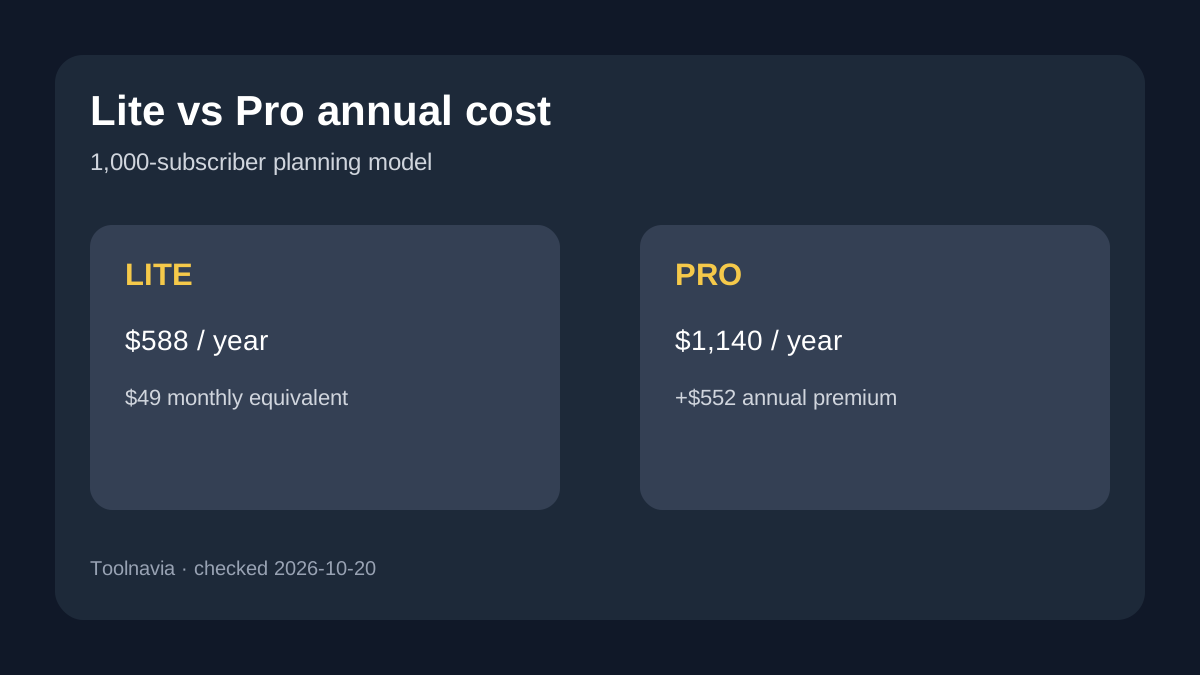
At 1,000 subscribers, current public pricing shows Lite at **$49 per month equivalent when billed annually** or **$59 month to month**. Pro is **$95 annual-billed** or **$109 monthly**. The annual totals are $588 and $1,140, so Pro costs **$552 more per year**. Under monthly billing, the totals are $708 and $1,308, a $600 difference.
The upgrade should not be justified by a vague desire to look professional. It should be tied to one documented gate: branding, publication count, seat count, automation count, subscriber ceiling, or a Pro-only capability that is already part of the operating plan.
Start with the $552 annual decision
The simplest planning model compares $588 for a full year of Lite with $1,140 for Pro. Pro therefore adds $552 per year, or $46 per month on an annualized basis. That is the minimum measurable value Pro needs to create before it becomes the cheaper business choice.
Monthly billing preserves flexibility but widens the difference to $50 per month. Lite costs $59 and Pro $109, so a twelve-month monthly commitment adds $600. Annual billing saves $120 on Lite and $168 on Pro compared with twelve monthly payments.
Do not confuse an annual-billed monthly equivalent with a monthly cancellation option. The $49 and $95 figures describe monthly equivalents paid on an annual schedule. A buyer who is still testing imports, forms, domains or sponsor workflows may rationally pay the higher monthly rate for a short validation period.
The simple annual crossover is month ten for both plans. Nine months of Lite at $59 costs $531, while month ten raises the total to $590, slightly above the $588 annual payment. Nine months of Pro at $109 costs $981; ten months costs $1,090, still below $1,140. Pro crosses during month eleven, when monthly payments reach $1,199. That difference makes monthly Pro more defensible for a test shorter than eleven months, provided the account can actually cancel or downgrade under its live terms.
Taxes, subscriber count, promotions, region and account history may change checkout. Save the final cart total and billing term. Every calculation below is a planning model, not a guarantee.
Branding removal is a commercial gate, not a cosmetic one
The official plan comparison places branding removal on Pro. Lite keeps beehiiv branding.
For many independent newsletters, this is not a reason to spend another $552. Readers care more about useful writing, predictable delivery and a trustworthy domain than a small platform mark. If the newsletter has no client contract, media-kit promise or white-label requirement, Lite can remain the more rational choice.
Branding becomes economic when a signed requirement depends on it. An agency producing a publication for a client may promise a white-label experience. A paid research product may need every visible element aligned with its own identity. A sponsor may require a clean landing page for a campaign. In these cases, the question is not whether the logo is annoying; it is whether keeping it blocks revenue or violates a deliverable.
The concrete Pro benefit is contractual white-label delivery: when a client or paid product requires branding removal, Pro can satisfy that present operating requirement.
Use a break-even test. If removing branding helps retain a client worth at least $46 per month in contribution margin, it can cover the annual Pro premium. If there is no named client, campaign or contract, assign the branding benefit a value of zero until evidence appears.
Do not invent a conversion lift. This article does not claim that removing beehiiv branding increases subscriptions. Only an A/B or cohort test on the buyer's own audience could support that claim.
The fourth publication is the clearest workspace trigger
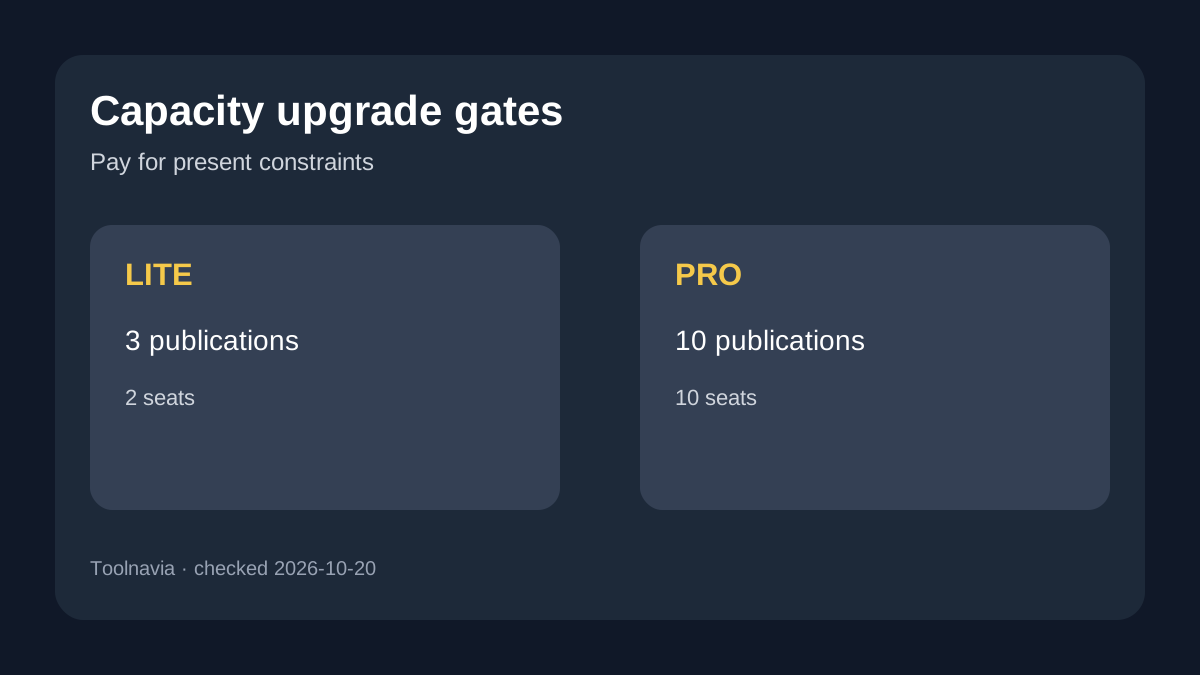
Current official comparison material describes Lite as supporting **three publications** and Pro as supporting **ten**.
A single newsletter with a main edition, a private customer update and a test publication still fits Lite. Pro becomes relevant when publication four is a real operating object: for example, separate newsletters for a parent brand, a regional audience, a paid research product and a partner community.
Count publications before paying. A language variant, tag or segment may not require a separate publication. Separate publications create independent editorial calendars, domains, templates, growth loops and analytics. If a fourth publication exists only to tidy an internal folder structure, the $552 premium is probably too high.
For a portfolio operator, calculate cost per incremental publication. Moving from three to four publications makes the first extra publication cost $552 for the year. Moving from three to ten spreads the same premium across seven extra slots, or about $78.86 per extra available slot. But unused slots have no value. A plan with capacity for ten is not cheaper than Lite merely because the denominator is larger.
Also verify how subscribers are counted across the workspace. Current independent analysis reports workspace-wide active subscriber counting. Duplicates or overlapping audiences may affect the paid tier. Map the lists and ask beehiiv how billing treats overlap before assuming ten publications each receive an independent subscriber allowance.
The third seat is the team trigger
Lite is described with **two seats**, while Pro supports **ten seats**.
A founder and one editor can stay on Lite. A third named operator—such as a designer, sales lead or client reviewer—creates the first seat constraint. Shared credentials are not a responsible substitute. They weaken accountability, complicate offboarding and may conflict with access policies.
The annual premium spreads differently with team size. At three active users, the upgrade adds $184 per user per year above Lite. At ten users, it adds $55.20 per user per year. These are allocation views, not market prices; they help compare Pro with the cost of manual review or a separate collaboration layer.
Pay only for real access. A freelancer who submits copy in a document but never needs beehiiv may not require a seat. A client who reviews a PDF proof may not need one either. Build a role matrix with publish, edit, analytics and billing permissions, then count the people who genuinely require platform access.
If the team needs fine-grained permissions, do not assume that a larger seat allowance automatically includes the exact roles. Verify permissions in the live account or documentation before using Pro as an access-control solution.
Automation count can outweigh branding
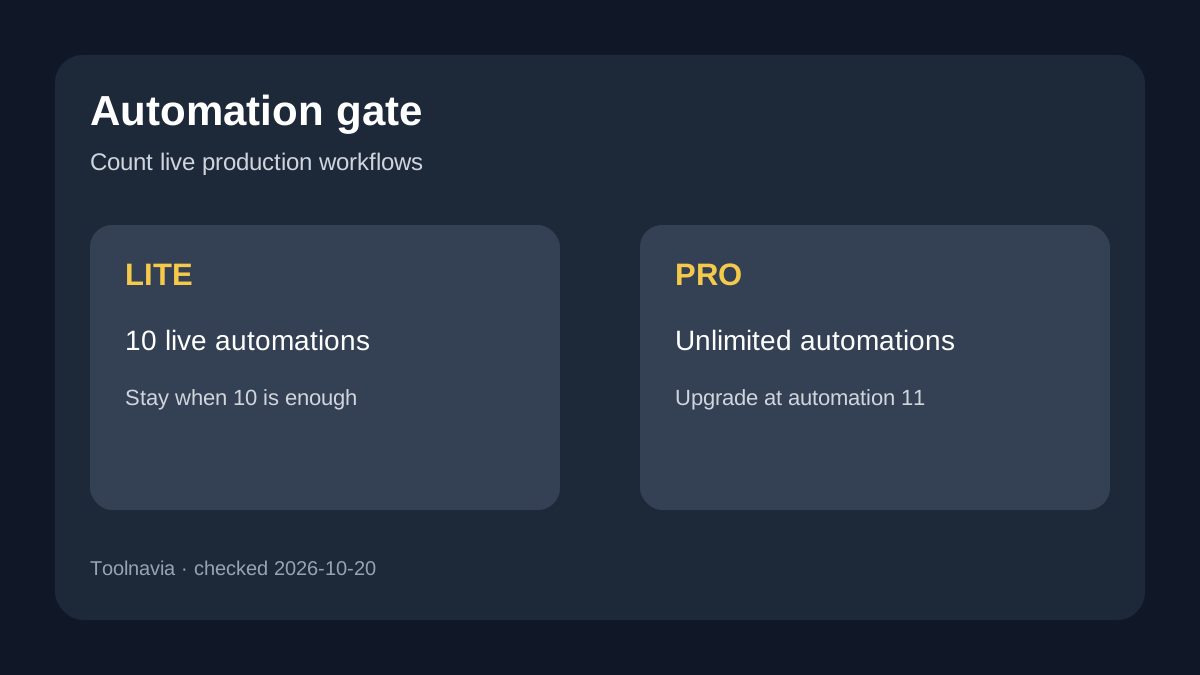
Current independent plan analyses describe Lite with **ten live automations** and Pro with **unlimited automations**, with Pro also associated with click triggers and additional testing capability.
Ten automations can cover a welcome series, paid-member onboarding, re-engagement, a lead magnet, an event reminder and several sponsor workflows. The useful question is not how many ideas exist. It is how many automations must be live at the same time.
List each production automation, owner, trigger, audience and last execution. Retire duplicates and temporary campaigns before counting. If only seven are active, Pro has no automation-count value today. If the eleventh automation replaces manual routing or protects paid-member onboarding, the upgrade may be justified.
Apply the same $552 break-even. At an internal labor value of $23 per hour, Pro needs to save 24 hours per year, or two hours per month. If maintaining a workaround for automation eleven consumes more than that, the upgrade can pay for itself. If a campaign runs once and can reuse an existing slot, it cannot.
Unlimited should not be read as unlimited sends, subscribers or AI use. Plan-wide limits and fair-use policies may still apply. Confirm each constraint independently.
Subscriber ceilings matter later, not at 1,000
The official 2026 pricing guide lists Lite up to **100,000 subscribers** and Pro up to **250,000**.
For a 1,000-subscriber buyer, this is not a current reason to upgrade. Paying $552 today for a ceiling 99,000 subscribers away is an expensive form of forecasting. Growth may change pricing, product requirements and revenue long before the ceiling is reached.
Use a trigger date instead. At 80,000 active subscribers, model growth to 100,000, request current checkout totals and schedule a migration or upgrade review. At 1,000, direct the budget toward acquisition, content and deliverability monitoring unless another Pro gate is already active.
The same principle applies to AI credits, analytics, dynamic content, webhooks and priority support. They are valuable only when tied to a workflow and measurement. Pro's current official list includes those capabilities, but the existence of a feature is not evidence of economic benefit.
Resolve the legacy Scale and Max evidence
Some independent reviews still describe beehiiv's older **Scale** and **Max** names and cite annual-billed prices around **$43 and $96**. Current October 2026 sources explain that Scale was renamed Lite and Max was renamed Pro, with current entry figures of $49 and $95.
This article does not merge the old and new figures. Current official pricing and the 2026 guide control the plan names and planning prices. Legacy pages remain useful for historical context but cannot authorize a current purchase calculation.
Existing accounts may move at renewal rather than immediately. A grandfathered invoice can therefore differ from the public catalog. Existing customers should inspect the renewal notice and account billing page; new customers should use live checkout.
The small difference between the old $96 Max figure and current $95 Pro does not make the old page reliable. Naming, limits and entitlements can change independently of price. Every claim is matched to the current plan label.
Four break-even scenarios
**Scenario 1: one publication, one editor, eight automations.** Lite wins. Pro's branding and capacity benefits are unused, so the $552 remains pure extra cost.
**Scenario 2: a client requires white-label publishing and contributes $100 per month in margin.** Pro can win because the annual premium is recovered in less than six months, assuming branding removal is a contractual requirement.
**Scenario 3: four active publications and three real platform users.** Pro is the operational fit. Lite fails two current constraints, and workarounds create access and governance risk.
**Scenario 4: eleven live automations save three hours per month at $23 per hour.** Annual labor value is $828. After subtracting the $552 premium, the modeled net value is $276, before any revenue effect.
Do not add the full values of branding, seats and automation when they protect the same client revenue. Count independent benefits only once.
Purchase checklist
1. Select the exact subscriber band and billing term in live checkout. 2. Confirm $49/$95 annual-billed and $59/$109 monthly are still visible. 3. Save the total annual charge, taxes, renewal terms and downgrade policy. 4. Count active publications; do not count segments or folders as publications. 5. Count named operators who truly need platform access. 6. Inventory live automations and retire temporary or duplicate workflows. 7. Confirm whether branding removal is tied to a contract or measurable revenue. 8. Verify workspace subscriber counting and overlap treatment. 9. Confirm the exact AI, analytics, webhook, dynamic-content and support entitlements. 10. Recalculate before renewal or when approaching 100,000 subscribers.
Final recommendation
Lite is the better default for a 1,000-subscriber newsletter with up to three publications, two seats and ten live automations. Pro earns its $552 annual premium when branding removal protects real revenue, publication four or seat three is already needed, or automation eleven saves at least about two hours per month at $23 per hour.
Buy Pro for a present constraint, not for an abstract future. Validate the gate, preserve the checkout total and review the account again at renewal.