TOOLNAVIA / BUYING GUIDE
AWeber Lite vs Plus: Is the 4th User Worth $90/Year?
The short answer
Affiliate disclosure: Toolnavia has not been approved for an AWeber offer. This guide contains no enabled commercial button or tracking link. Prices and plan limits were checked on October 21, 2026.
At a glance
- Best for
- Small teams deciding whether real user, workflow, branding or ecommerce constraints justify Plus.
- Price model
- $150 vs $240 annually
- Check first
- Checkout controls; no deliverability test; billing counts and limits may change.
Quick verdict
Choose **AWeber Lite** when one small team can stay within three users, one list, three landing pages, three automations and one custom segment. Choose **AWeber Plus** when a fourth person needs a named login, AWeber branding must disappear, or unlimited lists, landing pages, automations and segments are part of the operating plan.
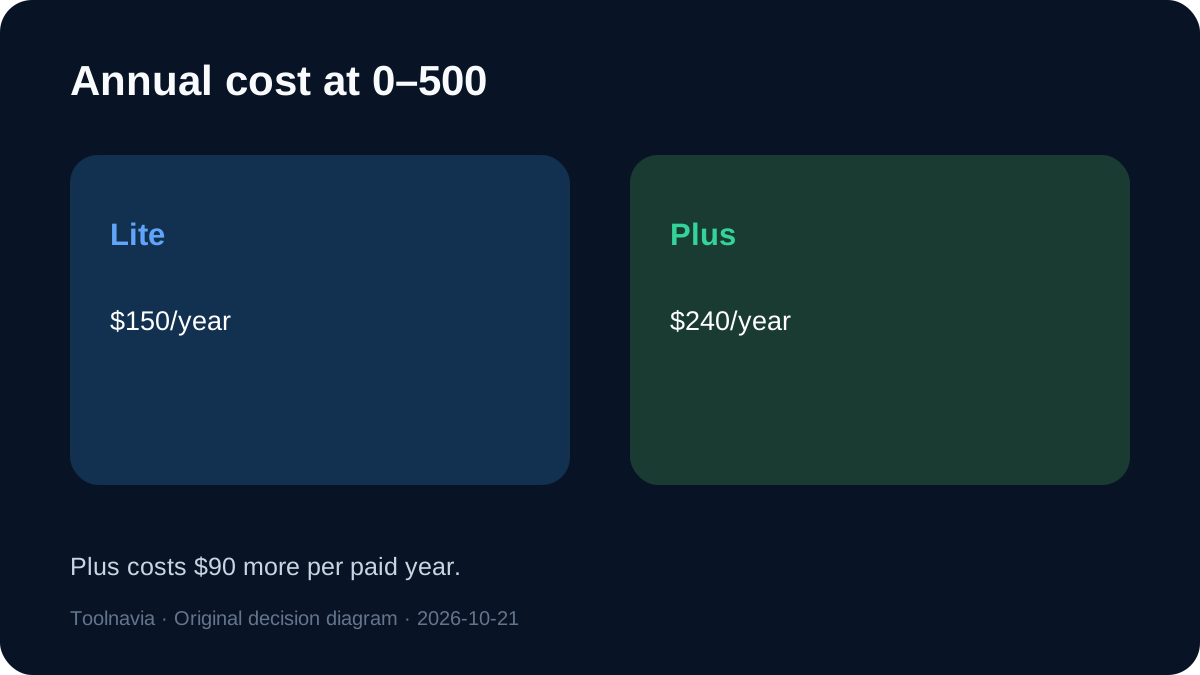
At the 0–500-subscriber tier, AWeber's detailed price table lists Lite at **$15 per month or $150 per year** and Plus at **$30 per month or $240 per year**. The annual upgrade therefore costs **$90 per paid year**, while the month-to-month upgrade costs **$15 per month** or $180 across twelve months. Plus is not automatically better because it has more features; it is better only when at least one locked capability prevents a real workflow.
Resolve the two annual-price displays first
The same official page also shows headline annual-billed equivalents of **$12.49** for Lite and **$19.99** for Plus. Multiplying those figures by twelve gives $149.88 and $239.88, while the detailed table shows $150 and $240. This is a twelve-cent annual display-rounding difference, not a decision-changing second price. We use the table totals because they state the actual annual cost directly. Save the checkout before paying, because the cart remains controlling.
Annual billing saves $30 on Lite compared with twelve $15 payments and $120 on Plus compared with twelve $30 payments. The simple annual-versus-monthly break-even is therefore month eleven for Lite: ten monthly payments cost $150, and the eleventh costs more. Plus reaches the crossover during month nine: eight payments cost $240, and the ninth costs more.
That comparison assumes continuous use and ignores the value of cash flexibility. A buyer still validating deliverability, imports or workflows may rationally pay monthly even when the annual total is lower. AWeber says plans have no long-term contract, and plan changes can be made from the account; an upgrade during a billing cycle produces a prorated invoice for the remaining period.
The fourth user is the cleanest team trigger
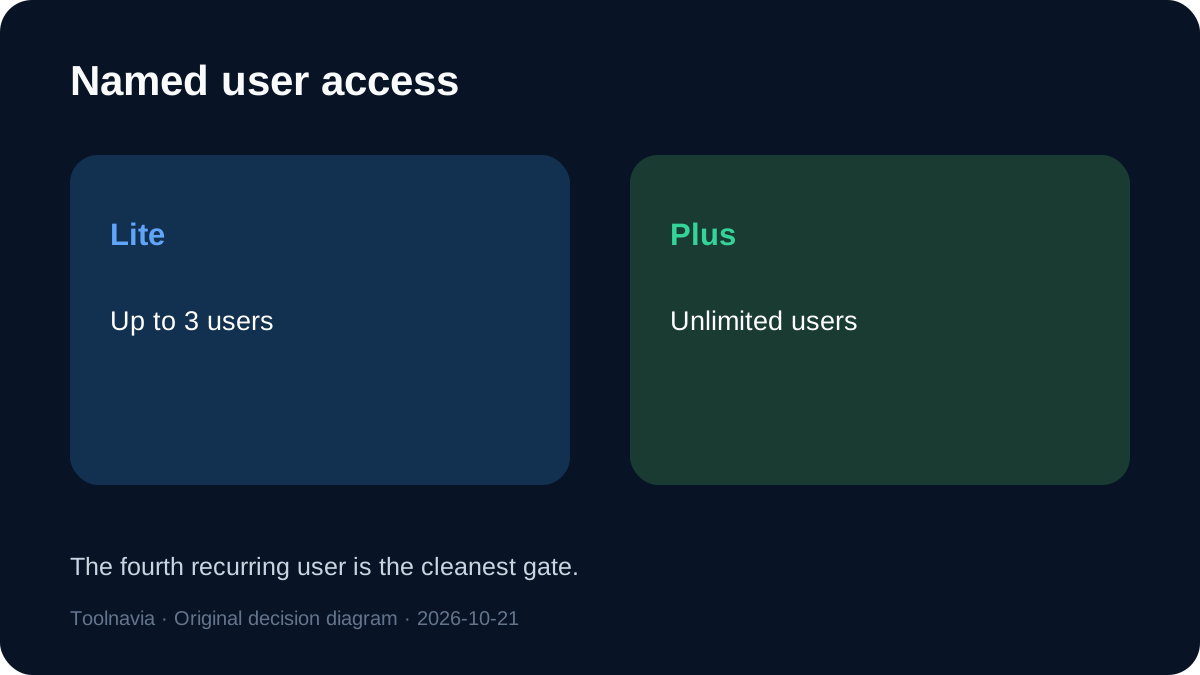
Lite includes up to **three users**. Plus lists **unlimited users**. For a solo creator or a team of two or three, user count alone does not justify the upgrade. The clear access gate appears when a fourth person needs a separate account for editorial, design, operations or client approval.
At the annual tier, the Plus premium equals $7.50 per month. For a four-person team, total software cost is $5 per user per month on Plus ($240 divided by 12 and four), compared with $4.17 per user per month for a fully used three-person Lite team ($150 divided by 12 and three). That small per-user difference can be reasonable when every person actually works in the platform.
Automation, lists and landing pages can trigger Plus before headcount
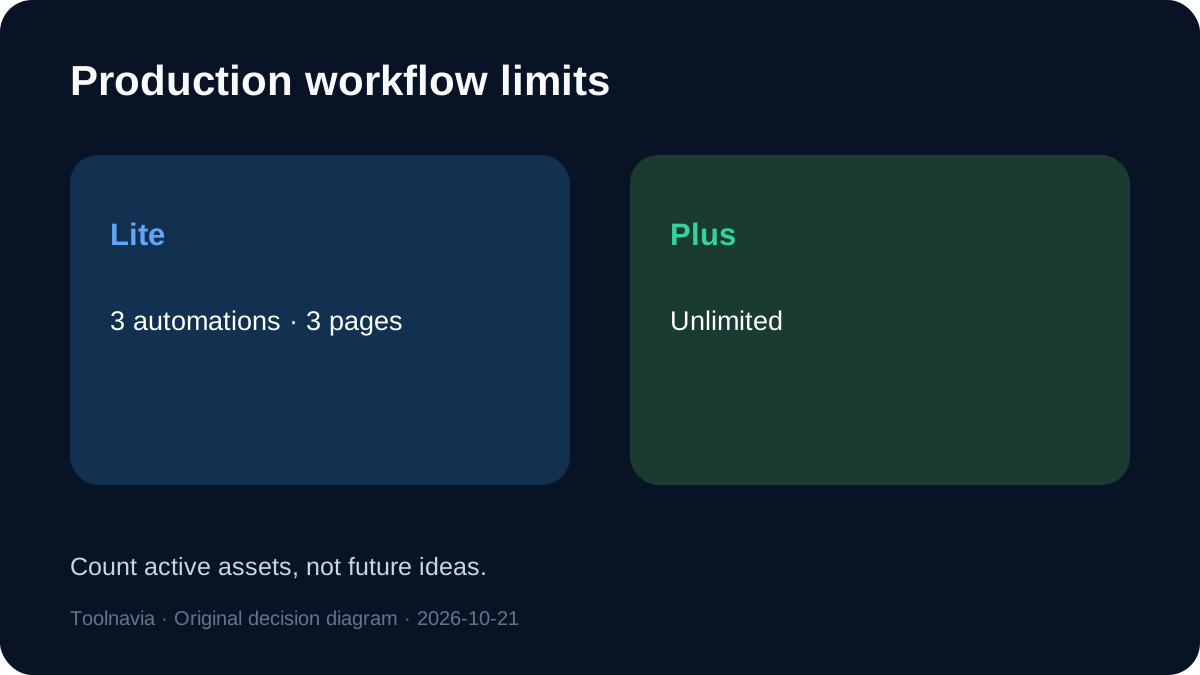
Lite caps the account at one email list, three landing pages, three automations and one custom segment. Plus removes those published caps. A team may therefore need Plus with only one user if it operates several lead magnets, onboarding flows or distinct audience journeys.
Count active production assets, not ideas. Three automations can cover a welcome sequence, a lead-nurture workflow and a customer follow-up. A fourth automation is a real trigger only when it must run at the same time. Likewise, unlimited landing pages have no value if the team publishes two evergreen pages and never tests alternatives.
Reporting, testing and branding are qualitative upgrade gates
Plus adds advanced reporting, sales tracking, split testing, priority support and removal of AWeber branding. These are harder to value than a user cap because their return depends on process maturity.
Branding removal matters when every customer touchpoint must present only the buyer's identity. Split testing matters when there is enough send volume to learn from variants and a team actually changes decisions from the result. Advanced reporting matters when someone owns a defined metric and reviews it on a schedule. Paying for dashboards that nobody inspects does not create insight.
Send volume is a smaller difference at 500 subscribers
At the 500-subscriber tier, Lite includes **5,000 sends per month** and Plus includes **6,000**. That is ten times versus twelve times the subscriber tier.
With a full 500-person list, 5,000 sends support roughly ten full-list broadcasts per month; 6,000 support roughly twelve. If the only problem is an occasional eleventh send, the $90 annual Plus premium may be defensible, but the team should first check whether every message targets the full list and whether inactive subscribers should remain billable.
Ecommerce fees create a measurable break-even
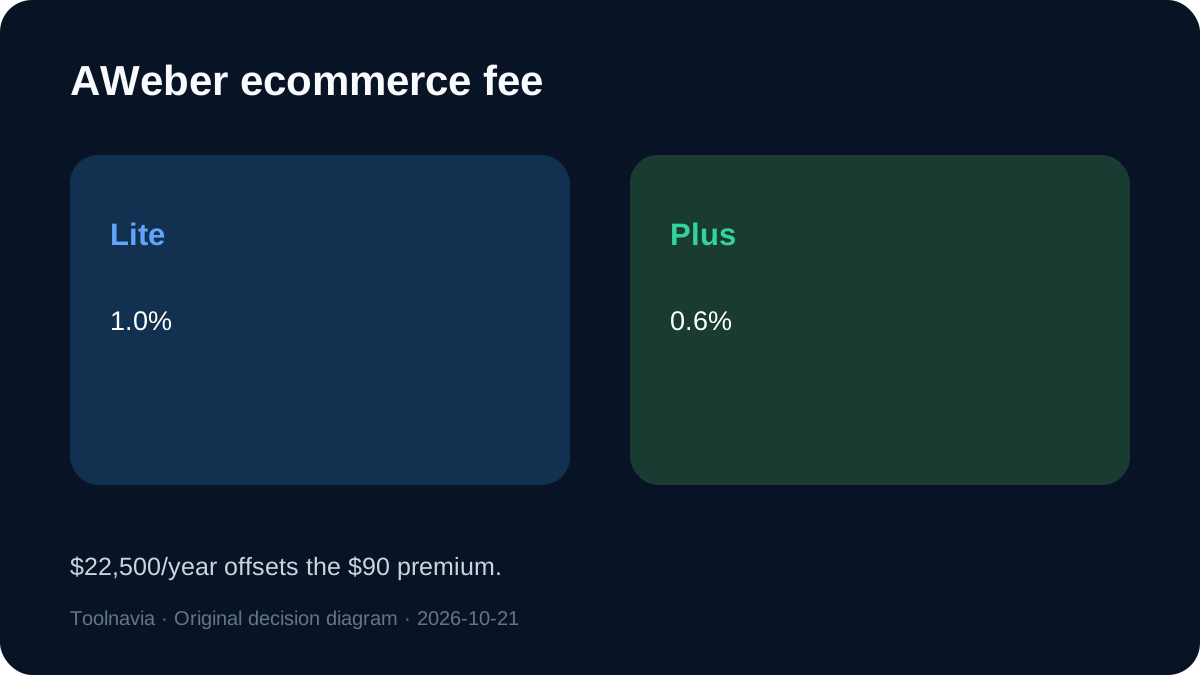
AWeber's ecommerce element charges a **1.0% transaction fee on Lite** and **0.6% on Plus**. Plus therefore saves 0.4 percentage points on eligible transaction volume.
Against the $90 annual plan premium, fee savings alone break even at **$22,500 in annual AWeber-processed sales**: $90 divided by 0.004. Against the $15 monthly premium, the monthly break-even is $3,750. Below those levels, the fee difference alone does not pay for Plus; above them, it can, before counting users, automation or reporting.
This calculation covers only AWeber's stated platform fee. Stripe or another payment processor may charge separate fees. Confirm which sales actually pass through the AWeber ecommerce element rather than applying the rate to all business revenue.
Subscriber growth changes both plans
AWeber prices both plans by subscriber tier. At 1,000 subscribers, the official table lists Lite at $25 monthly or $250 annually and Plus at $45 monthly or $450 annually. At 5,000 subscribers, the figures are $60/$600 for Lite and $90/$900 for Plus.
The upgrade premium therefore grows with the list. A decision that is easy at 500 subscribers may look different after crossing a tier. Archived or inactive records can also affect billing rules, so review the current account's billable count before projecting a year.
Do not lock the model to one promotional screenshot. Use the exact subscriber band, billing term and checkout total. Recalculate the user, workflow and ecommerce break-even whenever the list enters another tier.
Who should choose each plan?
Choose Lite when there are no more than three users; one list is operationally sufficient; three active landing pages and three automations cover the funnel; one custom segment is enough; AWeber branding is acceptable; and monthly sends stay within the published allowance.
Choose Plus when a fourth named user is recurring, more than three automations or landing pages must remain active, several lists or segments are genuinely required, branding removal is mandatory, split testing and advanced reporting change decisions, or eligible ecommerce volume approaches the fee break-even.
Stay on Lite when Plus is attractive only as “future capacity.” Upgrade timing is flexible: AWeber documents prorated mid-cycle upgrades, so a buyer does not need to prepay for unlocked capacity months before the constraint appears.
Checkout checklist
1. Select the exact 0–500 subscriber band and confirm the live cart total. 2. Treat $150 and $240 as the annual table totals; note the headline display rounding. 3. Count people who need named access during an ordinary month.
4. Inventory active lists, landing pages, automations and custom segments. 5. Measure full-list sends rather than assuming every message reaches all subscribers. 6. Estimate only sales processed through AWeber when modeling transaction fees.
7. Assign an owner to reporting or split tests before paying for them. 8. Recalculate at the next subscriber tier. 9. Save the checkout and plan-benefit screen because prices and limits can change.
Final recommendation
Lite is the better default at 500 subscribers for a small team that fits within three users and three active workflows. Plus earns its $90 annual premium when the fourth user, a fourth production automation, mandatory branding removal, advanced measurement or more than $22,500 of eligible ecommerce volume solves a current—not hypothetical—constraint.
The most economical path is to start with the limits you can measure, then use AWeber's documented prorated upgrade path when one of those limits becomes real.