TOOLNAVIA / BUYING GUIDE
ActiveCampaign Starter vs Plus: Is Action 6 Worth $408/Year?
The short answer
Affiliate disclosure: ActiveCampaign's affiliate program is open and pays cash commissions, but Toolnavia has not applied and is not approved for either exact plan. This guide therefore contains no enabled commercial button or tracking link. Prices and limits were checked on October 21, 2026.
At a glance
- Best for
- Solo operators deciding whether real automation depth or tool consolidation justifies Plus.
- Price model
- $180 vs $588 annually (planning model)
- Check first
- Checkout controls; official pages conflict; no deliverability test; contact billing and plan limits may change.
Quick verdict
Choose **ActiveCampaign Starter** when every important automation can stay within five actions, one user can own the account, and you do not need built-in landing pages, site messages or sales automation. Choose **Plus** when the sixth action is part of a live customer journey, or when replacing a separate landing-page or message tool makes the upgrade cheaper than the stack it removes.
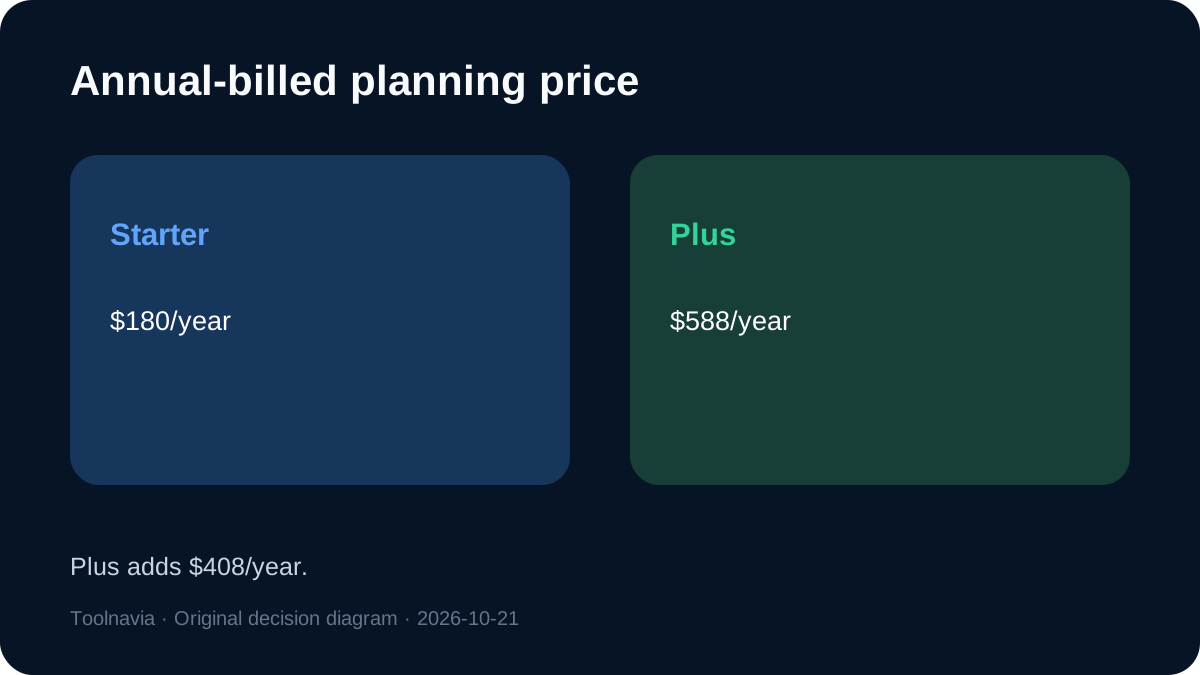
At 1,000 contacts, ActiveCampaign's current official comparison page lists annual-billed entry prices of **$15 per month for Starter** and **$49 per month for Plus**. That models to $180 and $588 for a paid year, so Plus adds **$408 per year**. Independent current pricing pages also show month-to-month prices of **$19 and $59**, or $228 and $708 across twelve months. Under monthly billing, the Plus gap is therefore $480 per year.
The upgrade should not be justified by the word “advanced.” It should be justified by a named constraint: action six, a required page, a recurring cross-channel step, or a measurable tool that Plus replaces.
Resolve the official price conflict before buying
ActiveCampaign's own pages are not perfectly synchronized. The official HubSpot comparison page shows Plus at $49 per month for 1,000 contacts, while the official Keap comparison page still states $79 for Plus—the figure used for Pro on newer pricing displays. Because the newer pricing page and several current independent analyses converge on $49 annual-billed and $59 monthly, this article uses those figures for planning.
That does not make an article quote a checkout guarantee. Region, tax, contact band, promotion and account history can change the live cart. Before payment, select exactly 1,000 contacts, record the billing term, confirm whether the amount is a monthly equivalent billed annually, and save the final total. If checkout differs, replace every annual number below with the cart total rather than forcing the cart to match the model.
The price conflict remains unresolved because a public page cannot prove what an authenticated buyer will see. Transparency is more useful than false precision: $15/$49 annual-billed and $19/$59 monthly are the planning figures; checkout controls the transaction.
The sixth automation action is the cleanest upgrade gate
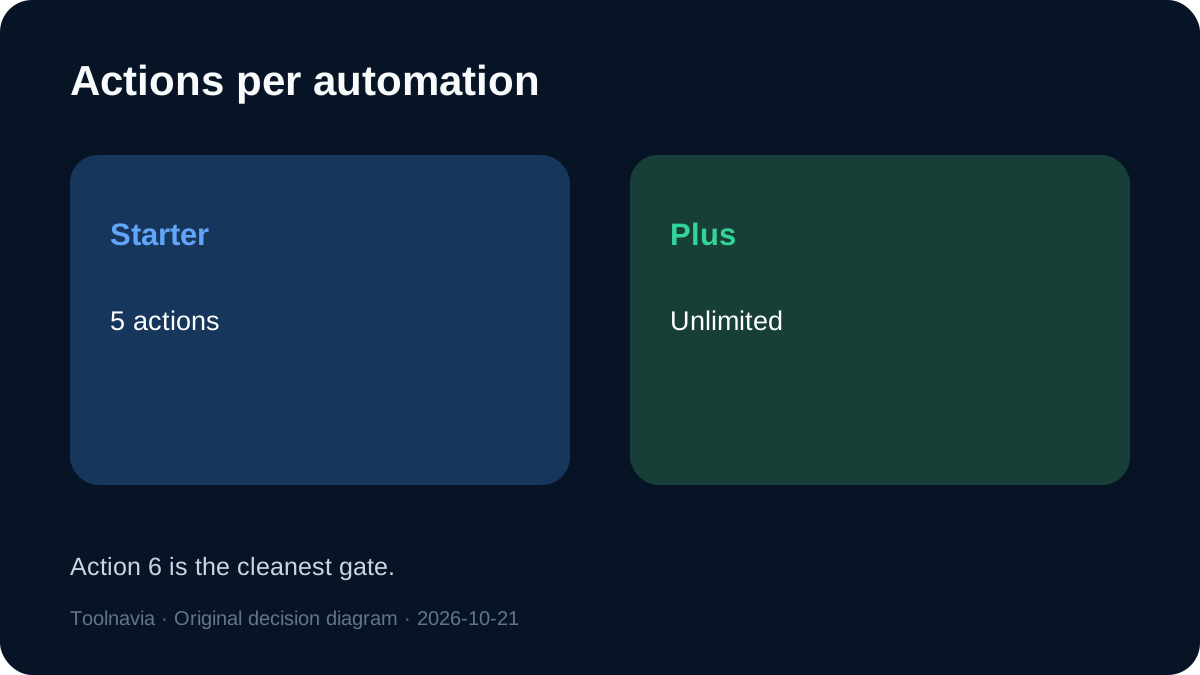
Starter limits each automation to **five actions or triggers**. Plus publishes **unlimited automation actions**. That is a more useful decision boundary than a long feature list.
A five-step customer journey might tag a lead, send a welcome message, wait, branch on behavior and send a follow-up. If the business needs a sixth step—perhaps notifying sales, updating a deal, changing a score or starting another channel—the buyer has three options: simplify the journey, split it into coordinated automations, or pay for Plus.
Splitting is not automatically free. It can create duplicate-entry risks, harder debugging and more manual monitoring. But neither is a sixth action automatically worth $408 per year. First ask whether the step runs regularly, changes customer treatment, and has a named owner. A workflow on a planning board is not a production constraint.
Use a labor break-even. At a fully loaded labor value of **$17 per hour**, saving two hours each month is worth $408 per year: 2 × 12 × $17. If keeping Starter creates at least two recurring hours of manual routing, reconciliation or repair every month, Plus can pay for itself through time. If the sixth action saves fifteen minutes twice a year, it cannot.
Both plans share important 1,000-contact limits
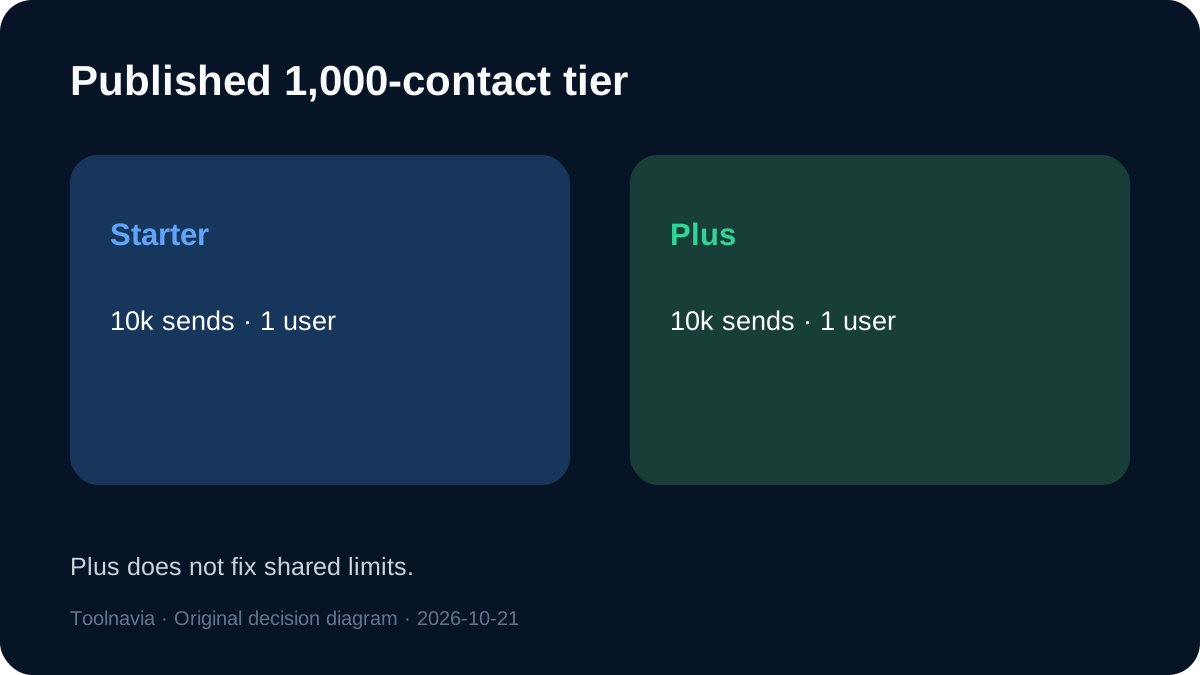
The official pricing page shows both Starter and Plus at the modeled entry tier with **1,000 contacts, 10,000 monthly sends and one user**.
That means Plus is not a seat upgrade at this tier, and it does not buy more base sends in the published comparison. A two-person team should not assume Plus grants a second named operator. Confirm current user rights and any add-on before turning Plus into an access-control purchase.
The same-send allowance also changes the value calculation. At a full 1,000-contact list, 10,000 sends support roughly ten full-list messages per month before segmentation. If send volume—not automation depth—is the real bottleneck, moving from Starter to Plus may not solve it. Clean inactive contacts, measure actual recipients and inspect the exact contact band before paying for unrelated features.
ActiveCampaign prices by contacts, and independent reviews warn that inactive records may still affect billable totals. The annual model is therefore valid only for the chosen band. Recalculate when the account approaches the next threshold rather than carrying the 1,000-contact price into a larger list.
Plus buys more than unlimited actions
Plus adds landing pages, site messages, cross-channel automation, generative AI capabilities and sales automation in the current official comparison. It also raises active goals from **15 on Starter to 25 on Plus**.
These features matter only when they replace work or software. A landing-page builder can consolidate acquisition pages; site messages can replace a separate on-site engagement tool; cross-channel steps can keep a customer journey in one system; sales automation can reduce manual deal updates. But unused inclusion is not savings.
Generative AI deserves a separate caution. ActiveCampaign's help documentation says some AI activities are purchased with a monthly limit and unused activities do not roll over. “Generative AI included” should not be read as unlimited AI consumption. Verify the exact allowance and add-on cost for the account before assigning any dollar value.
Likewise, 25 active goals are better than 15 only when the team already measures more than fifteen outcomes. A small company tracking trial start, purchase, renewal and churn has no economic reason to pay for ten unused goal slots.
Run the tool-replacement test
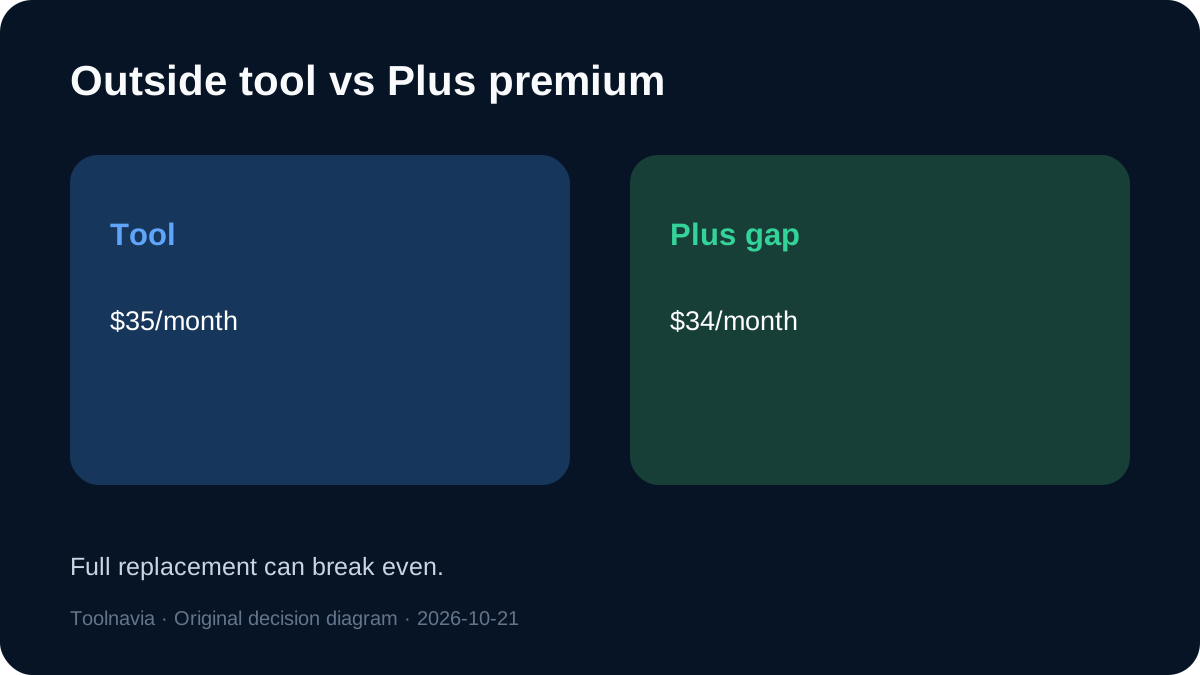
The annual Plus premium is $408 under the planning price. Suppose a separate landing-page and site-message stack costs **$35 per month**, or $420 per year. If Plus genuinely replaces that entire tool without sacrificing required templates, domains, analytics or consent controls, the upgrade can save $12 per year before counting automation time.
The word “genuinely” matters. A separate product may support more sites, stronger experiments or a workflow the included feature cannot reproduce. Test export, forms, tracking, cookie consent, custom domains and ownership before canceling anything.
For a $20-per-month external tool, annual cost is $240, leaving a $168 gap in favor of Starter. In that case, Plus still needs to create at least $168 of annual labor or outcome value. At $28 per hour, that is six hours per year, or thirty minutes per month. The model turns a vague bundle claim into a measurable threshold.
Do not count the same benefit twice. If the landing-page replacement already saves $420, do not also assign the full manual-time value of maintaining those same pages unless the labor saving is independent.
Annual versus monthly is a commitment decision
At the observed planning prices, Starter costs $180 annually versus $228 across twelve monthly payments, saving $48 for continuous use. Plus costs $588 annually versus $708 monthly, saving $120.
The simple crossover is month ten for Starter: nine monthly payments cost $171, while ten cost $190, above the $180 annual total. Plus also crosses during month ten: nine payments cost $531, while ten cost $590, just above $588.
This arithmetic assumes a full uninterrupted year. A buyer migrating from another platform may prefer monthly billing until imports, deliverability, forms and core automations are validated. Paying $40 more across the first two months can be cheaper than committing $588 to a plan the team abandons.
ActiveCampaign's public marketing material often emphasizes annual savings, but cancellation, refund and downgrade treatment must be checked in the live terms for the account. Do not call the annual difference “free money”; it is compensation for commitment and upfront cash.
A practical decision worksheet
Start with four yes-or-no questions.
1. Does a production automation need more than five actions or triggers? 2. Will Plus fully replace at least $34 per month of existing software? 3. Are landing pages, site messages, cross-channel steps or sales automation required now? 4. Will removing manual work save at least two hours per month at $17 per hour?
One strong “yes” can justify a trial of Plus, but it still needs validation. If every answer is “no,” Starter is the economically cleaner default at 1,000 contacts.
Then check the shared constraints. Are 10,000 sends sufficient? Is one user workable? Is 1,000 the correct billable-contact band? Does the account need paid AI activities beyond the plan? If the answer to a shared constraint is “no,” neither plan comparison alone solves the problem.
Finally, separate reversible and irreversible decisions. You can usually upgrade later when action six becomes real. An annual commitment is harder to reverse. Favor Starter or monthly billing while the workflow is uncertain; favor Plus annual only when the required capability and a twelve-month operating horizon are both stable.
Who should choose each plan?
Choose Starter for a solo operator with straightforward email journeys, no more than five actions per automation, no immediate need for built-in pages or site messages, and no separate tool expensive enough to replace. Its lower annual cost preserves $408 for list acquisition, creative or testing.
Choose Plus when unlimited automation depth prevents recurring manual work, when bundled pages or messages replace a real $34-plus monthly expense, or when cross-channel and sales automation are already mapped to a production process. The upgrade should have an owner, a launch date and a measurement plan.
Do not choose Plus because it may be useful after the business grows. Growth changes contact bands and possibly the plan economics. Buy the next capability when the constraint appears, then recheck the cart.
Checkout checklist
1. Select the exact 1,000-contact band and billing term. 2. Confirm the live Starter and Plus totals; preserve a screenshot or invoice preview. 3. Treat $15/$49 annual-billed and $19/$59 monthly as planning figures, not guarantees. 4. Count actions and triggers in the longest production automation. 5. Confirm that 10,000 sends and one user work on the exact account. 6. Test landing pages, site messages, cross-channel and sales automation before canceling another tool. 7. Verify any AI activity allowance and non-rollover rule. 8. Calculate tool replacement and labor savings without double-counting. 9. Recalculate at the next contact tier or before renewal.
Final recommendation
Starter is the better default for a 1,000-contact solo account whose real automations fit within five steps. Plus earns its modeled $408 annual premium when action six repeatedly creates work, or when a required included tool replaces at least about $34 per month of outside spend.
The safest path is to validate on the smallest workable plan, document the exact constraint, and upgrade only when Plus removes a current cost. Live checkout—not a comparison page—remains the final price authority. A further independent pricing analysis was reviewed for context but does not override the official cart.