TOOLNAVIA / BUYING GUIDE
AOMEI Backupper and SQL Server: Does VSS Make the Backup Application-Consistent?
The short answer
At a glance
- Best for
- General Windows image recovery where SQL is absent, non-critical or protected separately, and an isolated restore test has passed.
- Price model
- Live checkout controls edition, license, currency, promotion, tax and renewal.
- Check first
- Production SQL recovery that requires documented application-aware orchestration, transaction-log management, point-in-time recovery or database-level SLAs.
Verdict
AOMEI Backupper Professional can use Microsoft VSS to capture a live Windows volume, but **a successful image job is not, by itself, proof of an application-consistent or point-in-time recoverable SQL Server backup**. The buying decision turns on writer participation, SQL Writer state, the backup service actually used, transaction-log strategy and an isolated restore test.
Use Backupper Professional for workstation and general Windows image recovery when that is the real job. If the machine hosts a production SQL database with recovery-point objectives, log backups or application-level restore requirements, verify a documented application-aware workflow or choose a database/server product designed for it. AOMEI's SQL-specific Cyber Backup documentation is a separate product line and should not be assumed to describe Backupper Professional.
**Affiliate disclosure:** Toolnavia may earn a commission from the approved AOMEI link. The live order controls edition, license, price, renewal, tax and device rights.
VSS snapshot is not the whole consistency story
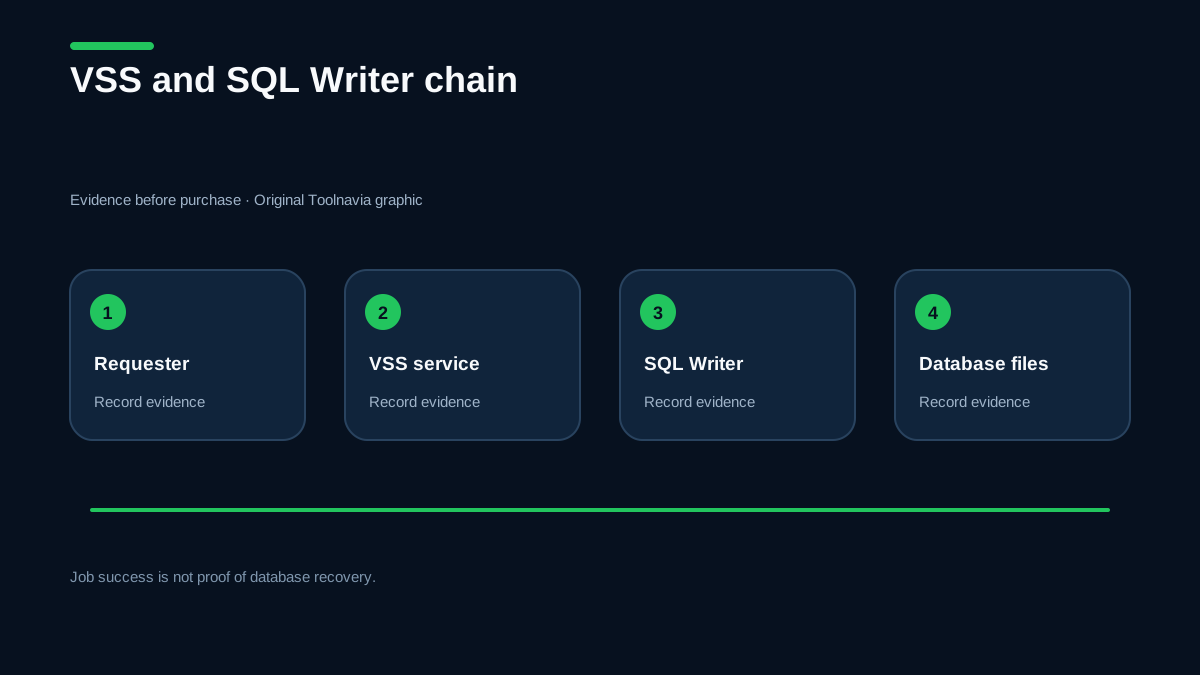
VSS is a coordination framework. A requester asks for a snapshot, a provider creates it, and participating writers prepare application data. Microsoft explains that writers briefly freeze writes so on-disk data can reach a consistent state.
AOMEI's help says Backupper can use Microsoft VSS while the machine remains in use and recommends it for system, partition and disk backup. That is useful, but the word “VSS” alone does not prove that every application writer participated successfully. Microsoft explicitly says a snapshot without writers can still be created and that such data is crash-consistent.

Check the actual requester, service and SQL Writer
For live SQL Server files, Microsoft says SQL Writer must be running when the VSS application requests backup or restore. It lets the backup program coordinate with database files that SQL Server normally locks. Before relying on an image, record the SQL Writer status, run `vssadmin list writers` or an equivalent supported check, and save the job log and Windows event evidence.
AOMEI also documents two backup services: Microsoft VSS and AOMEI Backup Service. Its error documentation says the program may switch to its own service if VSS cannot be used. That fallback can keep a job running, but the buyer should not convert “job completed” into “SQL writer coordinated” without log evidence.

SQL recovery needs more than a green image status
Microsoft's SQL Writer guide distinguishes component-based and non-component-based operations. Component-based requests explicitly select database components; non-component requests work at volume level and have narrower recovery behavior. The same guide's support matrix shows that SQL log backup is not provided by the VSS writer path.
That matters when the recovery objective is more precise than “restore the server near the last image.” A production SQL plan may need native full, differential and transaction-log backups, point-in-time recovery, copy-only behavior, availability-group handling or application-consistent orchestration. Backupper's public VSS pages do not document those SQL-specific controls, so do not infer them from a successful system image.
Microsoft adds another trap: a VSS operation can create an entry in the SQL `backupset` history even if the database files were not actually backed up. History rows and green task status are evidence to investigate, not restore proof.

What competitors reveal about the missing controls
Veeam's same-intent documentation explicitly calls its workflow application-aware, says it creates a transactionally consistent backup, and exposes SQL transaction-log handling. NAKIVO similarly distinguishes ordinary crash-consistent snapshots from app-aware VSS processing and offers scripts for non-VSS-aware transactional applications.
Those pages do not prove that AOMEI fails. They show the questions a buyer should expect a database-aware product to answer: Which writers are processed? Does failure stop the job or continue? Are logs truncated, copied or untouched? Which credentials are required? Can a database be restored independently? What is the supported recovery model?
If a vendor page does not answer those questions for the exact edition, treat the capability as unverified rather than filling the gap with an assumption.
The restore test before purchase
Build a small lab SQL instance with a disposable database. Take an image while writes are active, record the selected backup service and writer state, then restore to isolated hardware or a VM. Check database startup, `DBCC CHECKDB`, row counts, the last committed transaction, application login and event logs. Repeat after deliberately stopping SQL Writer to learn whether the job fails, warns or falls back.
Also test the recovery target that matters: whole-machine boot, volume restore, individual file mount and database-level recovery. A system image can be valuable even when it is not the right mechanism for point-in-time SQL recovery. The test should prove the claim you intend to make, not merely that an image file exists.
Buy, test or choose a database-aware product
**Buy Backupper Professional:** the primary need is general Windows image, clone or workstation recovery; the exact Professional feature and live license are verified; SQL is absent, non-critical or protected separately; and an isolated restore has passed.
**Test before annual or lifetime commitment:** the Windows host runs a small SQL workload, but writer participation, fallback behavior, log strategy or restore outcome is still unknown.
**Choose a database-aware/server workflow:** SQL recovery points, log management, application-level restore, production SLAs or supported database orchestration are mandatory. Veeam and NAKIVO are examples of documentation that exposes these controls; native SQL backup or another verified server product may also fit.
The right conclusion is deliberately narrow: VSS improves live-image coordination, SQL Writer can participate, and AOMEI can create useful Windows images—but only a documented writer path plus a successful database restore proves the recovery claim you need.