TOOLNAVIA / BUYING GUIDE
Namecheap Stellar SSL: 50 Free First Year—or a Wildcard Later?
The short answer
**Quick verdict:** Namecheap Stellar's SSL bundle is generous in year one, but it is not a promise of 50 paid certificates forever. Namecheap says each hosted domain or subdomain can receive one free single-domain certificate for one year, with a 50-certificate cPanel ceiling. If you later renew through Namecheap's paid catalog, Standard SSL currently renews at **$6.99 per name per year**. A **$44.39 Standard Wildcard** becomes cheaper than seven separate paid renewals—but only when those names are one-level subdomains of the **same** base domain.
> **Affiliate disclosure:** Toolnavia may earn a commission if you buy Namecheap through links here. It does not change your price or our verdict. Prices checked 2026-10-26; live checkout controls.

At a glance
- Best for
- Buyers comparing first-year free SSL with year-two individual, wildcard or SAN costs.
- Price model
- Up to 50 first-year certificates; paid renewal from $6.99 per name; verify checkout
- Check first
- The 50-certificate benefit is first-year only; wildcard math applies to one namespace.
What the first-year offer covers
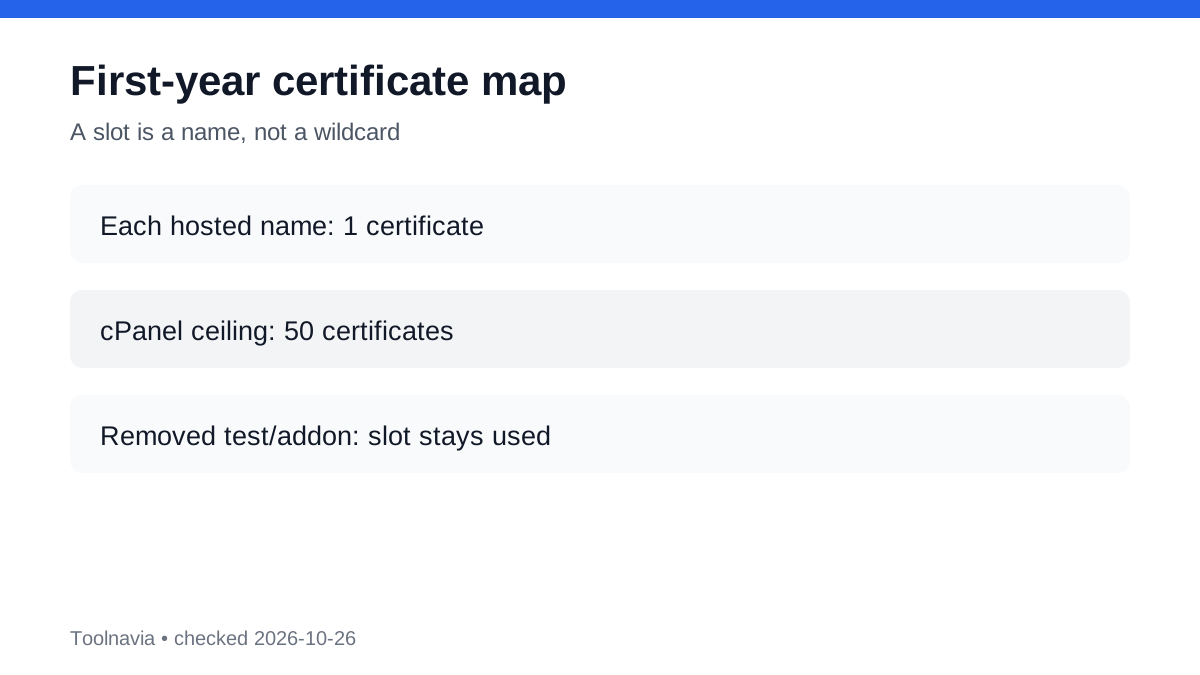
This is an included hosting benefit, not a reusable coupon. Namecheap describes one free single-domain certificate for every hosted domain or subdomain for the first year, up to 50 in the cPanel account. The primary domain, addon domains, test domains and subdomains all consume slots. Removing an addon or test name does not restore its slot.
A portfolio with one main domain, two addon domains and six subdomains therefore needs nine individual certificates. It fits in year one, but creates nine renewal decisions later.
Year-two paid renewal math
| Paid certificate | First displayed year | Annual renewal | Coverage | |---|---:|---:|---| | Standard SSL | $5.99 | $6.99 | One domain or subdomain | | Standard Wildcard | $39.99 | $44.39 | One base domain plus one-level subdomains | | Multi-Domain SSL | $19.50 | $23.40 | Three unrelated domains included; more SANs available |
These are point-in-time official USD figures, not a promise for your renewal date.
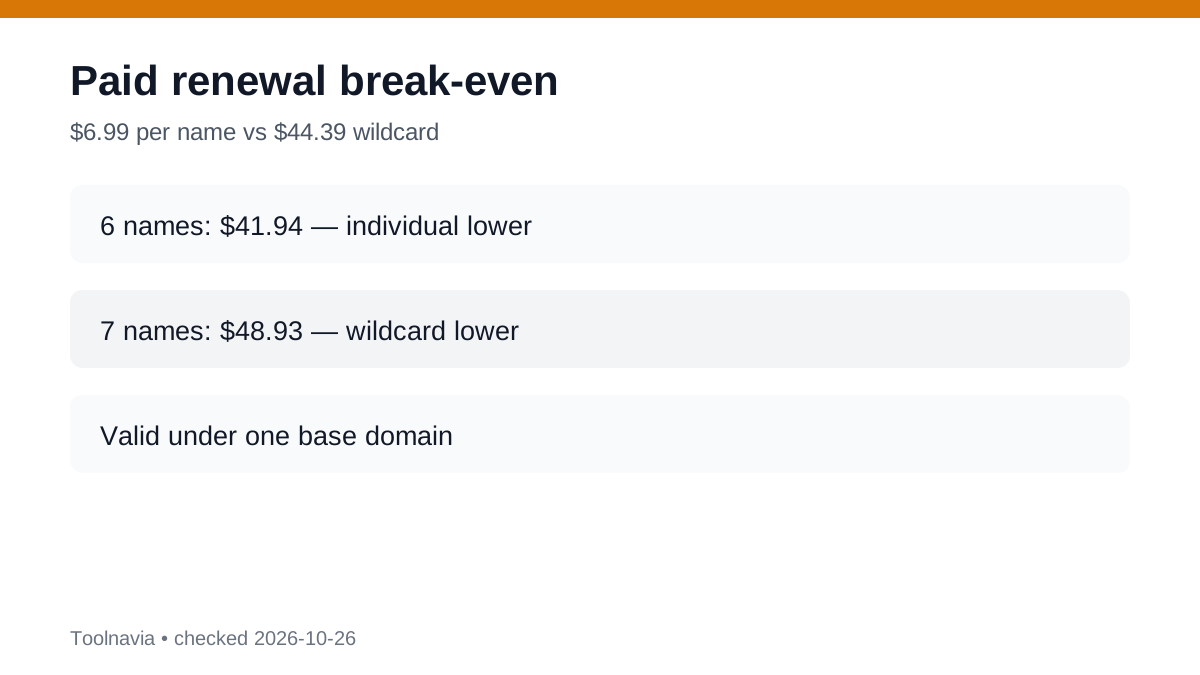
For one base domain with **n** paid subdomain certificates, individual renewals cost **$6.99 × n** and one wildcard renews at **$44.39**. The break-even is 44.39 ÷ 6.99 = 6.35. Six names cost $41.94, while seven cost $48.93. This is an invoice comparison, not a security-quality claim.

The boundary that prevents a false bargain
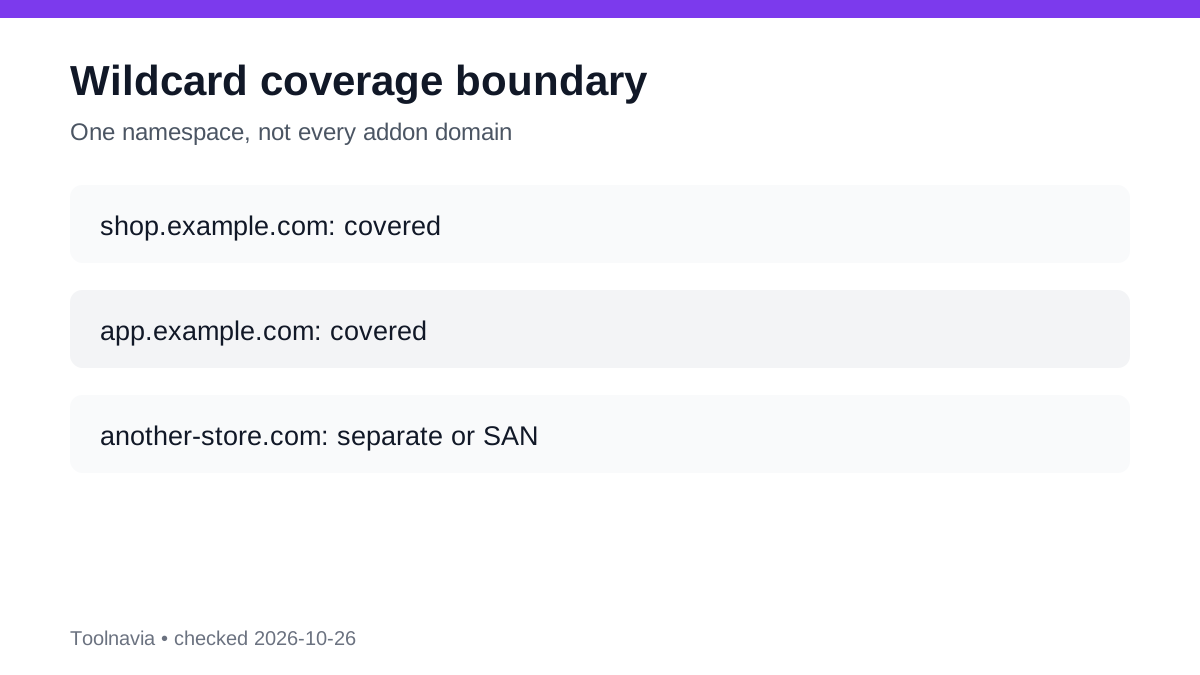
A wildcard is not a 50-domain certificate. It can cover `shop.example.com` and `app.example.com` under one base domain. It does not replace certificates for `another-store.com` or `client-site.net`, and generally not `eu.app.example.com` unless the product explicitly says so.
The seven-name break-even is valid only inside one namespace. For unrelated addon domains, compare individual certificates with the multi-domain product. The current multi-domain page includes three domains and allows additional SANs, but the complete SAN count controls the final price. Renew early enough to complete validation and installation before expiration.
Current same-intent pages from Hostinger and SiteGround explain why buyers expect included automatic SSL and clear wildcard boundaries, while 2026 comparisons from HostingAdvice and Bitcatcha treat free SSL as a hosting selection factor.

Before paying, check the free path
There is a real source conflict. The official first-year offer explains how to buy and auto-install a certificate after the free year, while TechRadar's 2026 review says a free cPanel SSL path remains available if you do not renew the paid certificate. Namecheap's certificate-provider transition also means the exact button and certificate-file lifetime can change.
Our conservative sequence is:
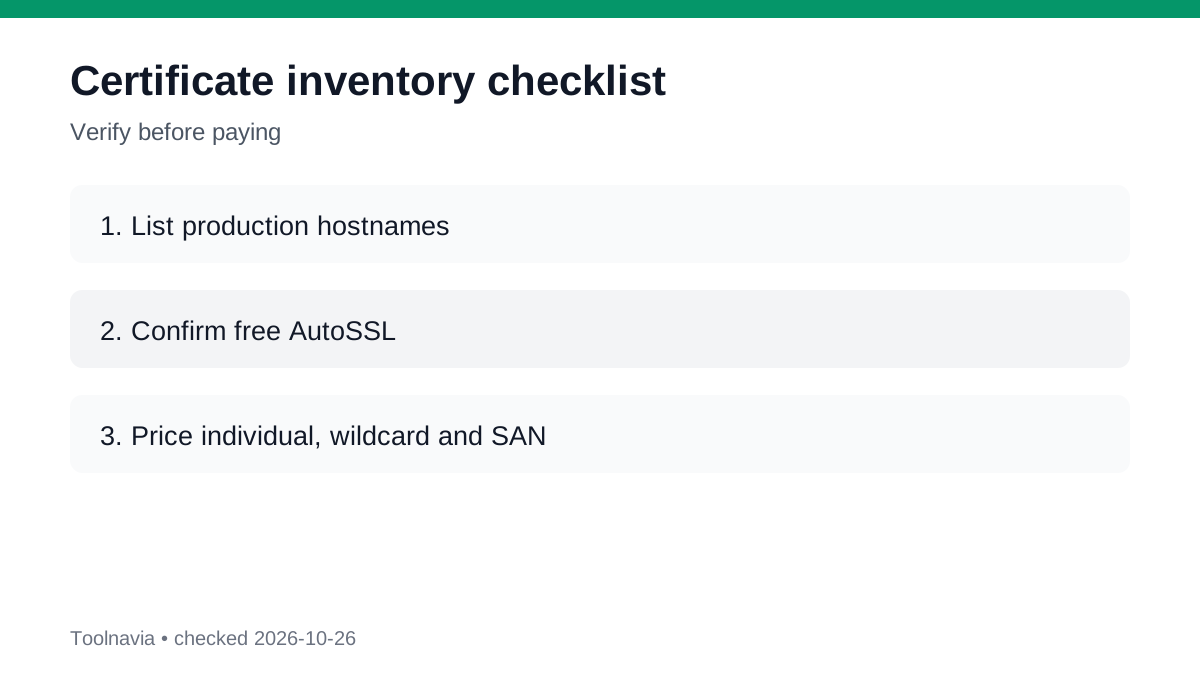
1. Inspect the certificate installed for every production name in cPanel. 2. Check whether AutoSSL or another included free certificate is available and auto-renews. 3. Ask Namecheap support to confirm the post-promo path for your exact account. 4. Buy paid Standard SSL only when you need that product's support, validation or workflow. 5. Use a wildcard only for many one-level subdomains under one base domain. 6. Price a multi-domain/SAN design for unrelated domains.
This article's break-even models **paid Namecheap products only**. It does not assume a paid certificate is mandatory.
Which architecture fits
**Individual certificates:** one to six paid names, unrelated domains, or strong failure isolation.
**Wildcard:** at least seven paid one-level subdomains under one base domain, with acceptable shared-key policy.
**Multi-domain SSL:** unrelated addon domains that benefit from one managed certificate, after pricing the full SAN count.
**Free automated path:** cPanel confirms it is available, auto-renews and meets support requirements.

Final decision
Stellar's first-year SSL offer is useful, but the durable decision is certificate architecture. Inventory names by base domain, verify the live free AutoSSL path, then price the paid fallback. A wildcard starts to beat separate $6.99 renewals at seven eligible names under one base domain. Across unrelated domains, that shortcut does not apply.
[Check Namecheap Stellar availability and current terms](https://namecheap.pxf.io/c/7883429/1632743/5618)