TOOLNAVIA / BUYING GUIDE
InterServer Standard: Multiple Domains or Separate Client Logins?
The short answer
InterServer Standard can be economical for several sites managed by the same owner. It is a different proposition when unrelated clients need their own hosting logins. InterServer explicitly says that adding a domain does not create a new panel user or an independent resource pool. This guide evaluates that account boundary from current documentation, without claiming a customer-account test.
At a glance
- Best for
- Related sites controlled by one trusted administrator.
- Price model
- Standard monthly first charge$2.50,then$7; separate reseller reference$19.95/month.
- Check first
- Additional domains are not independent users or dedicated resources.
Decide what the second domain should do
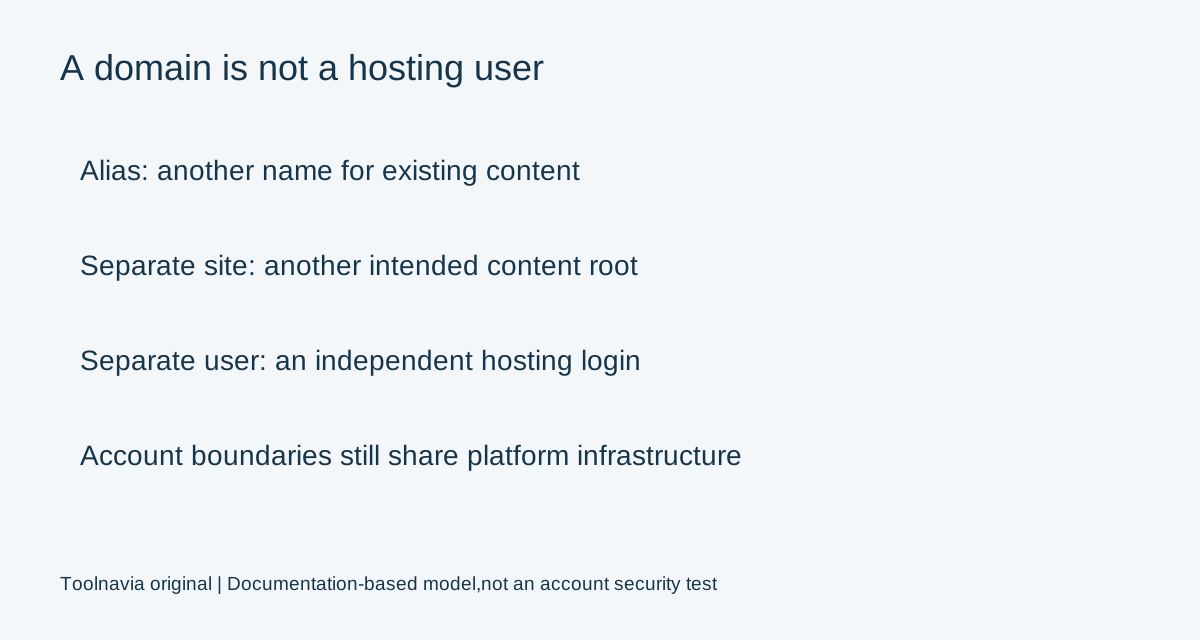
There are three distinct requests: another name displaying the same site, another website with its own content directory, and another customer with separate hosting credentials. InterServer's domain guide distinguishes aliases from independent content roots, then warns not to confuse adding a domain with creating a user.
For your own related projects, one account may be convenient. For a customer who must administer hosting without seeing other projects, evaluate a separate account arrangement before buying. A different URL alone does not establish that boundary.
Four useful Standard capabilities, with limits
| Capability | Practical value | Boundary | |---|---|---| | Additional domains | Consolidate eligible independent sites. | Domains share the existing account; actual package permissions apply. | | Alias or pointer | Give an existing site another name. | This does not create separate content or another owner login. | | DirectAdmin tools | Manage domains, files, mail and databases. | User-level tools do not include unrestricted reseller administration. | | Migration assistance | Reduce work for eligible transfers. | Matching supported panels and an agreed restore scope are required. |
These features can save administration time for one trusted owner. They do not make a single shared login suitable for every client relationship.
A panel login is an ownership boundary
DirectAdmin separates administrator, reseller and user roles. Resellers can create user accounts; a normal user manages that user's sites, email, databases and files. Having DirectAdmin in Standard therefore does not itself grant reseller-level account creation.
The same architectural distinction appears in cPanel's documentation: multiple domains share one account login and resources, whereas reseller customers receive separate accounts. This is comparison context, not a cPanel entitlement on Standard, whose published panel is DirectAdmin.
Our practical rule is to avoid giving an unrelated customer the master hosting login for a portfolio. Where the customer only edits content, evaluate application-level permissions separately. When hosting-level control or an eventual independent handover is required, plan the account boundary first.
Isolation does not mean separate hardware
InterServer markets its DirectAdmin reseller service around separate client logins and account separation. That can improve management boundaries, but it is not a promise of independent physical servers, unlimited CPU or immunity to every shared-platform incident.
CloudLinux describes CageFS as isolating users in separate filesystem environments. This helps explain why user identity matters; it does not prove that each domain under one user receives its own cage, or establish the exact isolation configuration of an uninspected InterServer account. Ask support what is enforced per user and what is pooled across the reseller package.
The Standard terms still allow restrictions for disruptive applications and publish account-level resource limits. An unlimited domain label cannot override those conditions.
Plan the handover before consolidating sites
InterServer's migration guide states that a full-account restore is not a merge into a destination already containing unrelated sites. Its complimentary service requires matching supported panels, and reseller moves need an account-by-account plan.
Before moving a client's site, inventory its files, database, mail, DNS records and scheduled tasks. Agree the destination username and restore scope. Preserve independent private backups and avoid restoring a full account over unrelated work. These are proposed preparation steps, not a migration we performed.
Our acceptance checklist is separate intended credentials where required, access limited to the correct project, a working HTTPS hostname, verified application actions and separately checked mail. Keep the source available until the owner accepts the result. Consult the existing [Standard migration guide](/en/hosting/interserver-wordpress-migration-checklist) for cutover planning.
Compare the right costs and choose
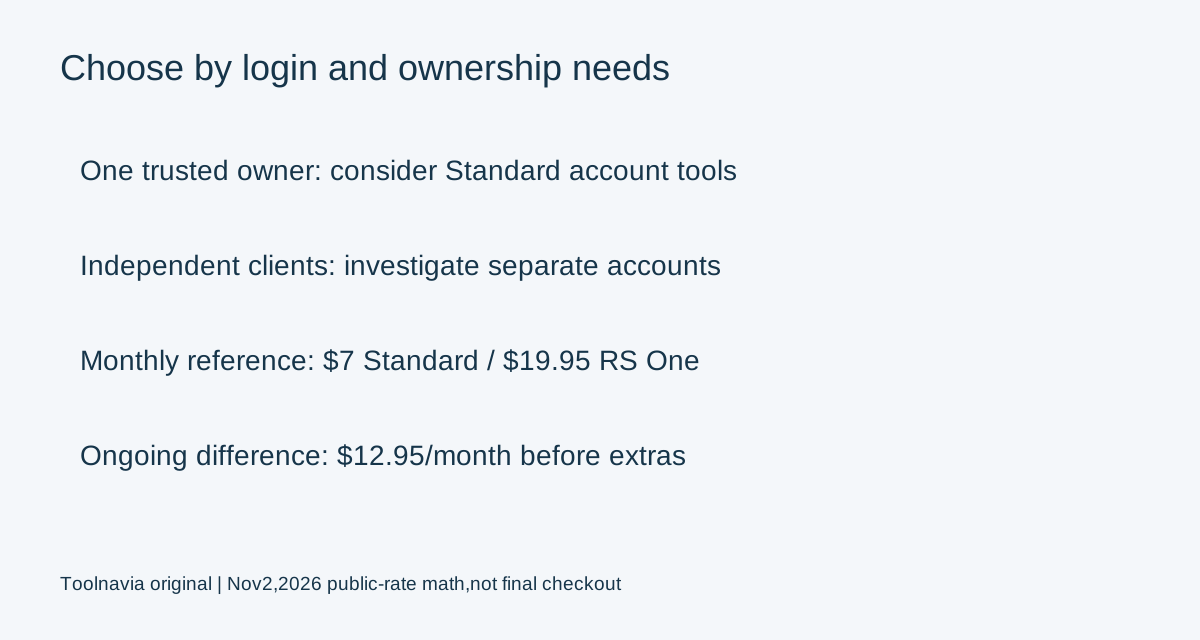
Checked November 2, 2026, Standard's monthly path starts at $2.50 for the first month and renews at $7 per month. The separate DirectAdmin reseller RS One reference is $19.95 per month, with 80GB storage and 500GB monthly bandwidth.
At those published monthly rates, the ongoing difference is $12.95 per month, or $155.40 over twelve months. This is comparison arithmetic, not a final cart quote. Taxes, options and different billing terms can change the bill. The reseller reference is an alternative architecture, not an entitlement included with the Standard offer below.
Choose Standard for related sites under one trusted administrator when the resource limits fit. Investigate separate accounts when independent hosting logins, client handover or account-level separation are requirements. Choose by who controls the sites, not simply by how many domain names fit.
Affiliate disclosure: Toolnavia may earn a commission from an eligible InterServer purchase through its referral link.