TOOLNAVIA / BUYING GUIDE
Hostinger Premium 48-Month Cost: $143.52 Upfront, Then $10.99/Month
The short answer
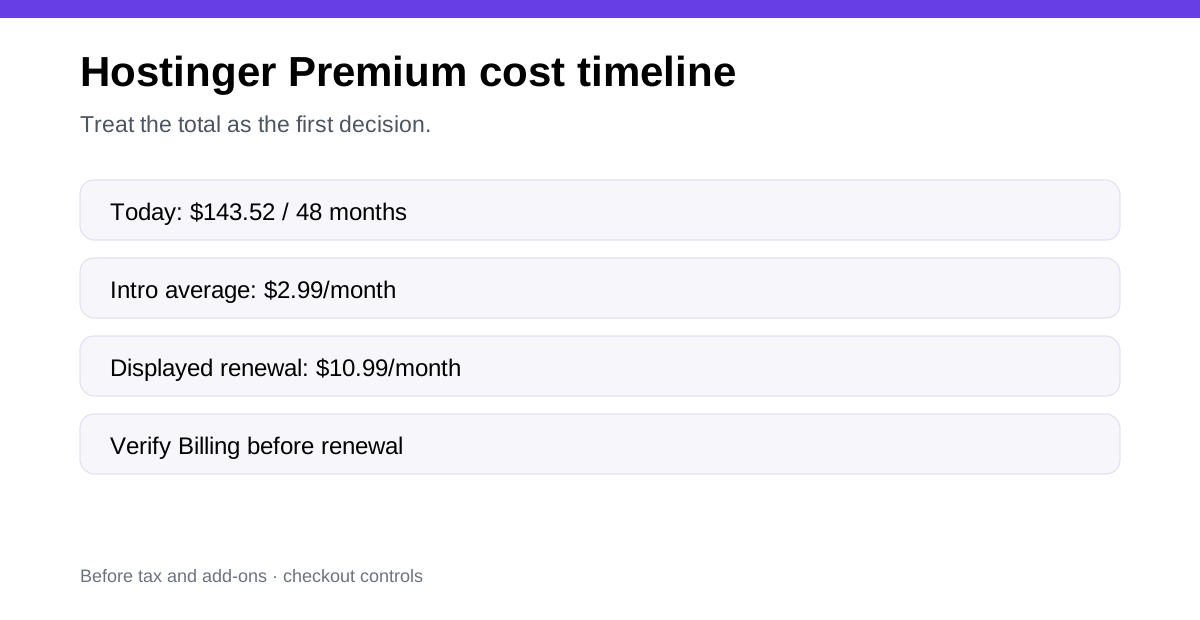
Hostinger Premium is worth considering for a small WordPress site, portfolio or brochure site only if you are comfortable prepaying four years. The current US offer displays $2.99 a month, but the buying decision is really $143.52 due for 48 months and a displayed renewal rate of $10.99 a month. If the renewal figure is already outside your budget, the low introductory average should not persuade you.
At a glance
$2.99 /mo equivalent · 48-month plan · USD
$143.52 paid upfront for 48 months. Taxes and optional services may add to the total.
| Websites | 3 included |
|---|---|
| Storage | 20 GB SSD |
| Renewal shown | $10.99/mo equivalent |
What you get for the first payment
Premium currently supports up to three websites with 20 GB of SSD storage. That is a practical fit for one main site plus a small test or side project, but it is not a promise of unlimited growth. The package also includes SSL, website migration, a CDN and weekly backups. Those reduce setup work: you can move an existing WordPress site, turn on HTTPS and keep a host-side recovery point without buying separate basics on day one.
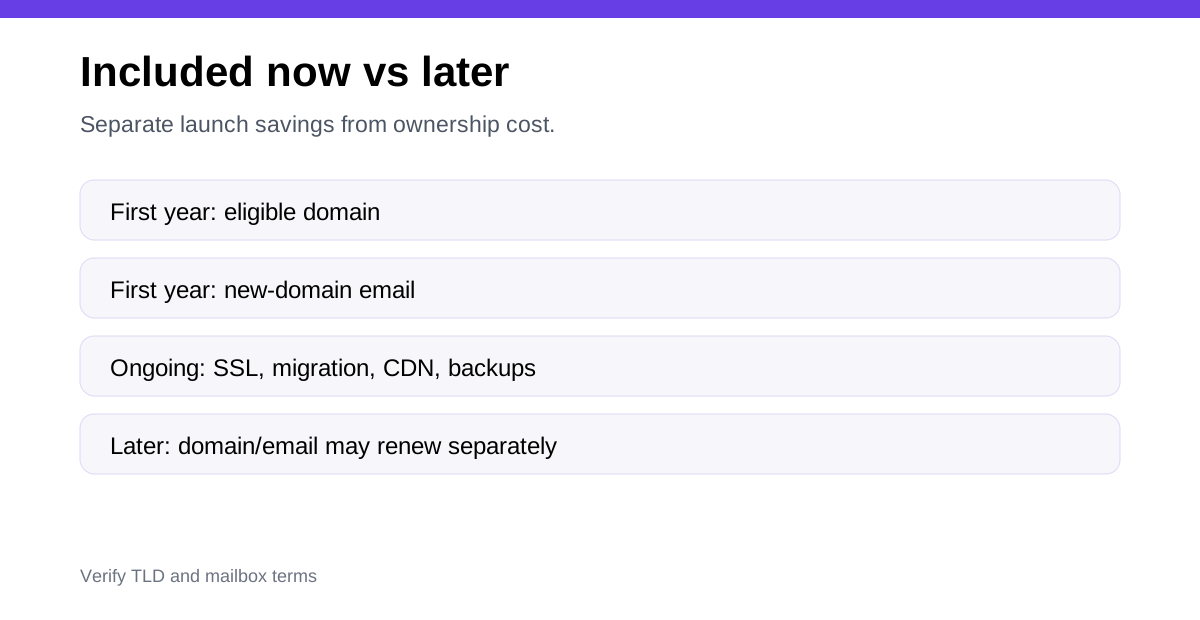
A domain is included for the first year on an eligible long-term purchase. Email for a new domain is also promoted as a first-year inclusion. These are real launch savings, but they are not permanent price reductions. The domain renews at the then-current regular price, and email may become a separate cost after the included period. Check the final cart for the exact domain extension and mailbox terms before paying.
The cost that matters after the promotion
At the displayed offer, 48 months cost $143.52 before tax and optional services. The listed renewal rate is $10.99 a month, or $131.88 for twelve months at that rate. That calculation is a planning reference, not a guarantee of the renewal cadence or future checkout total. Hosting prices can change, and your account’s Billing page is the final source for the next charge.
Hostinger says annual hosting can be charged before expiry when auto-renewal is on; check Billing for the current exact date. Put a reminder well before that date and review the renewal term, domain, email and any add-ons together. Turning off auto-renew does not erase the remaining paid term; it prevents an automatic next charge.
Independent reviews can retain older price snapshots, so this repair treats the current official page and final checkout as controlling.
Four reasons Premium can be a sensible starting point
First, the four-year prepayment fixes a low introductory average for a long runway. Second, three website slots give a solo buyer room for a main site and two small projects without immediately upgrading. Third, the included domain, SSL, migration and first-year email remove several launch tasks. Fourth, weekly backups and a CDN provide basic operational convenience for a low-maintenance site.
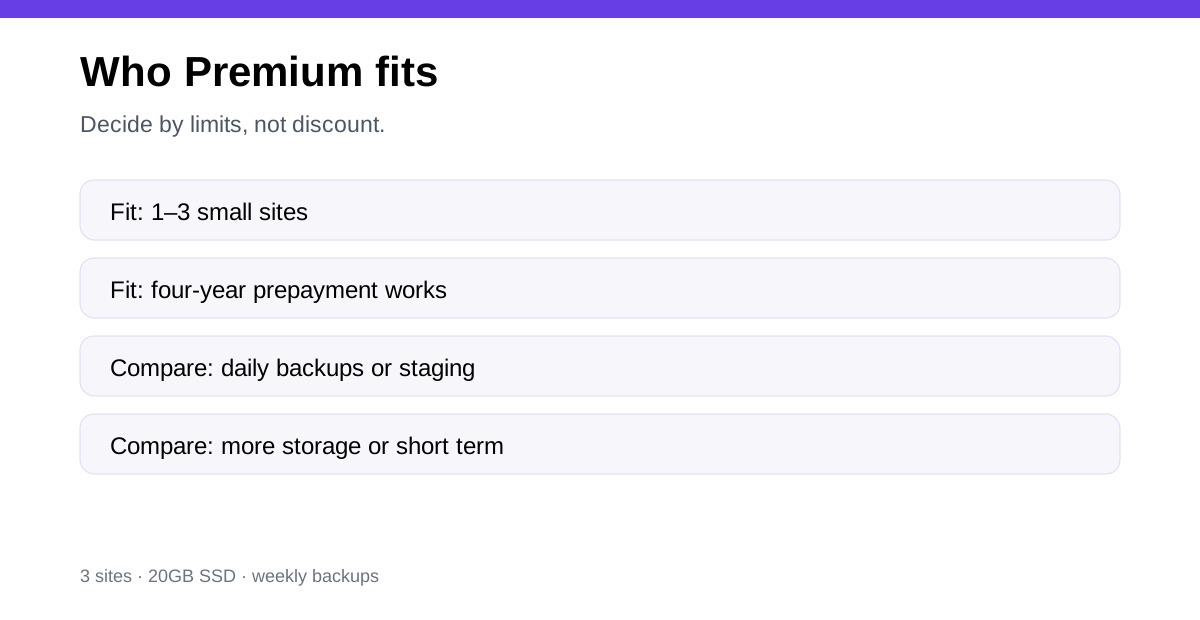
Those benefits are strongest when your site is small and predictable. Premium is a weaker fit if you need daily backups, staging, more storage, many active sites, advanced server control or a short commitment. Do not infer performance guarantees from the plan name or feature list; traffic, plugins and workload still determine whether the limits are comfortable.
Refund and checkout boundaries
The hosting policy generally gives eligible hosting purchases and renewals a 30-day refund window, but domains follow different rules. Domain renewals are not refundable, many new generic domain registrations have a much shorter 96-hour window, and the value of a free domain can be deducted from a hosting refund. Payment-method and product exclusions also apply.
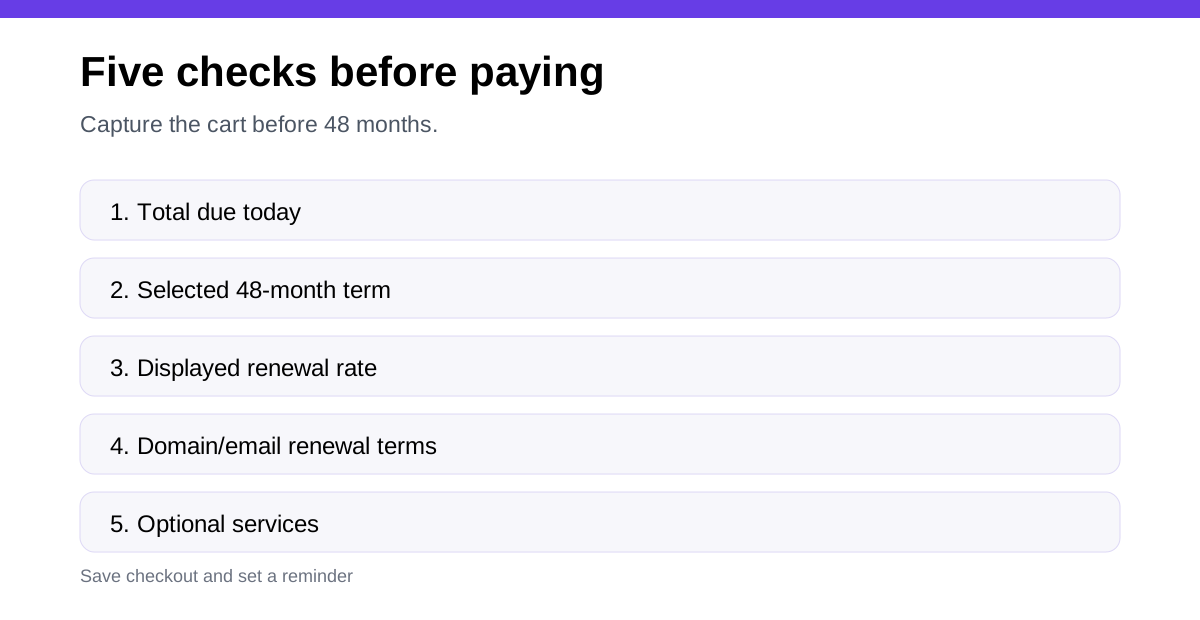
Before buying, open the checkout and verify five items: the total due today, the selected 48-month term, the displayed renewal rate, the domain and email renewal terms, and whether any optional services were added. If those numbers still work for you and three sites with 20 GB and weekly backups are enough, Premium is a reasonable low-friction start. If not, choose a shorter commitment or a plan whose renewal and operating limits fit before migrating.