TOOLNAVIA / BUYING GUIDE
GreenGeeks Pro vs GoDaddy Economy: Unlimited Sites or 1 Site?
The short answer
GreenGeeks Pro and GoDaddy Economy are both cPanel-style shared hosting, but they are not aimed at the same site portfolio. GreenGeeks Pro currently shows **US$4.95/month prepaid for 12 months**—US$59.40 by arithmetic—with **unlimited websites and 50GB web space**. GoDaddy Economy shows **US$6.99/month for the first 1-year term**—US$83.88 by arithmetic—with **1 website and 25GB NVMe**.
The year-two picture is different. GreenGeeks currently shows **US$18.95/month renewal**, while GoDaddy displays **US$11.99/month** as its regular/auto-renew reference. If those displays remain, a 12-month renewal model is US$227.40 for GreenGeeks versus US$143.88 for GoDaddy. The lower year-two number does not make GoDaddy the better multi-site plan; it means the site-count and resource model must be compared beside renewal.
At a glance
- Best for
- Buyers deciding between a multi-site 50GB shared account and a one-site 25GB account with explicit 512MB RAM.
- Price model
- GreenGeeks Pro $4.95/mo first 12 months, $18.95 renewal; GoDaddy Economy $6.99/mo first year, $11.99 auto-renew reference
- Check first
- Renewal models come from current displays and can change; GreenGeeks exact plan RAM and GoDaddy Economy backup retention are not claimed; no benchmark.
Quick verdict
Choose **GreenGeeks Pro** when you want several modest websites in one account, 50GB total web space, unlimited hosted domains/email accounts, free SSL and direct access to GreenGeeks system restore points.
Choose **GoDaddy Economy** when you need only one site, 25GB is enough, GoDaddy's domain/email/cPanel bundle fits your workflow and the published **1 CPU / 512MB RAM** account ceiling is acceptable.
Neither plan is declared faster here. Shared-hosting performance depends on workload, caching, PHP behavior and platform scheduling; plan tables are not a benchmark.
The first-year winner and renewal winner can be different
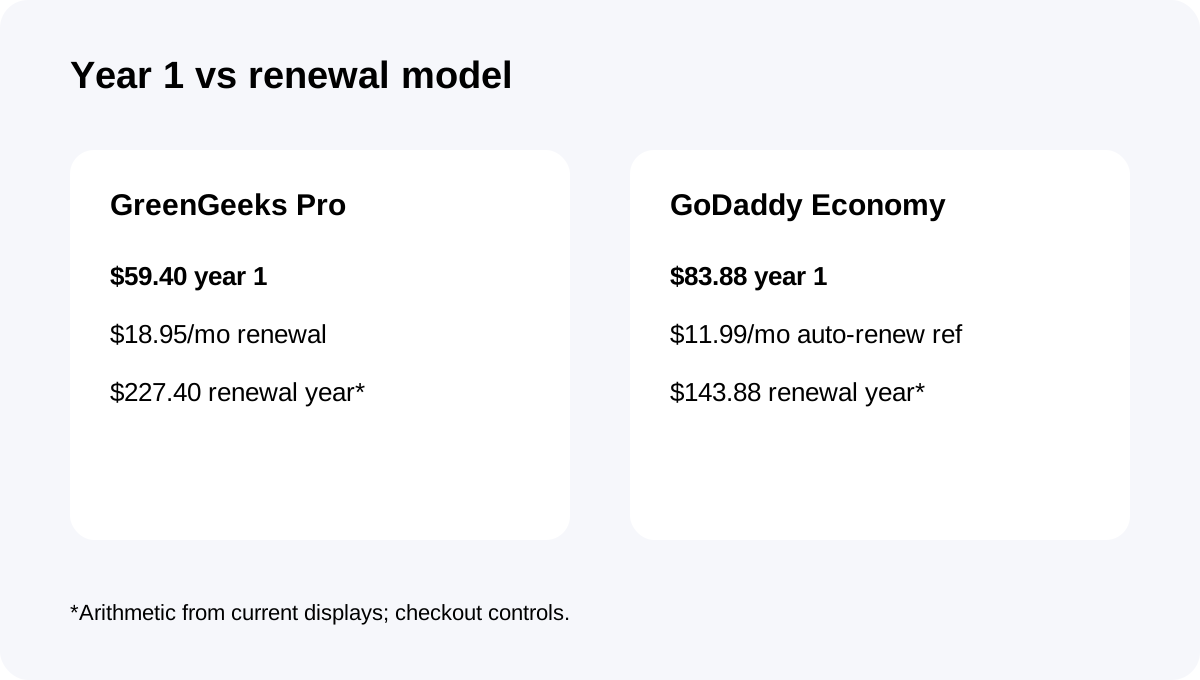
GreenGeeks Pro's current first year is US$4.95/month × 12 = **US$59.40** before tax. Its current renewal display is US$18.95/month, or **US$227.40** for a 12-month model if unchanged.
GoDaddy Economy's first-year display is US$6.99/month × 12 = **US$83.88**. Its current auto-renew/regular display is US$11.99/month, or **US$143.88** for a 12-month model if unchanged.
So GreenGeeks is cheaper up front, while GoDaddy's current renewal reference is lower. But that is not an equal-service cash comparison: GreenGeeks Pro is a multi-site 50GB account; GoDaddy Economy is a one-site 25GB account with a specific 512MB memory ceiling.
“Unlimited websites” still means one shared resource pool
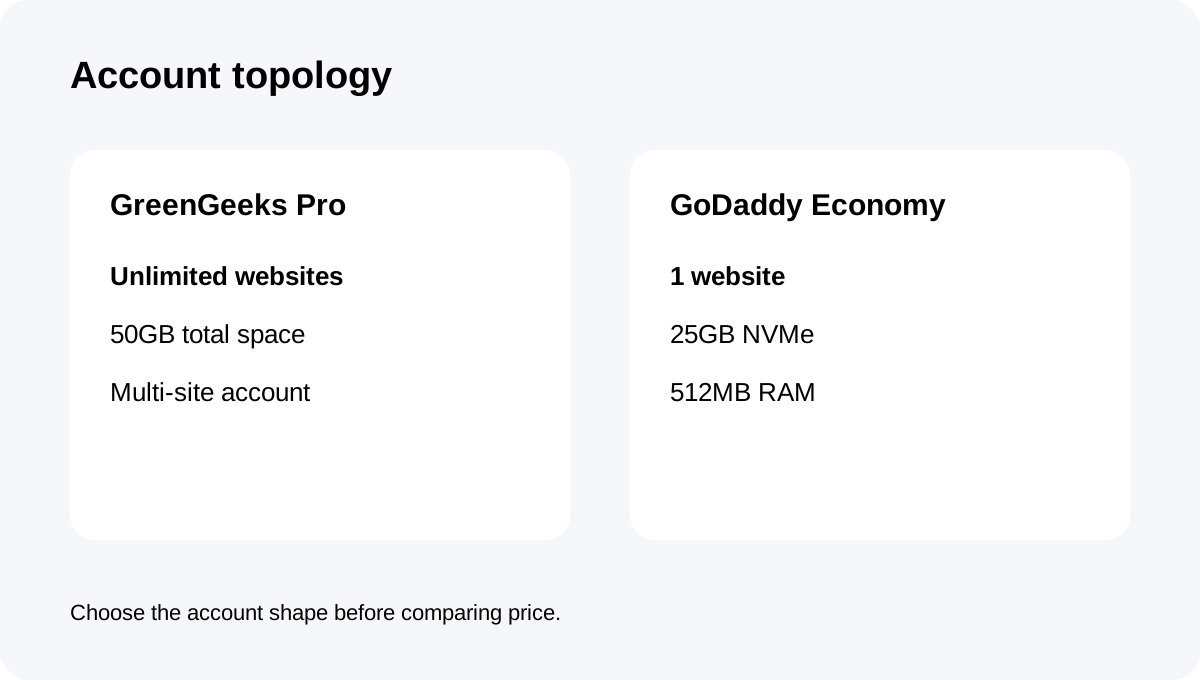
GreenGeeks Pro allows unlimited hosted domains and websites within its shared-hosting policies. It also lists 50GB of web space and unmetered transfer. “Unlimited websites” does not promise unlimited CPU, RAM, processes or inodes; every site still shares the account's finite platform resources.
GoDaddy Economy publishes more explicit account limits: 1 CPU core, 512MB RAM, 20 entry processes, 35 NProcs, 250,000 inodes and 25GB disk.
This creates a useful decision split. Several low-traffic brochure sites can fit GreenGeeks' topology better. One plugin-heavy WordPress site may care more about GoDaddy's 512MB published limit—and whether that is enough—than about the extra domain-management convenience.
25GB versus 50GB needs practical headroom
GoDaddy recommends leaving roughly 20% of maximum disk space free for system overhead. On a 25GB Economy account, that suggests planning around **20GB** rather than consuming every advertised gigabyte.
GreenGeeks Pro exposes 50GB total web space across its multi-site account. A buyer with several sites should budget media, email, caches, staging copies and database growth across the same total instead of multiplying 50GB by the number of domains.
If your portfolio is already near 20GB, GreenGeeks' larger storage pool is materially more comfortable. If your single site uses only a few gigabytes, storage is probably not the deciding dimension.
Backup access is clearer on GreenGeeks, but neither is an archive
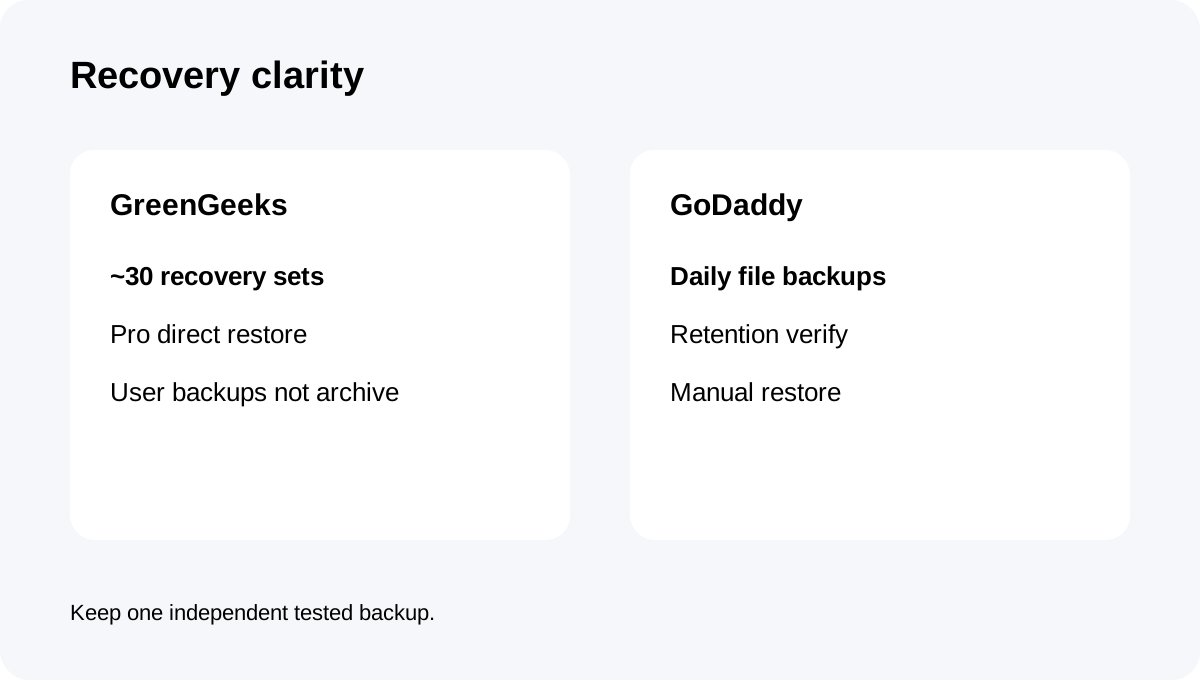
GreenGeeks aims to retain about **30 recovery backup sets**, and Pro customers have direct restore access. At the same time, GreenGeeks says user-generated backups stored inside the hosting account are not intended as long-term archive storage and are commonly purged after about 48 hours.
GoDaddy says Web Hosting includes daily file backups that customers can manually restore. The cited disaster-recovery help page does not publish an Economy-specific retention count, so this guide does not invent one.
For business-critical sites, keep at least one independent copy outside the hosting account and test a restore. A “daily backup” badge is not a recovery plan by itself.
Full-account portability becomes harder as GreenGeeks grows
GreenGeeks allows the normal full cPanel backup tool while the account is under 10GB. Above that threshold, its documentation directs users to separate file/database backup methods or a provider-assisted full-backup route.
That matters specifically on Pro because the plan can hold multiple sites and 50GB. If account portability is important, test the export path before the account grows beyond 10GB rather than discovering the limitation during a migration.
GoDaddy's smaller one-site Economy topology can be simpler to inventory, but 25GB of files plus databases and email still requires a verified export/restore workflow.
Domain, email and SSL should be priced beyond year one
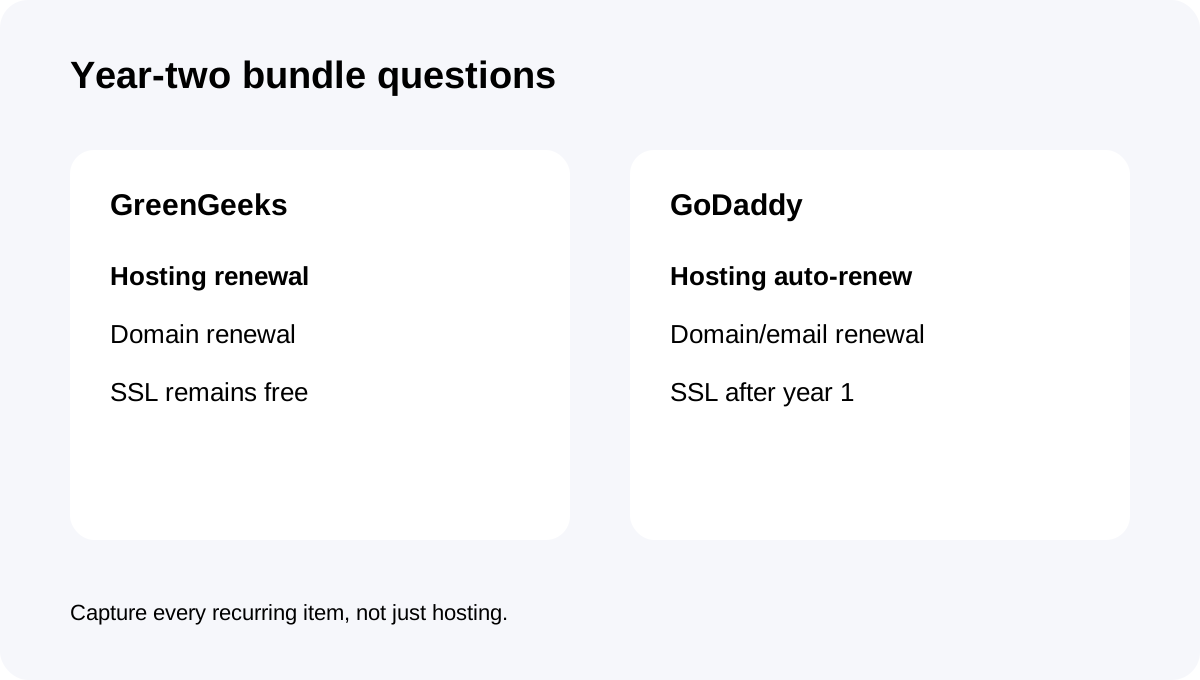
GreenGeeks Pro includes one domain for the first year, unlimited email accounts and free Let's Encrypt SSL. Domain renewal is separate after the included first year.
GoDaddy Economy advertises first-year domain/email benefits and specifically says the SSL certificate is free for **1 year**. That wording is important: do not assume the SSL inclusion is permanent on Economy.
A year-two budget should therefore capture hosting renewal, domain renewal, email entitlement and SSL status—not only the hosting headline.
Independent comparisons show the query is real, not the answer
Recent independent comparisons confirm that buyers actively compare GreenGeeks and GoDaddy. Their speed tests, scores and broad recommendations are not used here because current plan price, topology and resource limits come from the providers.
Checkout checklist
For **GreenGeeks Pro**, confirm the US$59.40 first-year total, US$18.95/month renewal, 50GB space, number of sites you intend to host, current account resource thresholds, system-backup access, full-backup workflow above 10GB and domain renewal.
For **GoDaddy Economy**, confirm the US$83.88 first-year total, US$11.99/month auto-renew reference, 1-site limit, 25GB disk, 512MB RAM, 20 entry processes, backup retention, domain/email renewal and SSL cost/status after year one.
**Bottom line:** GreenGeeks Pro is the stronger fit for a multi-site portfolio and is cheaper in the current first year. GoDaddy Economy can be cheaper at the current year-two renewal reference, but it remains a one-site plan with a 512MB published memory ceiling and first-year-only SSL wording.