TOOLNAVIA / BUYING GUIDE
DreamHost Managed VPS Business: $360 Upfront, No Root Access
The short answer
DreamHost Managed VPS Business is worth considering when several modest websites need protected server resources without taking on operating-system maintenance. It is not a root-access VPS or an isolated database service. The displayed $10 monthly equivalent requires three years upfront, and current official pages disagree about refunds. This is document-based analysis, not a performance test.
At a glance
- Best for
- Measured conventional websites whose owner values managed OS upkeep over root control and has confirmed acceptable refund, database and full-term costs.
- Price model
- $10/month equivalent on 36 months: $360 upfront; $24.99/month renewal reference; tax/extras and refund eligibility require confirmation
- Check first
- Docker or root-dependent workloads, an isolated database included in the base price, application development outsourcing, or an unresolved refund requirement.
Four benefits for conventional websites
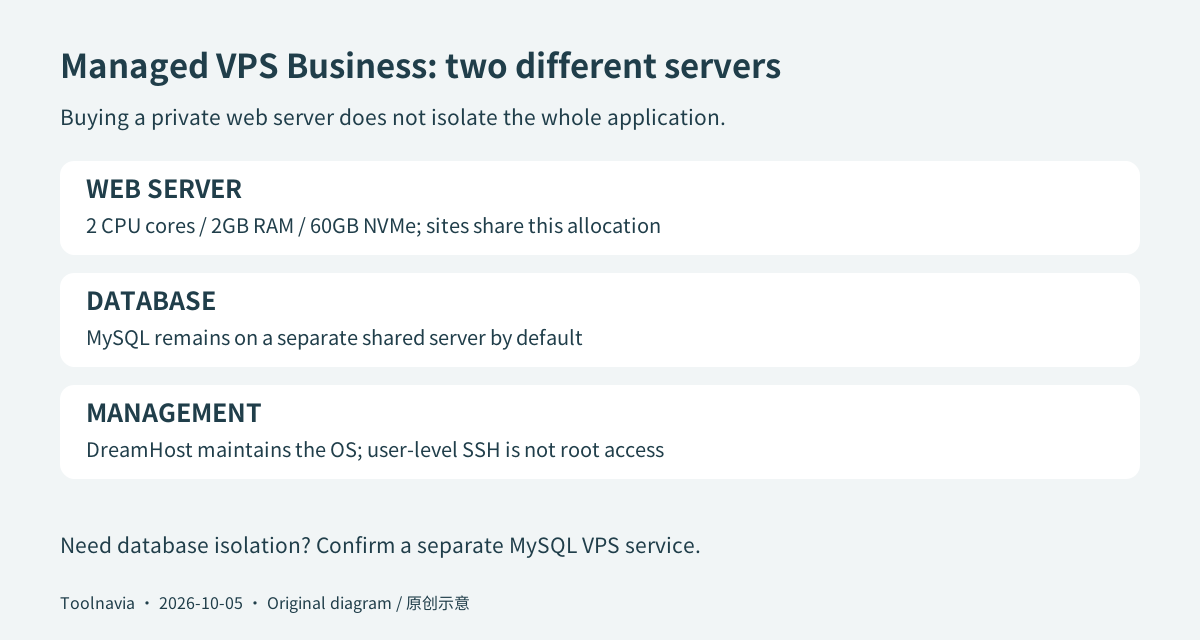
Business lists two CPU cores, 2GB RAM and 60GB NVMe storage. Multiple websites share that allocation; unlimited site count does not mean unlimited capacity. The buying question is whether your combined workload fits, not how many domains you can attach.
First, DreamHost maintains the managed operating system and its security updates, reducing server-administration duties while leaving application work with you. Second, protected RAM and CPU allocations plus panel resource graphs make it easier to assess a growing workload. The overview says a RAM upgrade does not require a restart, whereas a downgrade does. This is useful expansion control, not a guarantee that a busy application will remain fast.
Third, SSH and Git support allow command-line and deployment work within the permitted user environment. They do not grant root, sudo or Docker installation privileges on this managed product. Fourth, included SSL and domain email consolidate basic website operations. Each mailbox still has a 25GB policy limit; advanced mail or application requirements may justify a separate service.
A private web server does not make MySQL private
The Managed VPS overview places MySQL databases on a separate shared server. MySQL VPS is an additional product, not part of the Business web-server allocation. The 60GB website-storage figure must not be presented as dedicated database capacity.
Diagnose the bottleneck before upgrading. High web-server memory use and slow database queries are different problems; adding web RAM is not proof that a database-heavy checkout will improve. Buyers needing database isolation should obtain a separate quote and configuration. This service is also distinct from DreamPress, the managed WordPress product already covered by Toolnavia.
Unmetered bandwidth means no per-GB transfer bill under the policy, not unlimited processing power. DreamHost can restrict traffic that affects its network. The resource policy does not impose a monthly visitor threshold on Managed VPS, but the plan's resources still apply.
Budget the commitment, not just the monthly equivalent
The three-year Business display gives $10 × 36 = $360 in base hosting charges, paid upfront. It lists $24.99 per month on renewal after that period. At an unchanged rate and the same 36-month term, renewal arithmetic would be $899.64. That is a conditional calculation, not a guaranteed future invoice.
The terms renew service for the original term at the then-current nonpromotional price. Taxes, domain renewal, extra database services and paid application work belong in the budget. The personalized checkout, customer eligibility and final tax amount were not captured. Confirm these before ordering; no alternative monthly-plan price is inferred from the three-year offer.
Resolve the refund contradiction before paying
The current Business card advertises a thirty-day money-back guarantee. However, the Managed VPS overview limits the guarantee to Shared Hosting, and the current terms explicitly exclude VPS. These official statements remain inconsistent.
Ask DreamHost for written confirmation tied to the exact Business order and payment term. Do not treat a $360 prepayment as a risk-free trial, and do not infer which statement legally overrides the others. A buyer who requires a dependable refund option should defer purchase until that condition is clarified.
Back up the database as well as the website files
DreamHost's website-restoration guide generally describes about two weeks of file backups, without a guarantee. Its restore action recovers website files, not the database. The account-export tool separately packages users, databases and mailboxes; generated downloads remain available for fourteen days. That download window is not a promised fourteen-day version history.
WordPress likewise explains that files and the database are separate parts of a complete recovery set. Keep matched copies outside the hosting account and test a disposable restoration. A restored homepage alone does not prove that orders, posts or mail are intact.
Move the sites, then retire the old bill
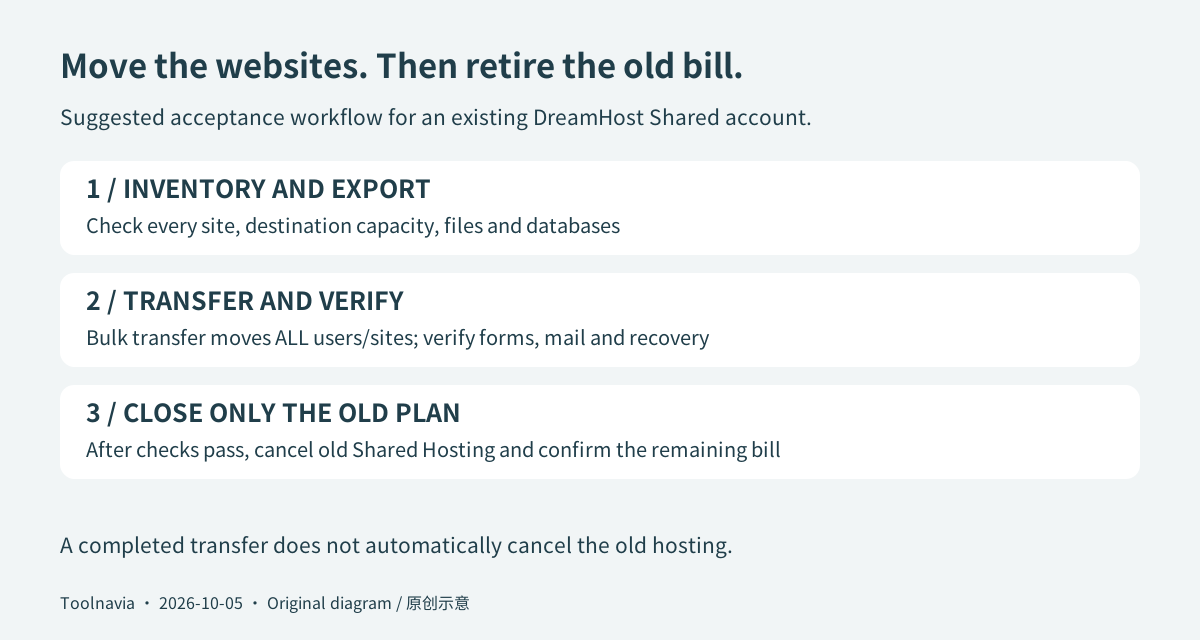
For an existing DreamHost Shared Hosting account, the documented bulk-transfer flow moves all users and websites to the private server; existing plans remain active until manually closed. It is not the right button for moving just one site without reviewing the account's scope.
Use this suggested acceptance sequence: inventory every site and its disk usage, export files and databases, confirm the destination fits, then perform the appropriate transfer. Check forms, login, database writes, email and a disposable restore. Keep the old service until those checks pass. Only then close the intended old Shared Hosting plan, preserve cancellation confirmation and verify which recurring charge remains.
Choose Business for measured conventional websites when managed server upkeep outweighs root control and the full commitment is acceptable. Skip it for Docker, an isolated database included in the base price, or an unresolved refund requirement. DreamHost's open cash affiliate program covers Managed VPS; Toolnavia approval is not evidenced, so tracking remains disabled.