TOOLNAVIA / BUYING GUIDE
Cloudways Scale vs BigScoots E75: $199 Autoscaling or $35 Care?
The short answer
At a glance
- Best for
- WooCommerce stores choosing between automatic traffic-spike capacity and lower-cost hands-on managed hosting.
- Price model
- Cloudways $199/month base; BigScoots $35/month or $350/year
- Check first
- Plans meter different resources; independent tests are not the exact pair; Cloudways usage and BigScoots sustained overages can add cost.
Quick verdict
Choose **BigScoots Essential 75** when one WooCommerce store is comfortably inside the published **75,000 monthly visitor, 10GB storage and 150GB bandwidth** envelope and the priority is a lower fixed bill plus hands-on WordPress support. It is currently **$35 month to month or $350 a year**.
Choose **Cloudways Autonomous Scale** when the business case is not “more visits” but **unpredictable concurrency**: product launches, flash sales, paid-campaign bursts or seasonal events where automatic replicas and high availability may protect revenue. Scale is currently **$199 per month**, billed hourly per application, before extra autoscaling, disk or bandwidth charges.
This is not a speed contest. Public benchmark evidence does not test this exact pair, and visitor allowances are not performance guarantees. The purchase is a choice between a low fixed managed plan with explicit limits and a much more expensive usage-aware autoscaling platform.
The annual base-price gap
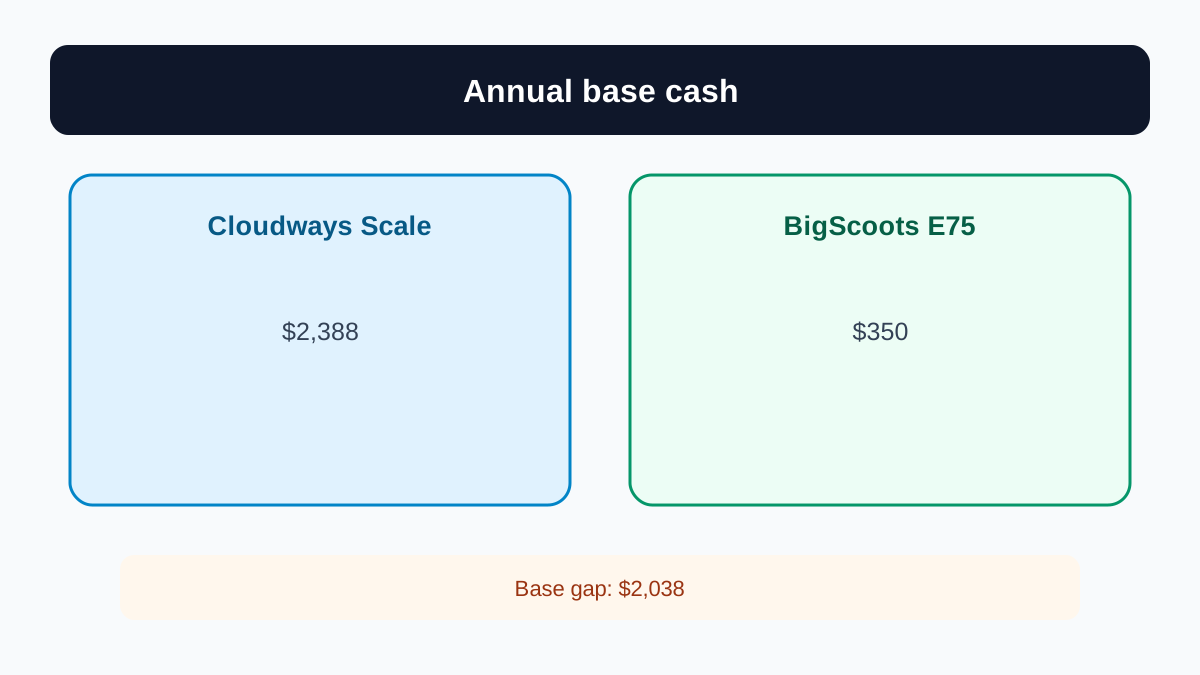
| Exact plan | Billing option | Base cash for 12 months | What the base measures | |---|---:|---:|---| | BigScoots Essential 75 | $350/year | $350 | One site within published plan limits | | BigScoots Essential 75 | $35/month | $420 | Same plan with monthly flexibility | | Cloudways Autonomous Scale | $199/month cap | $2,388 | One app, hourly billing, autoscaling platform |
On annual billing, Cloudways Scale costs **$2,038 more per year** before any Cloudways autoscaling or overage charge. BigScoots' annual rate is simply two months below its monthly total; it is a billing option, not a coupon claim.
Cloudways converts the $199 monthly price into an hourly rate. If the app is active for only part of a month, the bill is prorated; an active production store should budget near the monthly cap. Deactivating billing is not the same as keeping a store live.
What Cloudways Scale actually buys
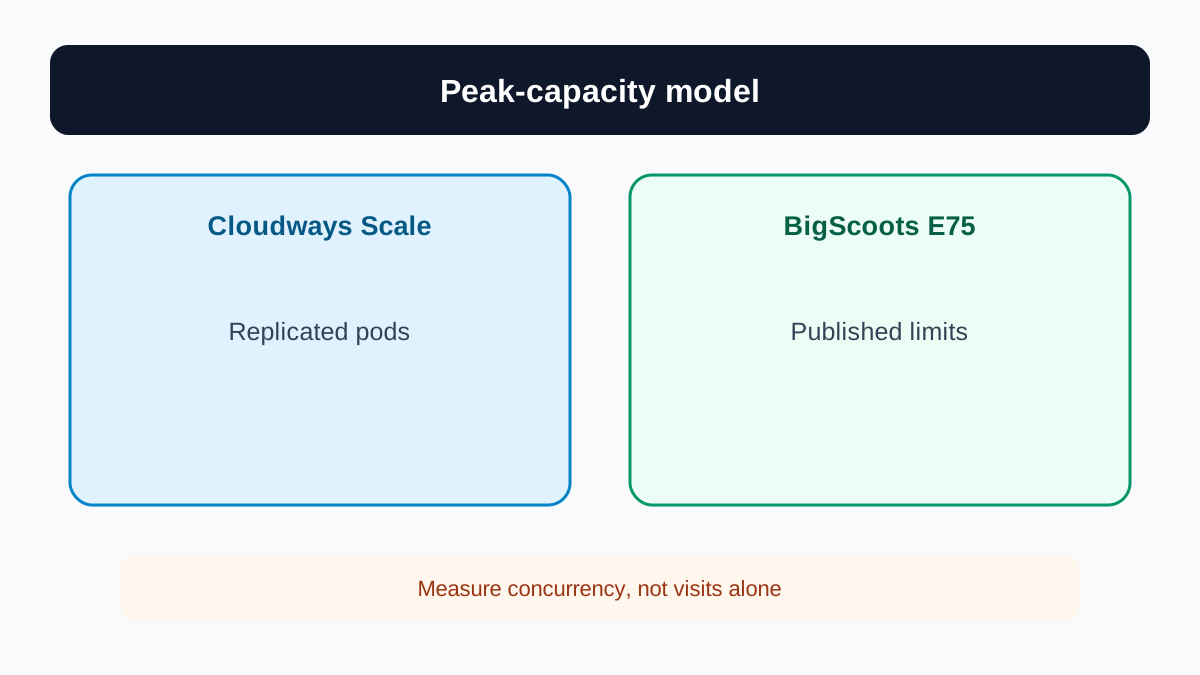
Scale is one application with two baseline autoscale servers, 50GB disk and 250GB bandwidth. When demand rises, Autonomous can create replicated pods with their own CPU, RAM and PHP workers, then remove them when demand falls.
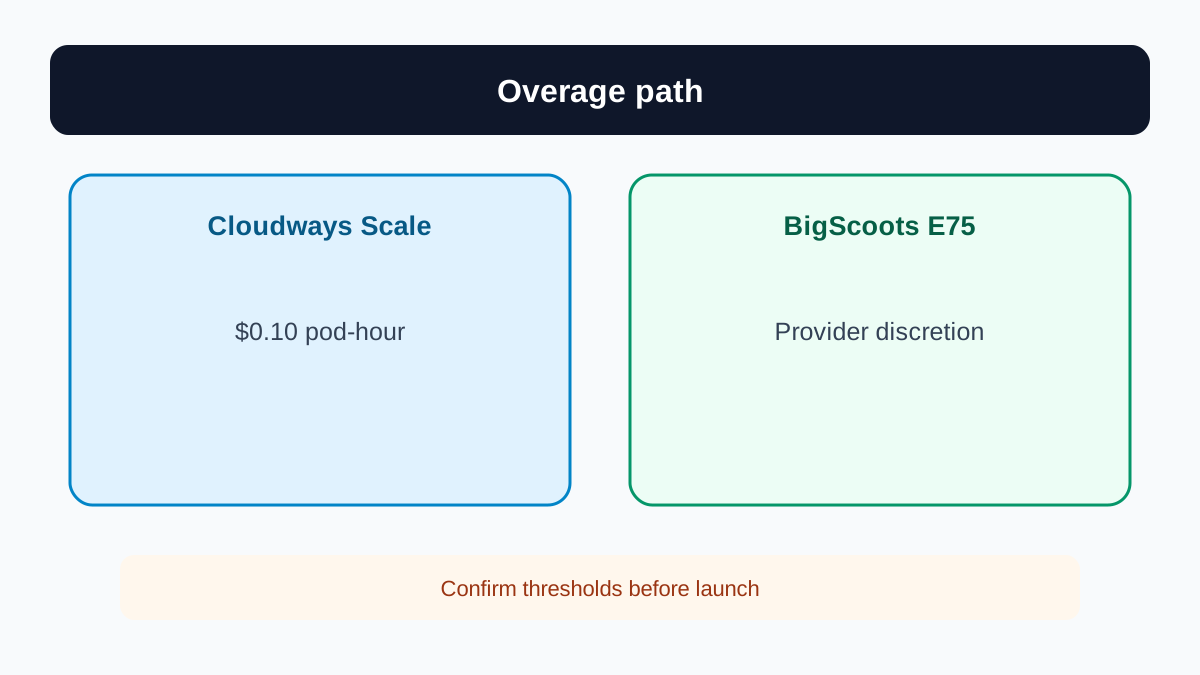
Extra Scale containers cost **$0.10 per container-hour**. Disk beyond the allowance is **$1 per GB per month**, prorated hourly; bandwidth beyond the allowance is **$0.04 per GB**; visits themselves are not billed.
Example: four extra containers running for three hours add **$1.20**. That is inexpensive for a short burst, but a recurring baseline mismatch can compound. Set an autoscaling budget threshold and monitor the dashboard instead of treating $199 as a guaranteed all-in ceiling. An independent Autonomous review reaches the same operational conclusion: one app per plan and active budget monitoring matter.
The useful Cloudways question is: “What is the value of staying responsive during our worst simultaneous checkout window?” Average monthly visits alone cannot answer it.
What BigScoots E75 actually buys
Essential 75 includes one WordPress site, free migration and staging, a Cloudflare-powered CDN, 75,000 monthly visitors, 10GB local storage and 150GB bandwidth. The public offer is simple to budget: $35 monthly or $350 annually.
The visitor allowance is a plan boundary, not a promise that every 75,000-visit store will behave identically. A cache-friendly catalog and a plugin-heavy store with expensive uncached checkout requests can put very different pressure on hosting.
BigScoots' terms say short, non-recurring overages **may** be permitted without an immediate plan change or fee, at BigScoots' discretion. Repeated or sustained overages can lead to an upgrade requirement, current overage fees, a request to reduce usage, throttling or other action. Do not turn “may permit” into “free burst capacity.”
Support model: human help versus automated capacity
BigScoots is the clearer fit when the team wants a WordPress-focused provider to help with migration and day-to-day platform questions. Its public page includes migration and staging, while an independent managed-host review highlights support as a strength. Exact application-development work and emergency response scope should still be confirmed in writing.
Cloudways Autonomous removes capacity planning from the critical path: the platform adds and removes pods automatically. That does not eliminate operational work. Teams must still own WooCommerce releases, plugin compatibility, checkout monitoring, database behavior and cost thresholds.
Cloudways is automation-first; BigScoots is support-first. Neither label proves a faster store.
Traffic spikes and the limit mismatch
The plans meter different things. TechRadar also warns that separate add-ons can make the final Cloudways bill harder to predict. Cloudways does not charge for visits under its new model, but it charges for extra containers, disk and bandwidth. BigScoots publishes visits, storage and bandwidth as plan limits and handles temporary or sustained excess under its terms.
That makes a direct “cost per visitor” calculation misleading. A 100,000-visit content-heavy store may be easier than a 30,000-visit subscription store with uncached account pages and synchronized renewal jobs.
Use these measurements instead:
1. Peak concurrent sessions and checkout requests. 2. Uncached PHP response time during campaigns. 3. CPU, database and queue saturation during the busiest fifteen minutes. 4. Storage and bandwidth growth by billing period. 5. Revenue lost per minute when checkout becomes slow or unavailable.
Break-even: the $2,038 question
Cloudways' annual base premium over BigScoots annual billing is $2,038. It breaks even only if the autoscaling model avoids more than that amount in expected downtime, abandoned checkouts, emergency engineering or premature manual upgrades.
For a store earning $100 gross profit per hour, the premium equals roughly **20.4 hours** of gross profit. At $500 per hour, it equals about **4.1 hours**. Those are sensitivity examples, not promises that either host prevents a specific outage.
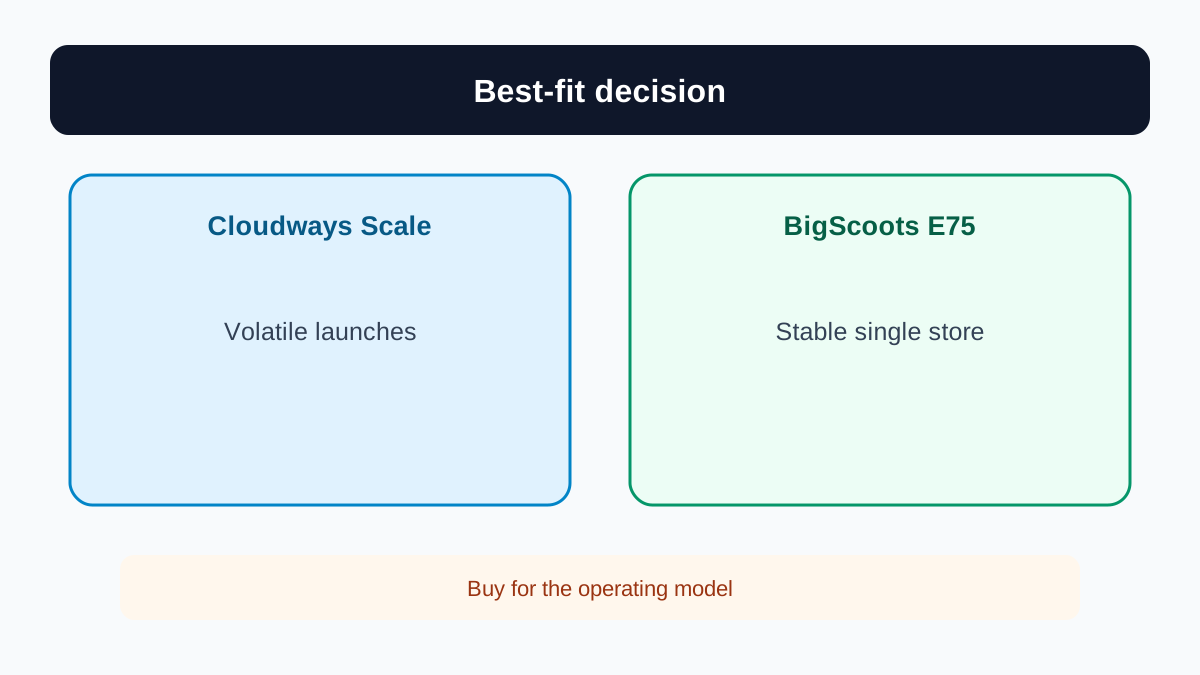
If the store has never saturated its current host and campaigns are predictable, BigScoots is the rational default. If launches can create sudden, revenue-critical concurrency and the team can observe cost and application behavior, Cloudways Scale may be the safer capacity purchase.
Independent evidence: useful but not plan proof
Hostingstep's long-running Autonomous test and load test support the proposition that the architecture can handle concurrent requests, but its tested plan and lightweight WordPress workload are not this WooCommerce Scale purchase.
The Inspry benchmark includes both BigScoots and a Cloudways configuration on a large WooCommerce data set, but at different configurations and prices from E75 and Autonomous Scale. Servebolt's version explicitly warns that plugins, cacheability, geography and support needs can change the outcome.
Use these sources to design a trial. Do not copy their rank into a guarantee.
Who should buy which plan?
Choose BigScoots Essential 75 if:
- one store fits the published 75k/10GB/150GB limits; - $350 annual billing materially improves margins; - migration and human WordPress support are more valuable than automatic replicas; - the team can monitor limits and discuss upgrades before usage is sustained.
Choose Cloudways Autonomous Scale if:
- launches or campaigns create unpredictable concurrent demand; - one revenue-critical application justifies a $199 monthly base; - the team will set autoscaling budgets and watch disk and bandwidth; - automatic pod replication is worth more than the $2,038 annual base premium.
Delay both if you cannot produce peak-load measurements, a rollback plan, a recent restore test and a realistic downtime-cost estimate.
Checkout and migration checklist
1. Save the exact plan, billing cadence, amount due and renewal date. 2. Confirm one-application/one-site scope and staging behavior. 3. Record storage, bandwidth and visitor or autoscaling boundaries. 4. Ask BigScoots how sustained E75 overages are priced today. 5. Set Cloudways autoscaling budget thresholds before a campaign. 6. Run a copy of the real store with checkout, search, scheduled actions and payment webhooks. 7. Keep an independent backup and a DNS rollback plan.
Bottom line
**BigScoots E75 is the value choice for one managed store inside known limits. Cloudways Scale is the resilience choice for volatile, revenue-critical concurrency.** Do not pay six times more for a vague promise of speed; pay for autoscaling only when peak-demand economics justify it.
Commercial links use only the exact Toolnavia plan routes. No coupon code or guaranteed performance result is claimed; live checkout and account terms control.