TOOLNAVIA / BUYING GUIDE
Cloudways Growth vs BigScoots Essential 75: Autoscale or 75K Cap?
The short answer
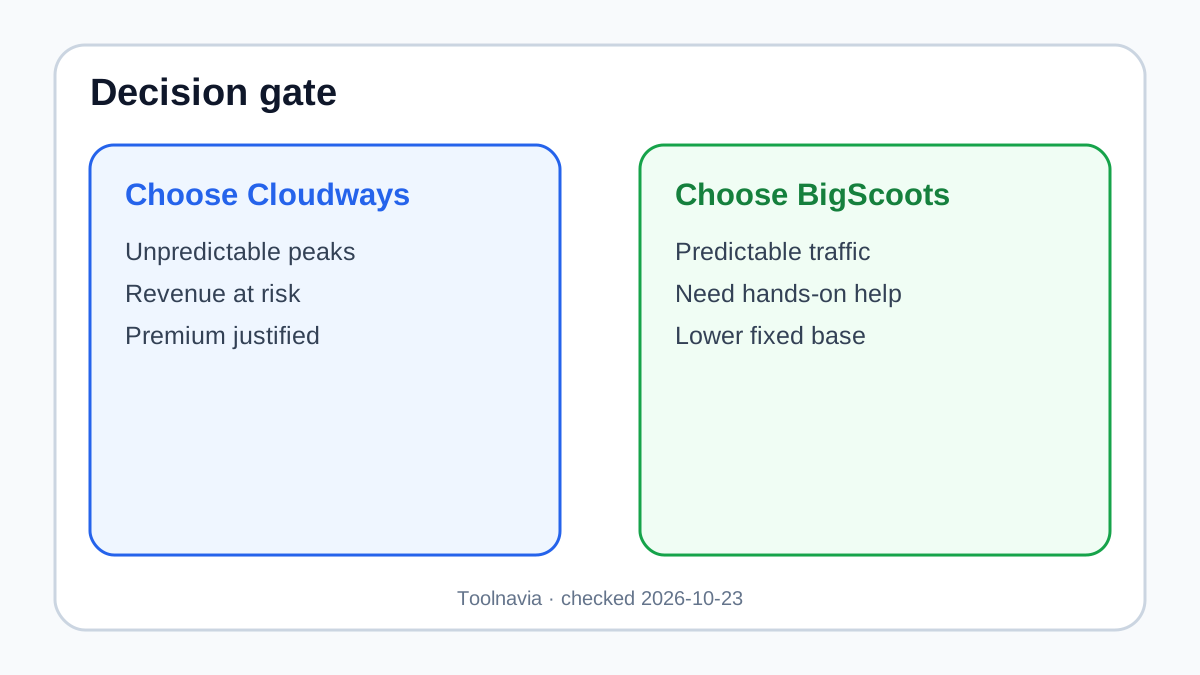
**Quick answer:** Choose BigScoots Essential 75 for a predictable site below **75,000 monthly visitors**; choose Cloudways Autonomous Growth only when unpredictable peaks make automatic scaling worth a much higher base.
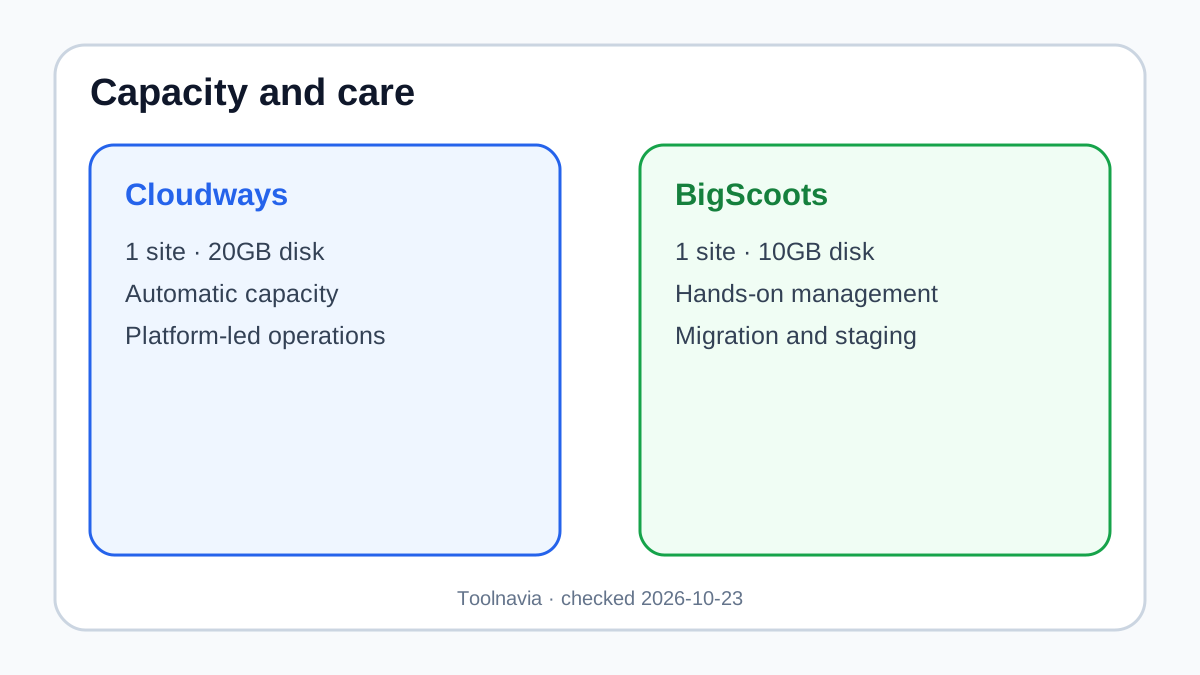
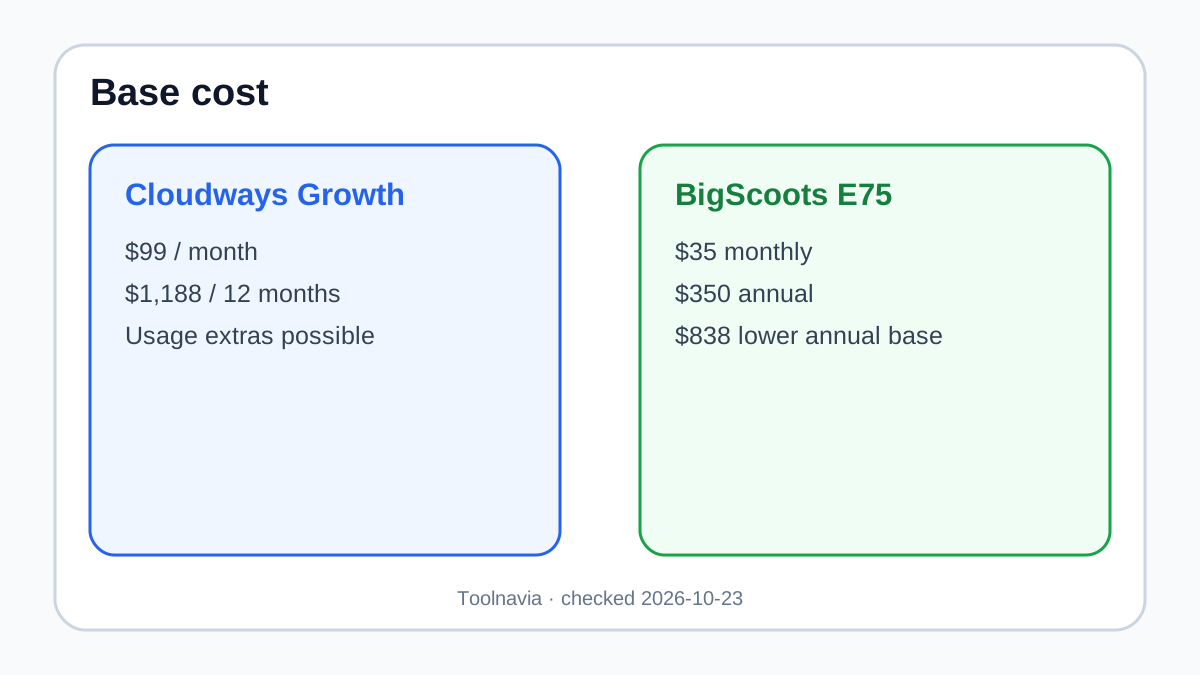
BigScoots is **$35 monthly or $350 annually**, with **10GB storage and 150GB bandwidth**. Cloudways is **$99/month**, with **20GB disk, 150GB bandwidth, unmetered visits and automatic scaling**.
The annual base gap is **$768** against twelve BigScoots monthly payments or **$838** against its annual option. That premium needs a measurable peak-risk or operational benefit.
At a glance
- Best for
- One-site buyers deciding whether unpredictable peak risk justifies Cloudways autoscaling over BigScoots' lower fixed 75K-visitor plan.
- Price model
- Cloudways Growth is $99/month. BigScoots Essential 75 is $35 monthly or $350 annually, before optional services and plan changes.
- Check first
- No private checkout, universal performance, unlimited-bandwidth or zero-overage guarantee.
The cost floor before traffic moves
Cloudways Growth's live plan card lists $99 per month. Twelve base months are $1,188 before extra autoscale servers, storage, bandwidth, tax or paid add-ons. BigScoots is $420 when paid monthly or $350 when paid annually.
This is a base-cost model, not a checkout receipt. The BigScoots public page says the displayed hosting prices include tax, but a configured cart can still contain optional resources or services. Cloudways usage and account details can change the invoice. Verify both final summaries before purchase.
The separate Cloudways **$25 Advanced Support** promotion is not a $25 Growth hosting plan. It discounts an optional support add-on and must not be used to reduce the hosting comparison.
Visitor cap versus autoscaling
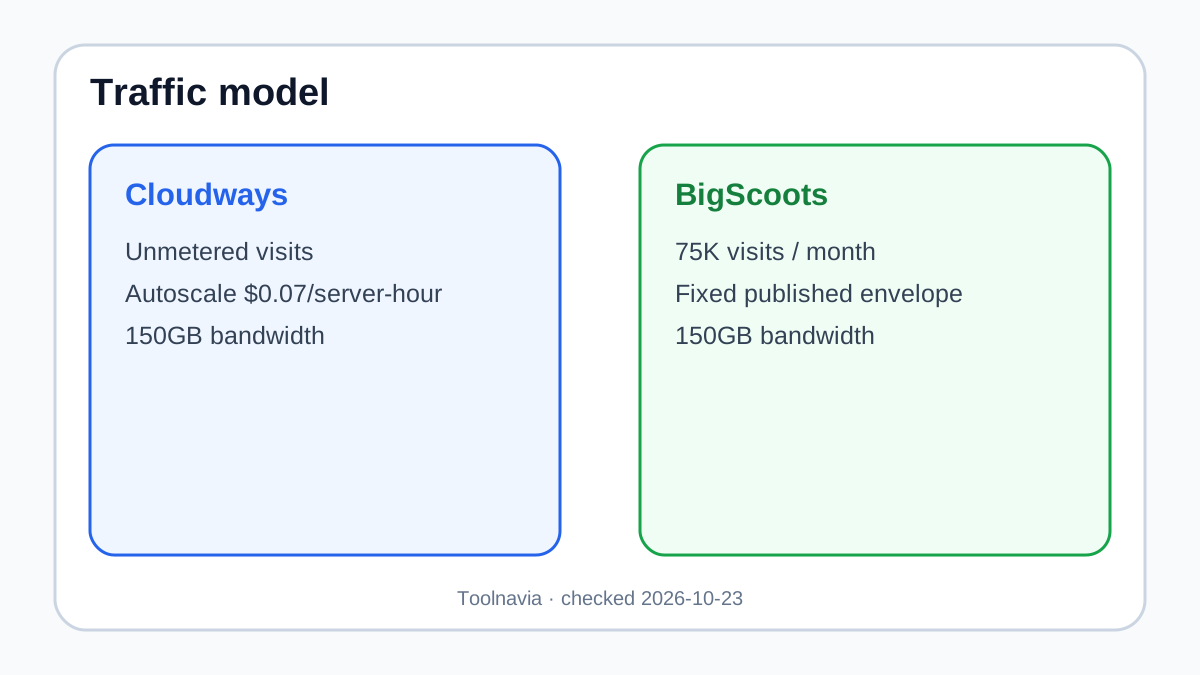
BigScoots publishes a 75K monthly-visitor allowance for Essential 75. That makes capacity planning understandable: compare analytics with the allowance, leave headroom for growth, and ask what happens if a month exceeds it.
Cloudways publishes unmetered visits, but that does not mean unlimited resources or a flat bill under every peak. Growth includes one baseline server; additional autoscale servers are billed at $0.07 per hour. Storage beyond the included amount and bandwidth beyond the plan allowance can also add cost.
For illustration, one extra server for 100 hours adds $7. One extra server running for a 730-hour month adds $51.10. These are arithmetic scenarios, not forecasts. Real scale-out duration and server count depend on the workload.
Capacity is not a simple winner
Both plans are for one site and both list 150GB bandwidth. Cloudways lists 20GB disk, twice BigScoots' 10GB. Cloudways' material focuses on Kubernetes-based autoscaling and high availability. BigScoots emphasizes hands-on WordPress management, migration, staging, CDN and direct support.
Unmetered visits can be valuable when traffic is bursty, but 150GB bandwidth still creates a transfer boundary. A media-heavy campaign may hit bandwidth before visit count becomes the main issue. Conversely, a light, cacheable page can serve many visits without needing long scale-out periods.
No public plan table proves which host will be faster for your site. Themes, plugins, cacheability, database work, geography and third-party calls all matter. Current reviews help define the operating models, not guarantee your result. A fresh independent plan review also corroborates Growth's $99 base and published capacity.
The break-even question
Cloudways costs $838 more per year than BigScoots' annual option before Cloudways usage extras. To justify Growth, estimate the business value of avoiding manual intervention during a peak.
Suppose a launch produces four hours of extra capacity across two additional servers. At $0.07 per server-hour, the extra charge is only $0.56, but the $99 base still applies. The stronger economic argument is not cheap burst hours alone; it is reducing the chance that a valuable peak overwhelms a fixed environment.
If the site earns little during peaks, the insurance may not justify the base premium. If one failed promotion, ticket launch or checkout event could cost more than $838, automatic capacity deserves a controlled test.
Support and operating responsibility
BigScoots' differentiation is hands-on managed WordPress help. Its official material promises proactive monitoring and optimization; independent owners frequently praise responsive support. Those are useful signals, not a private service-level guarantee.
Cloudways also manages WordPress infrastructure, but Autonomous is sold around platform automation and scaling. Buyers still need to understand usage, cache behavior, application health and the bill. A more automated platform does not remove the need for backups, monitoring or a rollback plan.
Choose by the operational gap your team actually has. A small team may gain more from a person who knows the site than from automatic capacity it rarely uses. A campaign-driven business may value automatic scale more than a cheaper predictable envelope.
A five-step traffic test
1. Export twelve months of analytics and mark normal monthly visitors, bandwidth and the largest hourly peak. 2. Identify the business events that create peaks: launches, email sends, ad bursts, ticket sales or viral content. 3. Clone the site, align CDN and cache settings, and test uncached paths such as search, cart, checkout and logged-in pages. 4. Model the BigScoots $350 annual base against Cloudways' $1,188 base plus realistic extra server-hours. 5. Choose Cloudways only when measured peak risk and reduced intervention are worth the premium; otherwise keep the lower BigScoots base.
Ask both providers about overage handling, migration, backup retention, support scope and cancellation before moving production.
Who should choose BigScoots
Choose Essential 75 when the site fits comfortably below 75K monthly visitors, bandwidth stays within 150GB, traffic is fairly predictable and hands-on WordPress care is a priority. The $350 annual price creates the clearest cost floor.
Do not select it merely because it is cheaper. Keep traffic headroom, verify how bursts and overages are handled, and plan an upgrade path before a campaign forces the decision.
Who should choose Cloudways
Choose Growth when one site has unpredictable peaks, missed peak traffic has real business cost, and automatic scaling is worth at least $768–$838 more per year before usage extras. It also fits teams wanting 20GB disk and a platform designed to add capacity automatically.
Do not read “unmetered visits” as “unlimited everything.” Bandwidth, disk, extra servers and add-ons remain billable boundaries.
Bottom line
**BigScoots Essential 75 is the value and support default** for a predictable single site inside its visitor and storage envelope.
**Cloudways Autonomous Growth is the peak-risk purchase** for a single revenue site that can justify a much higher base in exchange for automatic capacity.
Verify live plan labels, checkout totals, overage rules and support scope on the purchase date. Prices and limits here were checked on 2026-10-23.