TOOLNAVIA / BUYING GUIDE
pCloud Lifetime: 99 Years—but Can You Transfer the Account?
The short answer
Affiliate disclosure: This guide contains a verified pCloud affiliate link. If you buy through it, Toolnavia may earn a commission at no extra cost to you. That relationship does not change the verdict; the contract and checkout page control.
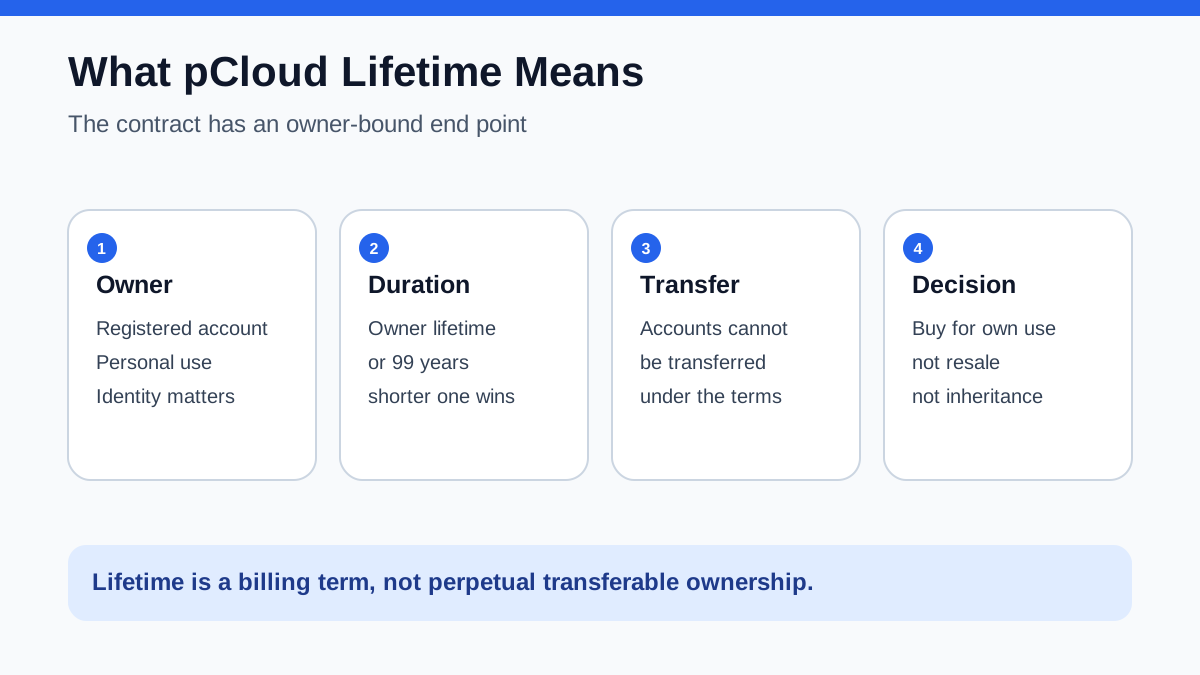
pCloud “Lifetime” is not a transferable storage asset that lasts forever. The current contract defines it as the lifetime of the account owner or 99 years, whichever is shorter, and says user accounts are not transferable. The decision is therefore more specific than annual versus one-time price: you are prepaying for your own use of one account, subject to pCloud continuing the service and to the account rules.
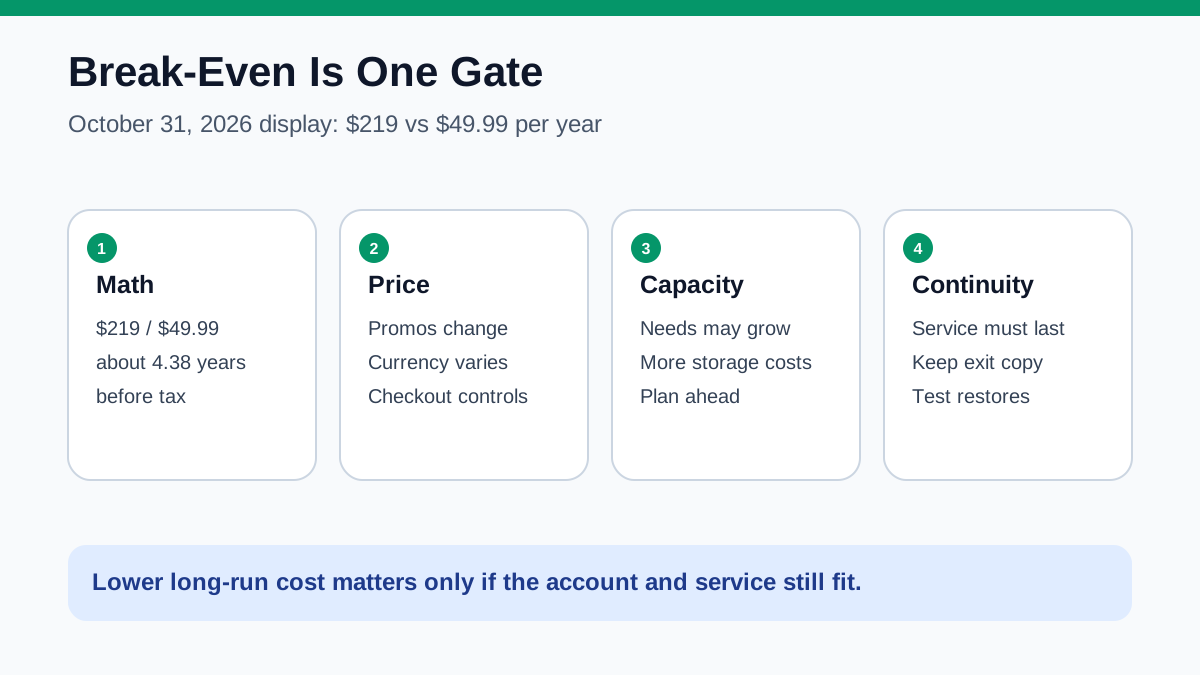
At the official prices rechecked on November 1, 2026, Premium 500 GB showed $49.99 per year. The general Lifetime route displayed $219, while another official custom/campaign route displayed $199. The general-route pre-tax break-even is about 4.38 years ($219 ÷ $49.99); the $199 route is about 3.98 years. Use the price and terms shown in your actual checkout.
At a glance
- Best for
- Long-term personal buyers with stable capacity needs who accept an owner-bound, non-transferable account.
- Price model
- Annual $49.99; Lifetime $219 general route or $199 on another official route; checkout controls.
- Check first
- Accounts are non-transferable; no inheritance workflow was found; official Lifetime routes show different current prices and promotion refund terms can differ.
Quick verdict
The Premium reference plan is 500 GB with 1,000 GB of monthly shared-link traffic. Six external pages were reviewed for recurring buyer questions and stale-price risks—not as authority over pCloud's contract or checkout.
Choose pCloud Lifetime only when all four statements are true:
1. You expect to use the same personal account longer than the current break-even period. 2. You can pay upfront and still keep an independent copy of important files. 3. The storage tier is likely to remain sufficient. 4. You do not need the account or Lifetime entitlement transferred later.
Choose annual billing if your horizon, capacity or provider preference is uncertain. Do not buy Lifetime as an inheritance plan: the official material reviewed here contains a non-transfer rule and no documented inheritance workflow. Estate-specific questions should go to pCloud support before purchase.
What “Lifetime” legally means
The official definition has two endpoints: the account owner’s lifetime and 99 years. The earlier endpoint controls. “Lifetime” therefore does not mean perpetual service, ownership of infrastructure or a right that automatically passes to heirs.
The same terms say accounts are not transferable and only the registrant may use the account. A promotion page separately says plan transfers between accounts are not allowed. That limits resale, gifting and succession value.
This guide does not invent what happens after death. The reviewed official pages do not provide a formal inheritance procedure. The defensible conclusion is narrower: the account is owner-bound, transfer is prohibited, and anyone buying for estate continuity needs written guidance from pCloud.
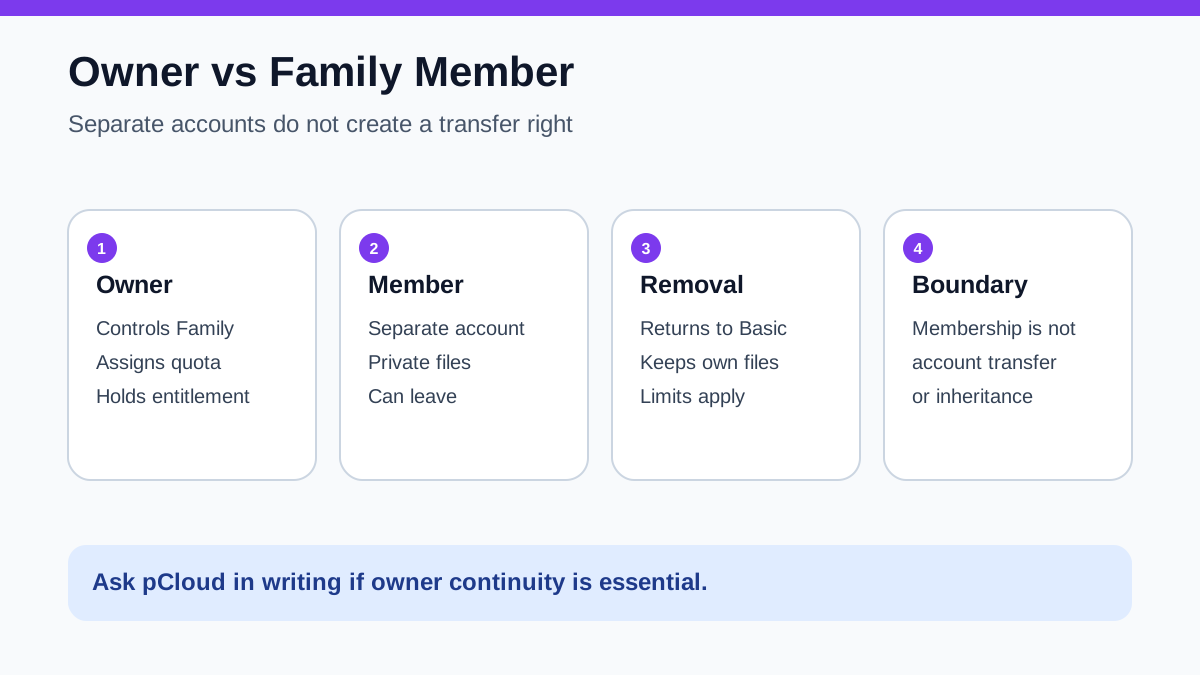
Family membership is not an account transfer
pCloud Family can invite up to four members. The owner assigns storage quotas, while each member keeps a separate private account. A member who leaves or is removed keeps the account and files but returns to Basic, subject to storage limits.
That means:
- Family membership gives a separate member account access to owner-controlled capacity. - Personal account transfer is prohibited by the terms reviewed here. - Business ownership workflows belong to a separate product. - No formal personal Lifetime inheritance process was found.
If several people need continuity, evaluate Family on its own terms. The deletion help page warns that deleting a Family owner account may affect the whole Family plan and member accounts.
Break-even is useful arithmetic, not the whole decision
| Premium 500 GB option | Displayed price | What it buys | |---|---:|---| | Annual | $49.99 per year | One year, renewing unless canceled | | Lifetime | $219 general route; $199 on another official route | Owner lifetime or 99 years, whichever is shorter |
The general-route arithmetic is $219 ÷ $49.99 = 4.38 years. At an actual $199 checkout, it is about 3.98 years. These are two current official displays, not a guaranteed discount. If prices stayed unchanged and you kept using the account, the nominal break-even would arrive around year four or five.
Adjust that number for:
- tax and currency at checkout; - promotion and refund conditions; - the risk that capacity needs grow; - unused prepaid subscription value; - the opportunity cost of paying today; - provider continuity after break-even; - the time and storage needed to export a large library.
Independent reviews commonly place break-even around three to five years, but they use different dates, regions and promotions. Use the live checkout amount rather than an old review table.
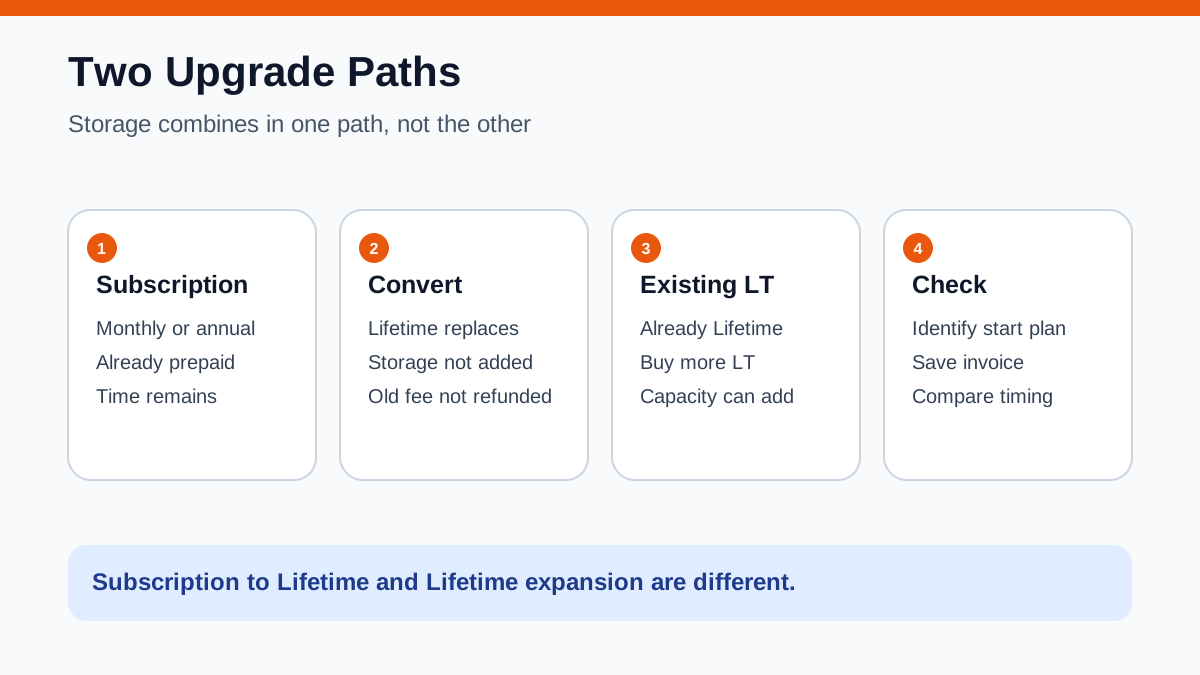
Two upgrade paths that should not be confused
Monthly or annual to Lifetime
pCloud says moving from monthly or annual to Lifetime replaces the subscription. Storage does not combine, and the prior subscription payment is non-refundable. Someone who paid for a year yesterday could lose most of that prepaid value by converting today.
Before converting, record remaining time, compare waiting until renewal, confirm capacity, save the invoice and read the exact refund terms.
Lifetime to a larger Lifetime capacity
The Lifetime-upgrade help describes another path: purchasing additional Lifetime storage can add to an existing Lifetime allocation. Its example turns 500 GB plus a new 2 TB purchase into 2.5 TB. That is not a contradiction; subscription conversion and Lifetime expansion are different transactions.
Refunds: 14 days, with a promotion caveat
The general terms describe a 14-calendar-day money-back guarantee, but reserve the right to decline a refund for promotional or discounted purchases. A specific Family promotion explicitly allowed refunds during its first 14 days.
Promotion-specific terms can differ, so “14-day refund” is not unconditional. Save the exact checkout terms, note the payment date, test core functions immediately and submit any request in writing inside the stated window. Canceling a subscription is not automatically a refund request.
Inactivity, deletion and service continuity are separate
The current deletion help says Premium, Premium Plus and Lifetime accounts are not deleted for inactivity. That reduces one risk but does not make the plan immortal.
Voluntary deletion is different. The page says files are scheduled for deletion, describes a three-month recovery period and tells users to download important files first. Provider continuity is different again: a one-time plan has value only while the service and account remain usable.
A sensible Lifetime buyer keeps:
- one local copy under personal control; - another copy elsewhere for irreplaceable data; - an inventory of cloud-only folders; - periodic restore tests; - securely stored recovery information for the owner.
Who should buy pCloud Lifetime
Lifetime can fit someone with stable personal storage needs who expects to stay beyond the live-price break-even, has tested pCloud’s workflow, can pay upfront without cutting the backup budget, accepts non-transferability and can add capacity later if necessary.
The verified affiliate route is [View pCloud plans](https://partner.pcloud.com/r/157872). Check price, currency, tax and refund language before paying.
Who should stay annual—or choose another structure
Annual billing is safer if you may leave within four or five years, storage needs change quickly, you recently prepaid for a year, or budget flexibility matters more than long-run arithmetic.
Choose another structure when transfer, succession or organizational ownership is essential. If client-side zero-knowledge protection is required, compare the separate pCloud Encryption cost rather than assuming Premium includes every privacy feature.
For workflow details, see [pCloud Drive vs Sync vs Backup](/software/pcloud-drive-sync-backup-500gb). For tier pricing, read [pCloud Premium 500 GB pricing](/software/pcloud). For exit planning, use [Canceling pCloud Premium safely](/software/pcloud-premium-cancellation-data-exit). Region-sensitive buyers should read [pCloud EU or US](/software/pcloud-eu-us-region-before-buying).
Five-minute pre-purchase checklist
1. Confirm the intended owner and account email. 2. Read the current Lifetime definition and non-transfer clause. 3. Record annual and Lifetime totals in the same currency. 4. Add tax and unused subscription value to the break-even. 5. Identify whether this is subscription conversion or Lifetime expansion. 6. Save refund and promotion terms. 7. Test the free account with representative files. 8. Keep an independent backup and exit plan. 9. Ask pCloud in writing if Family continuity or estate handling matters. 10. Buy only when the owner-bound risk is acceptable.
Bottom line
At the November 1, 2026 official displays, Premium 500 GB was $49.99 annual, while Lifetime appeared at $219 on the general route and $199 on another official route. The nominal break-even is therefore about 4.38 or 3.98 years, depending on the checkout actually offered. The more important limit is contractual: Lifetime ends at the owner’s lifetime or 99 years, whichever is shorter, and the account is not transferable.
That may still be rational for one person with stable needs and independent backups. It is not a perpetual, transferable asset. Treat price, refund terms, capacity and owner-bound risk as one decision.