TOOLNAVIA / BUYING GUIDE
Namecheap Quasar vs UltaHost Basic: Is 1GB Enough?
The short answer
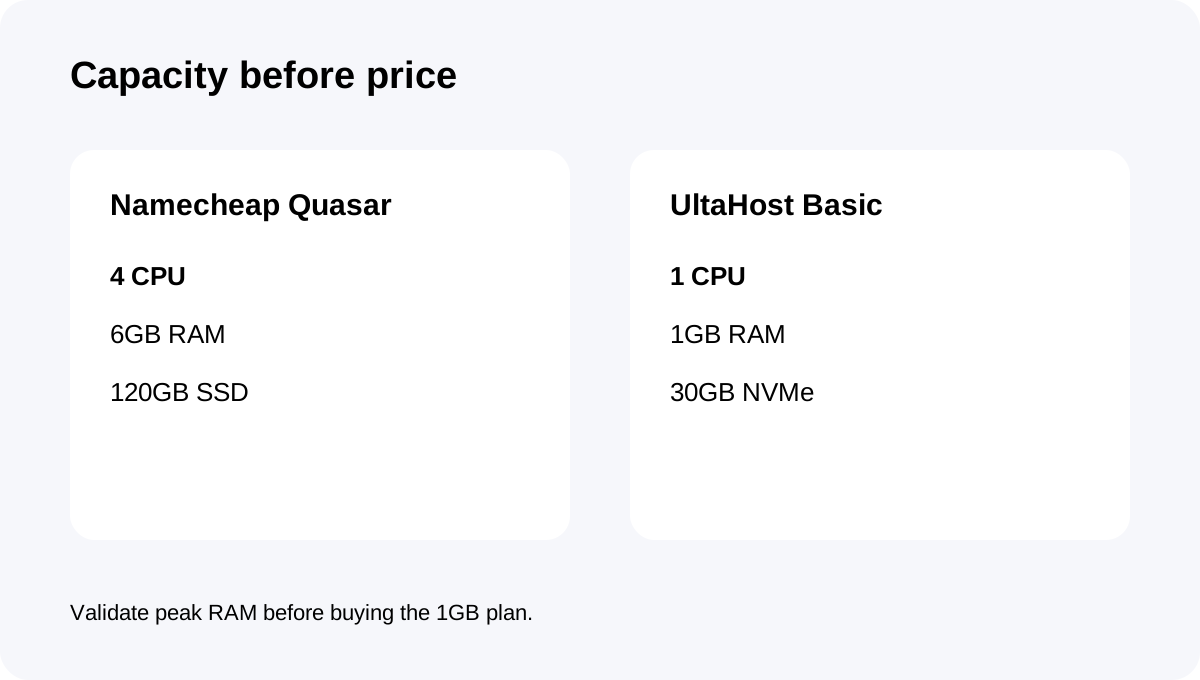
Namecheap Quasar with Complete management and cPanel Solo and UltaHost VPS Basic both look like managed cPanel VPS purchases, but they solve different capacity problems. The Namecheap stack has **4 CPU cores, 6GB RAM, 120GB SSD and 3TB transfer**. UltaHost Basic has **1 CPU, 1GB RAM and 30GB NVMe**. The lower UltaHost number is attractive only if 1GB is genuinely enough.
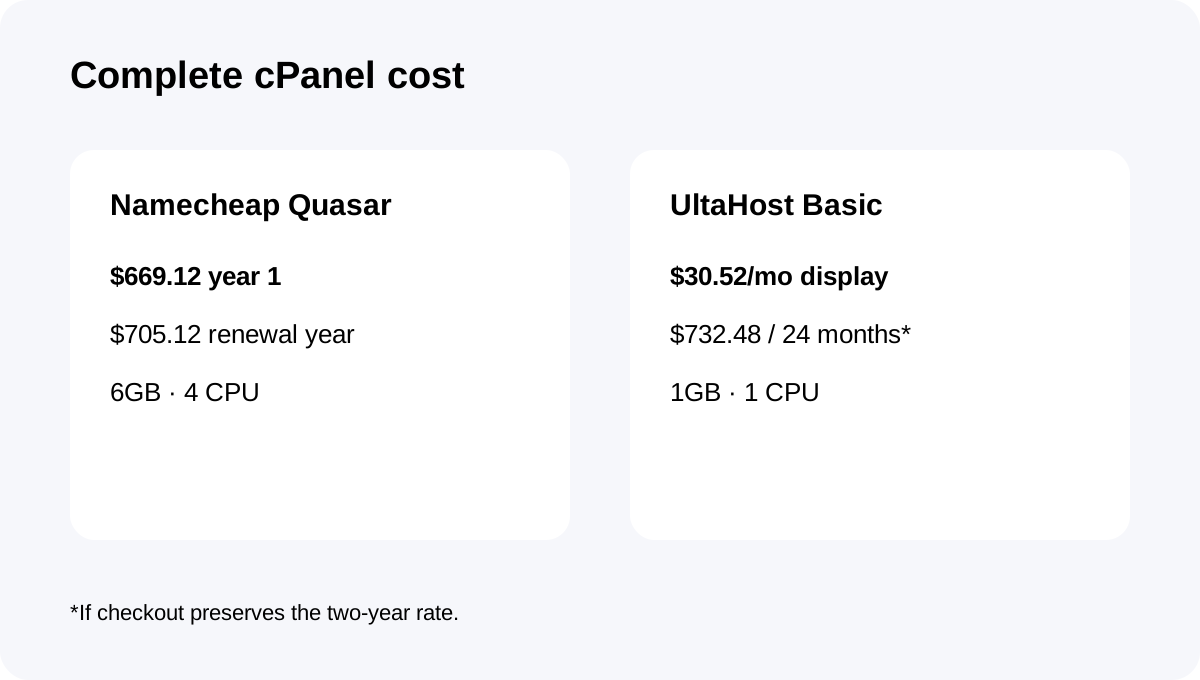
For a cPanel comparison, Namecheap's first annual year is **US$154.56 server + US$300 Complete + US$214.56 cPanel Solo = US$669.12**. A renewal-year planning total is **US$705.12**. UltaHost's cPanel Basic page displays **US$30.52/month on the two-year selection**, or US$732.48 over 24 months if that rate and term survive checkout. Namecheap's first two years total US$1,374.24 at today's published components—a US$641.76 gap—but it supplies six times the memory and four times the CPU.
At a glance
- Best for
- Buyers validating whether a 1GB managed VPS is enough before paying for a 6GB cPanel stack.
- Price model
- Namecheap US$669.12 first annual managed Solo year; UltaHost cPanel Basic US$30.52/month two-year display
- Check first
- No benchmark; checkout controls price; UltaHost two-year VPS and cPanel refund exclusions apply; Namecheap Complete removes root.
Quick verdict
Choose **UltaHost VPS Basic** when a light site, small control panel footprint or staging workload fits inside 1GB RAM, the two-year commitment is acceptable, and you verify the exact panel and invoice in checkout.
Choose **Namecheap Quasar + Complete + cPanel Solo** when the workload already needs several gigabytes of memory, four cores and more local storage, or when paying more now is safer than migrating immediately after a 1GB ceiling.
This is not a speed benchmark. CPU model, host contention, storage implementation and application tuning are unknown. The decision is capacity, support boundary, refund exposure and verified checkout—not a claimed fastest host.
Compare the complete cPanel cost
Namecheap's primary Quasar grid shows US$12.88/month billed yearly: US$154.56 up front for the server and US$190.56 at annual renewal. Complete management adds US$25/month, and cPanel Solo adds US$17.88/month. That makes the first-year planning total US$669.12 and the renewal-year total US$705.12, before tax or optional extras.
The same Namecheap page also exposes US$15.88 in a comparison table, while its renewal notice lists US$18.88 for monthly renewal. These are not interchangeable. This article uses the explicit annual purchase and renewal figures for annual math, and treats **US$61.76**—US$18.88 + US$25 + US$17.88—as the steady monthly renewal-path model. Checkout controls the actual first invoice.
UltaHost's plain Basic page displays US$5.52/month on a two-year selection. Its cPanel page displays US$30.52/month and includes five cPanel accounts. The US$25 difference is why a US$5.52 headline is not a like-for-like cPanel comparison.
The 1GB threshold matters more than the price gap
UltaHost Basic's 1GB can fit a small static site, a light control panel, a test server or a carefully tuned low-traffic application. It leaves little room for a database, PHP workers, mail services, security agents and traffic spikes at the same time. A buyer who must upgrade soon has not really saved the headline difference.
Quasar's 6GB, four cores and 120GB disk give a broader operating envelope, consistent with Namecheap's own plan-selection guidance. That does not guarantee better real-world speed, but it reduces the chance that memory alone forces an immediate plan change.
Before buying, measure current peak RAM, swap use, CPU saturation, disk growth and backup size. If the workload already peaks above roughly 700–800MB before adding cPanel services, Basic deserves a migration test rather than an optimistic purchase.
“Managed” is not one universal service
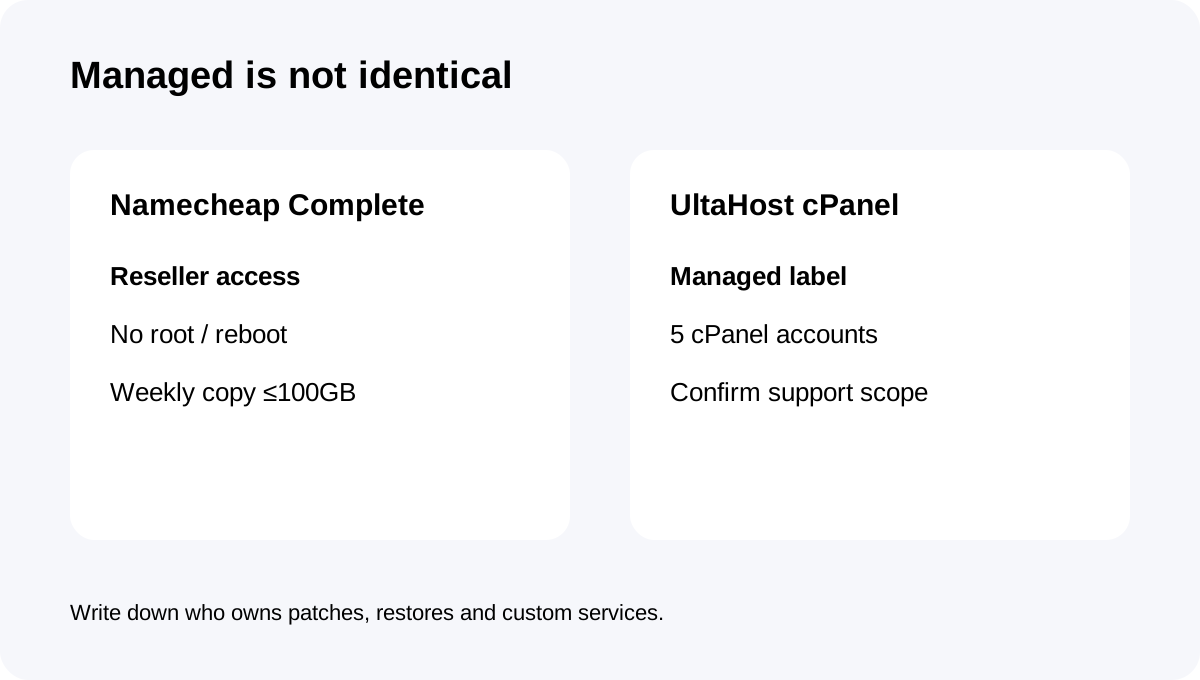
Namecheap Complete includes monitoring, core-service work, incident root-cause handling, server-failure restoration, cPGuard and one weekly offsite copy up to 100GB when the data fits. The trade-off is important: the customer gets reseller WHM/cPanel access, not root, reboot or SolusVM access. Third-party software installation is outside the included scope.
UltaHost labels the cPanel Basic configuration fully managed and includes five cPanel accounts. The public plan page does not define every application, migration, malware cleanup or third-party daemon the support team will own. Ask for written confirmation if a specific stack is business-critical.
The plans therefore should not be reduced to “managed versus managed.” Write down who patches the OS, restores data, diagnoses application failures, supports custom services and controls root credentials.
Refund badges do not remove term risk
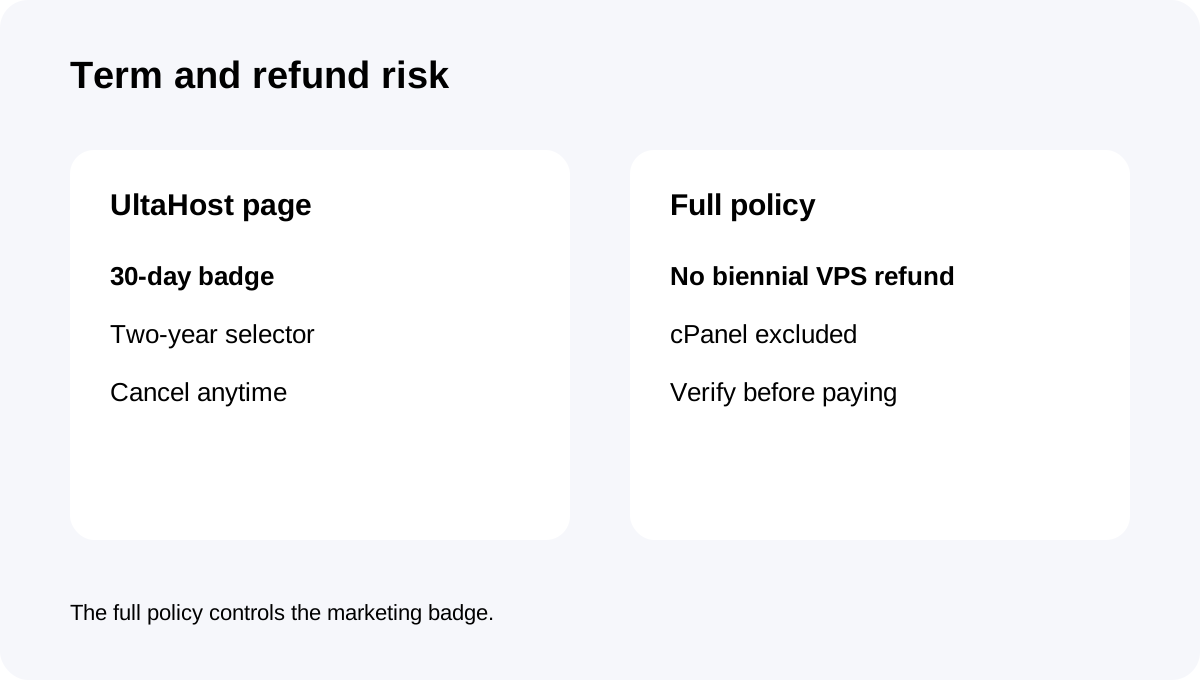
UltaHost's VPS and cPanel pages display a 30-day money-back badge, but the full policy says yearly, biennial and triennial VPS plans are not refundable. It also excludes cPanel and other paid panels. Because the US$30.52 display is tied to the two-year selector, treat that configuration as a commitment until the cart and support confirm otherwise.
Namecheap advertises a 30-day VPS guarantee, but management, licenses, taxes and renewal treatment still need confirmation in the order. Do the restore, mail, cron, DNS and load tests before moving production.
Upgrade economics
If UltaHost Basic passes a real load test, its cPanel configuration can preserve substantial cash. If it fails, compare the next UltaHost tier that actually matches the measured workload—not Basic's headline—against Quasar. A one-time migration, DNS cutover and emergency upgrade can erase part of the initial saving.
Quasar's extra capacity is not automatically worth US$641.76 over the first two years. It is worth the premium only when the workload uses the headroom, the included weekly backup fits the recovery plan, and reseller-level access is acceptable.
Evidence and market context
Two independent pages surface the Namecheap-versus-UltaHost choice, so the provider-selection intent is real. Their scores and broad catalog claims are not imported because neither binds the exact Quasar Complete/Solo stack to the exact Basic cPanel configuration. Official product and policy pages control the facts here.
Checkout checklist
For **Namecheap**, confirm Quasar billing cycle, first payment, renewal, Complete, AlmaLinux, cPanel tier, account count, reseller-only access, backup usage, data center, taxes and total due.
For **UltaHost**, confirm Basic, location, monthly versus two-year selection, whether the invoice is prepaid, control panel, five-account limit, management scope, renewal, cancellation date and the written refund exclusion.
**Bottom line:** UltaHost Basic is the budget fit for a verified 1GB workload. Namecheap Quasar is the higher-cost capacity choice. Buy the workload envelope, not the smallest number on either page.