TOOLNAVIA / BUYING GUIDE
InterServer One Slice Network Cost: 2TB, Shared 10Gbps and $3 IPv4
The short answer
At a glance
- Best for
- Small self-managed workloads below 2TB with one public IP.
- Price model
- $3/month includes 2TB, shared 10Gbps and one public IP; extra justified IPv4 currently $3/month.
- Check first
- Post-2TB policy is not published; shared 10Gbps is not guaranteed; extra IPv4 needs justification.
Quick verdict
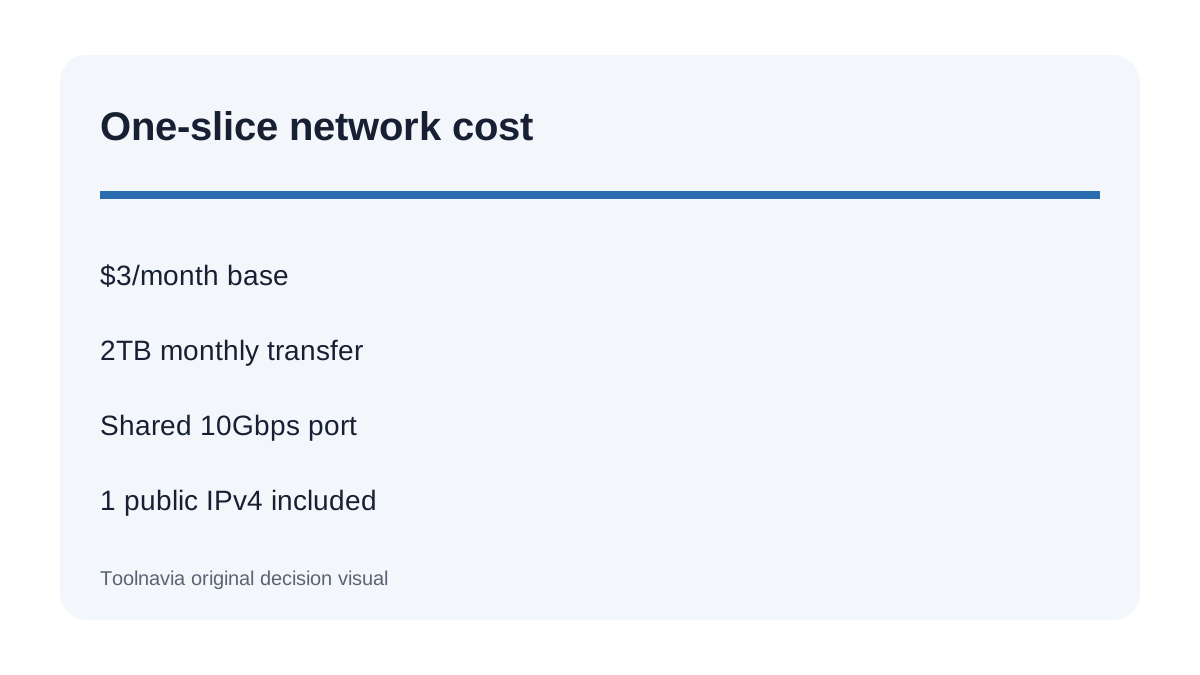
InterServer's one-slice Linux Cloud VPS currently costs $3 per month and lists 2TB monthly transfer, a **shared** 10Gbps port and one public IP. A second justified IPv4 is currently another $3 per month, so the first extra address doubles the base bill.
What happens after 2TB is not published in the current pages reviewed here. They do not state an excess-transfer price, throttling rule or automatic-suspension policy. Do not import DigitalOcean or Vultr's $0.01 model. If outbound traffic might approach 2TB, ask InterServer for the current account and location policy before ordering, or budget another $3 slice when its extra resources and 2TB transfer are all useful.
What the $3 allowance includes
One Linux slice includes one CPU core, 2GB RAM, 40GB SSD, 2TB monthly transfer, a shared 10Gbps port, one public IP and root. Billing is monthly, with no VPS trial or money-back guarantee. The current grid lists two slices at $6 with 4TB transfer and three at $9 with 6TB; the separate current low-cost page also repeats 2TB per Linux slice.
That is a clear whole-slice scaling path. It does not prove that InterServer sells transfer-only overage, charges automatically, throttles service or leaves it unchanged after 2TB. Treat 2TB as a planning ceiling until support supplies the missing rule.
Shared 10Gbps is not guaranteed VM speed
InterServer's technical explainer says the 10Gbps connection is shared by VPS instances on a node. Throughput can vary with node activity, route, disk performance and the remote endpoint. “Shared 10Gbps” therefore cannot be written as a guaranteed 10Gbps rate for one VM.
Test the real workload. A website should be checked from user regions. Downloads and backups need sustained tests to the real destination at different times. Replication needs latency and packet-loss checks, not only a peak-speed result. New York metro, Dallas and Los Angeles follow different routes, so use the published test endpoints before selecting a region.
One public IP is often enough
One slice includes one public IP. Name-based hosting and TLS SNI usually let multiple domains share that IPv4, while a reverse proxy can route several services through one address. Multiple sites or certificates alone do not require extra IPv4.
Buy another address only for a documented technical or policy need. InterServer says additional IPs require justification and currently cost $3 each per month, with the FAQ describing up to five additional addresses.
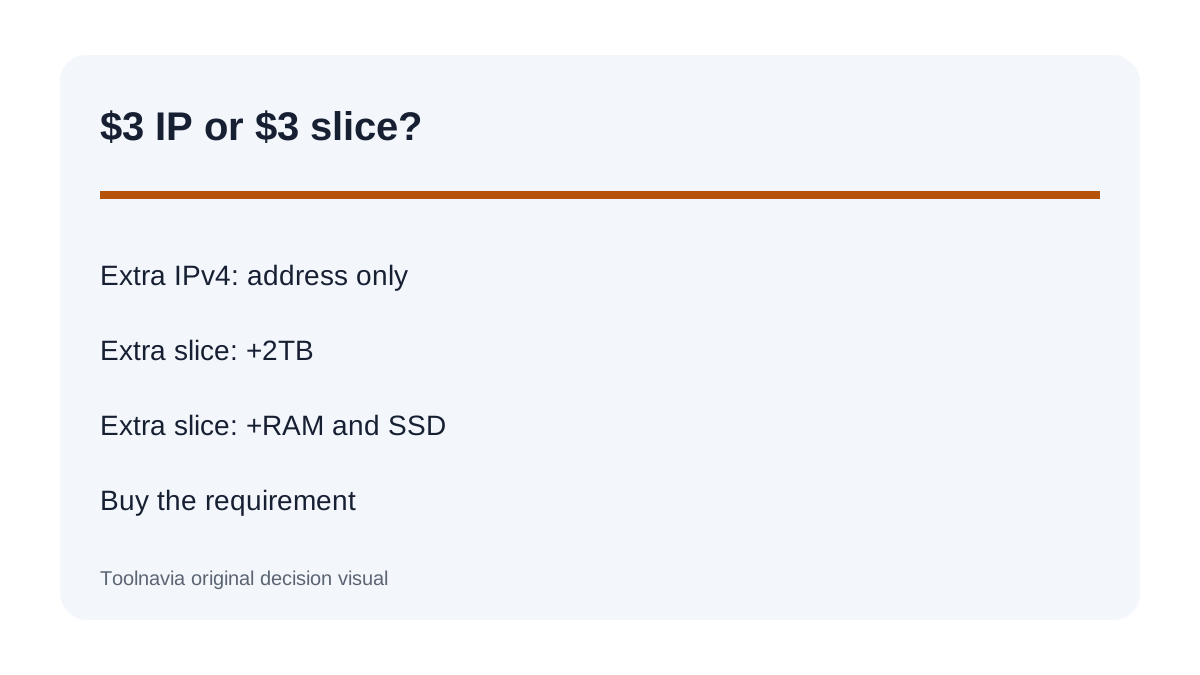
The first extra IP changes the bill from $3 to $6 without adding CPU, RAM, SSD or transfer. A second slice also costs $3 more but publishes another 2GB RAM, 40GB SSD and 2TB transfer. The purchases solve different problems: an IP adds addressability; a slice adds resources. Compare the requirement, not the matching price.
The old $1 versus current $3 IPv4 conflict
An older InterServer tutorial still says an additional IP costs $1 per month. The current FAQ and upgrades page both state $3 per IP per month. This guide uses the current $3 figure and treats $1 as historical, not an available offer.
Address justification and regional inventory may affect availability. Verify the price and approval requirement in the order flow or a support ticket; do not build a production network around the old $1 sentence.
What 2TB means for real workloads
Two terabytes is a transfer allowance, not a visitor guarantee. Cached content may serve many visits with modest outbound data, while downloads, media, off-site backups or public objects can use the allowance quickly. Monitor bytes sent from the VPS rather than estimating from page views.
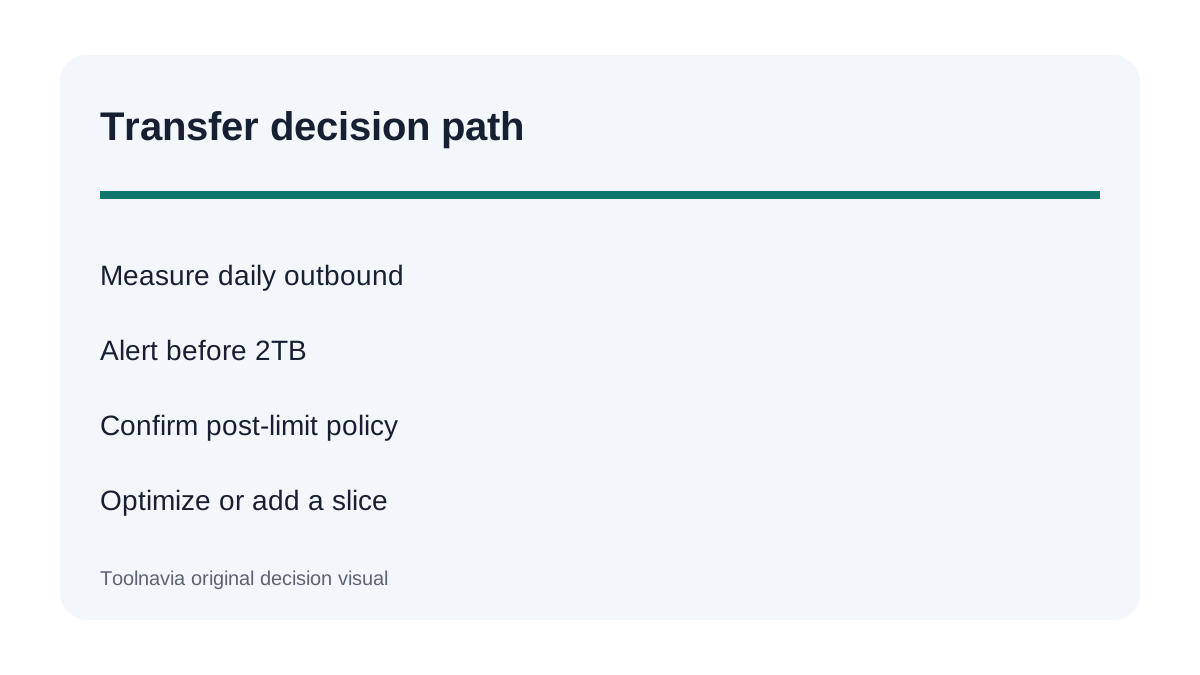
A planning budget starts with daily outbound transfer, multiplies it by the billing period, then adds headroom for releases, cache misses, bots, backup jobs and spikes. At an even pace, 2TB is roughly 66GB per day over 30 days, but real usage is uneven. Set alerts well below the limit and inspect the meter after large deployments or backups.
If use repeatedly approaches the allowance, reduce bytes with caching or a CDN, move bulk files to a service designed for them, or add a slice when its resources and extra 2TB are useful. None of those choices proves how InterServer enforces the original 2TB limit.
Why competitor overage pages are not InterServer policy
DigitalOcean publishes pooled outbound allowances and $0.01/GiB excess transfer; Vultr publishes its own allowance and overage price. Akamai/Linode documents another pool model, while Hetzner prices IPv4 separately.
Those are examples of explicit cost documentation, not transferable terms. The missing InterServer rate is a purchase question. Obtain a written answer for the exact account and location before a bandwidth-heavy launch.
Pre-purchase checklist
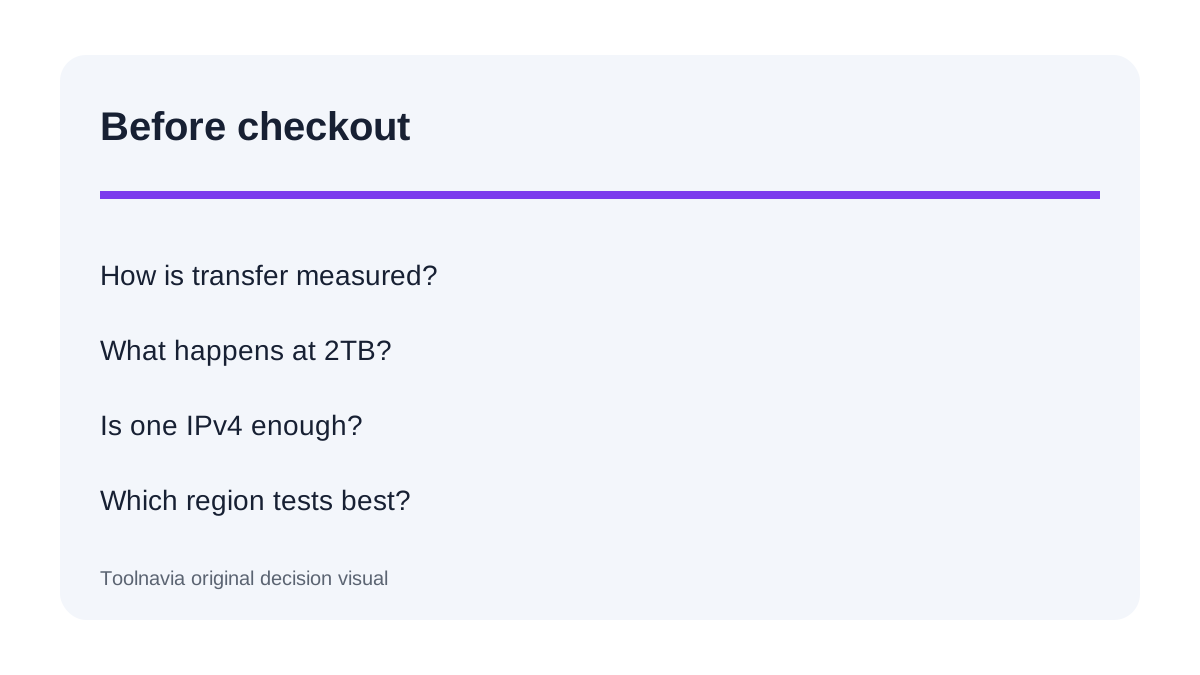
Confirm the checkout price and included transfer. Ask whether usage is outbound-only or another total, when it resets, what alerts exist, and exactly what happens at 2TB. Request the current excess rate if one exists or the required upgrade path if it does not.
Confirm whether one IPv4 is enough. If another is approved, verify the current $3 monthly price and any reverse-DNS, firewall or mail-reputation work. Test New York, Dallas and Los Angeles against real users and storage destinations.
Finally, monitor transfer, keep external backups, secure root, patch the unmanaged server and rehearse migration. Network allowance does not replace security, backup or administration.
Who should choose one slice
Choose one slice when a small self-managed app fits 2GB RAM and 40GB SSD, monthly outbound use stays comfortably below 2TB, one IP is enough, and the team accepts a shared port. It is a low-commitment starting point when usage can be measured before scaling.
Do not choose it solely because the page says 10Gbps. If another IP, panel, backup storage or more transfer is required, $3 is not the final bill. Bandwidth-heavy or IP-heavy buyers should get the post-2TB and address-approval rules in writing.
Toolnavia may earn a commission from the exact approved one-slice offer. That does not change the unresolved post-2TB disclosure or the recommendation to verify current terms.