TOOLNAVIA / BUYING GUIDE
Hostinger Premium Account Sharing: One Hosting Plan Means All Its Sites
The short answer
At a glance
- Best for
- One trusted team maintaining all sites in a hosting plan.
- Price model
- US$95.52 prepaid for 48 months; displayed same-term renewal US$10.99/mo.
- Check first
- Account Sharing of a hosting plan includes all its websites; Collaborator is not read-only.
Verdict: decide the isolation requirement first
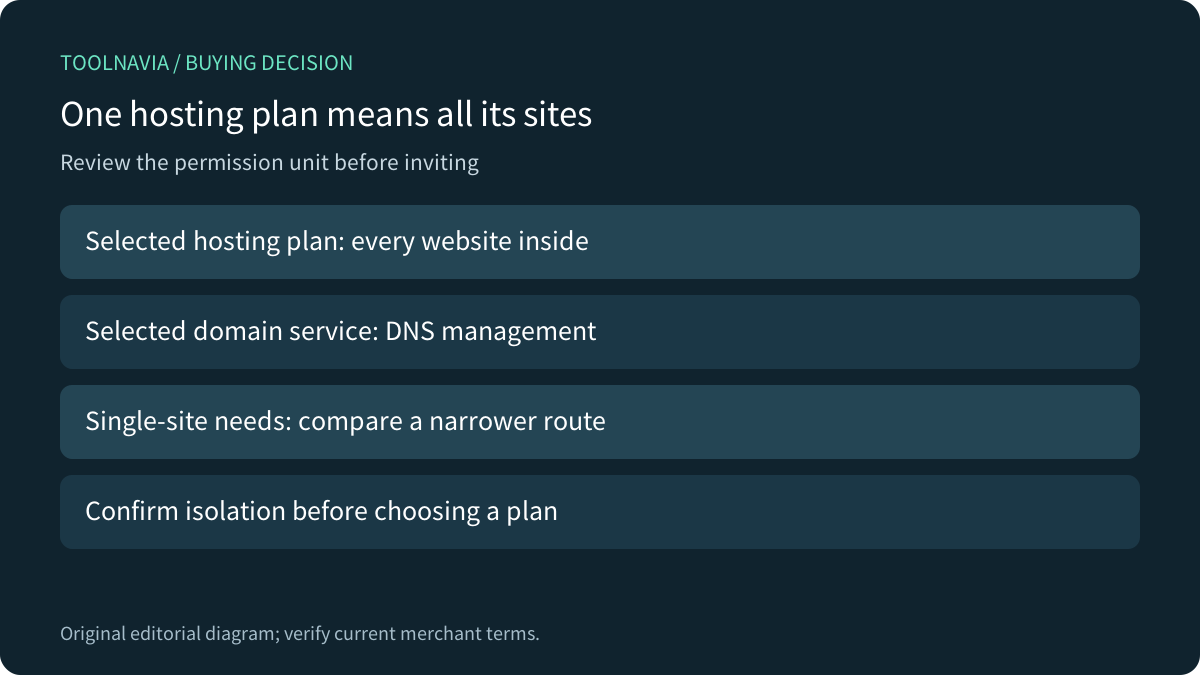
Hostinger Premium can fit a small group of sites maintained by the same trusted team. It is a poor assumption for an owner who wants one contractor to manage only one website through Account Sharing: Hostinger's current guide says sharing a hosting plan gives access to every website under that plan. Selecting one service is not selecting one website.
The US Premium card currently lists three websites. Capacity for three sites does not establish three independently delegated panels. This is documentation analysis; no invitation, account, credential or payment was operated.
Separate maintenance from spending
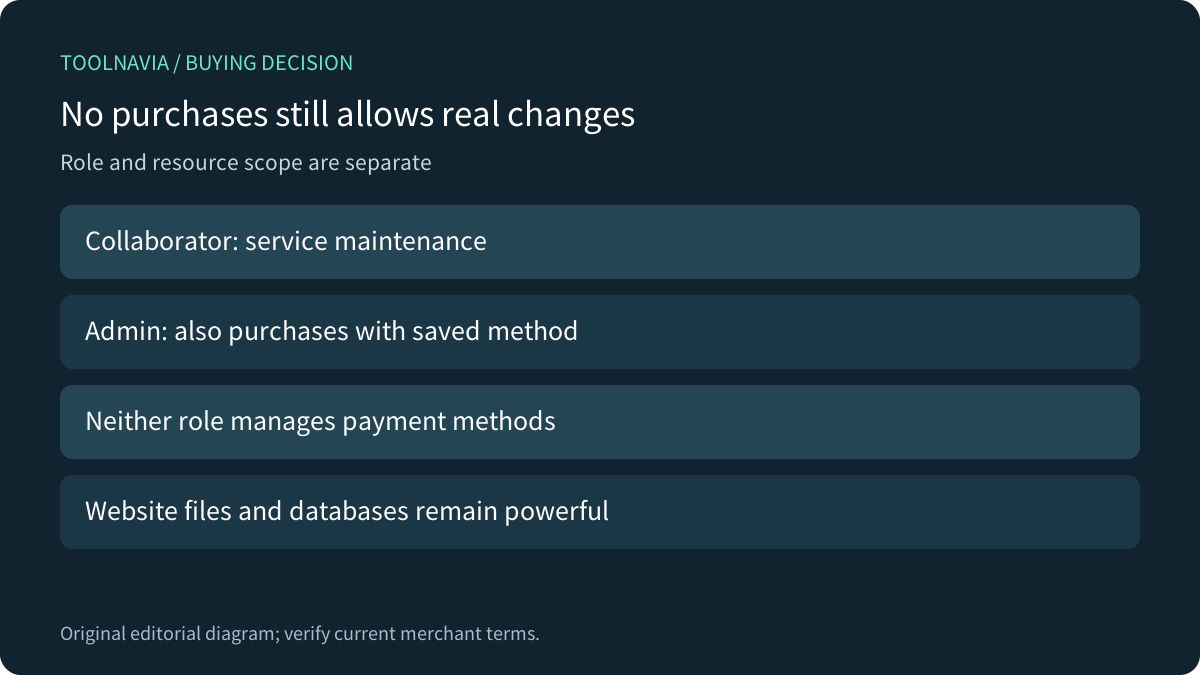
Hostinger currently calls its shared roles Collaborator and Admin. Collaborator can manage services but cannot purchase; Admin can also buy using an added payment method. Neither role can manage payment methods or change the owner's profile.
The practical implication is that a contractor can lack purchasing authority while retaining substantial operating power. Hostinger separately documents file, database and hosting-setting changes. A broken deployment does not need a billing permission. Define the permitted work and the affected sites before choosing the role.
Do not upgrade the role merely because an owner-only action is unavailable. Identify who will handle that task, and check whether the missing action is intentionally excluded. An account label is not a substitute for a responsibility agreement.
Map services and websites independently
The sharing guide distinguishes domain access, which includes DNS management, from hosting access, which includes website files and settings. Giving a contractor the domain alone is therefore not a workaround for editing the website. Conversely, hosting-plan access may exceed a single-site assignment.
Make a two-column inventory: the subscriptions in the account and the websites inside each hosting subscription. Mark the contractor's actual assignment against both. For example, if two unrelated businesses share one Premium plan, the relevant question is whether both should be visible to the same maintainer, not whether the plan still has spare storage.
Hostinger documents separate FTP access as one narrower file-access option and Agency per-website sharing as another route. Neither should be assumed to provide every required dashboard or database operation. Verify the exact workflow before choosing a more expensive plan.
Review what happens to later services
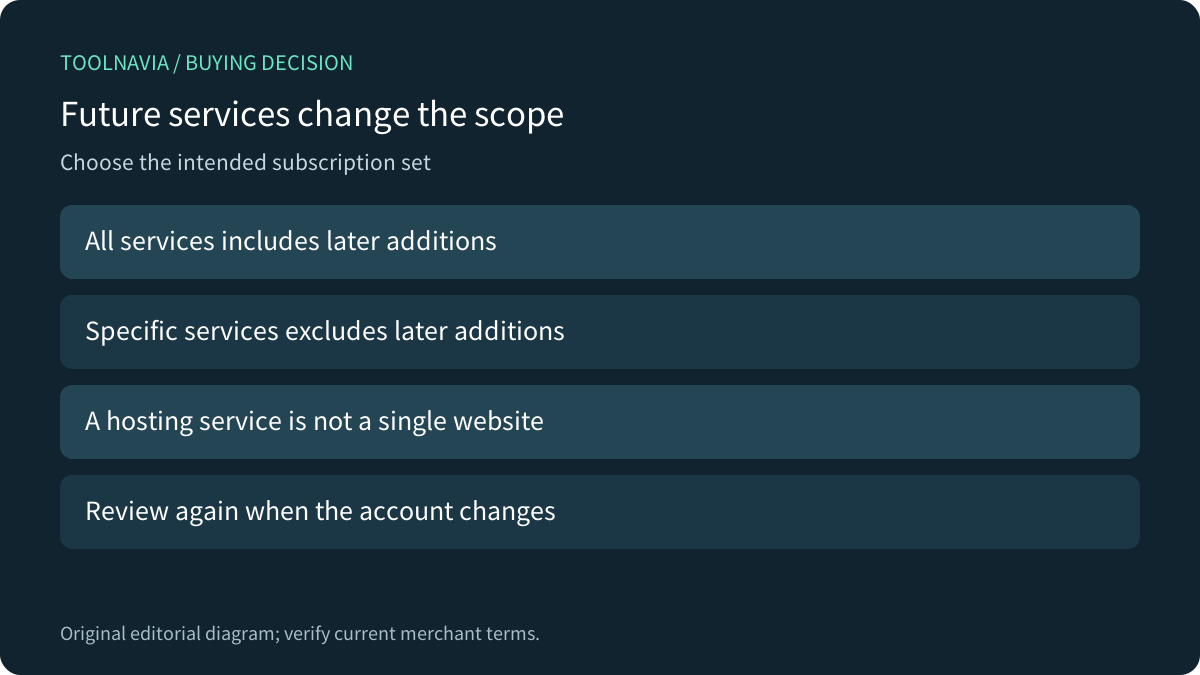
All services includes services added later. Specific services limits the grant to the selected subscriptions and does not automatically include later additions. That distinction matters when an account grows after the original engagement.
Consider an owner who later adds a second brand's domain or email subscription. A broad invitation may expand the maintainer's reach without a new website assignment. Record why the chosen scope is necessary, and review it when adding products or changing contractors. These are operating recommendations, not a claim that Toolnavia tested hidden panel behavior.
Compare the correct permission layer
WordPress defines its own roles and capabilities. A person editing content may need an appropriate WordPress role rather than hosting-account access. A hosting collaborator and a WordPress administrator are separate identities; one role name does not describe the other system.
GoDaddy also separates delegate identity and purchase authority. Cloudways Flexible documents limited server, action and application access. These alternatives illustrate questions to ask about scope, not interchangeable entitlements or proof that Hostinger Premium supports their controls.
Four useful Hostinger capabilities are separate collaborator login, a no-purchase role, specific-service selection and removable grants. Their value depends on whether the documented hosting-plan boundary matches the actual assignment.
Accept and close the engagement deliberately
For a proposed authorized exercise, use two synthetic websites and a named test collaborator. Review the selected services and role, then check expected visibility and exclusions. Do not create a charge to prove purchase permissions. If the requirement is one-site isolation, stop when the selected route cannot establish it.
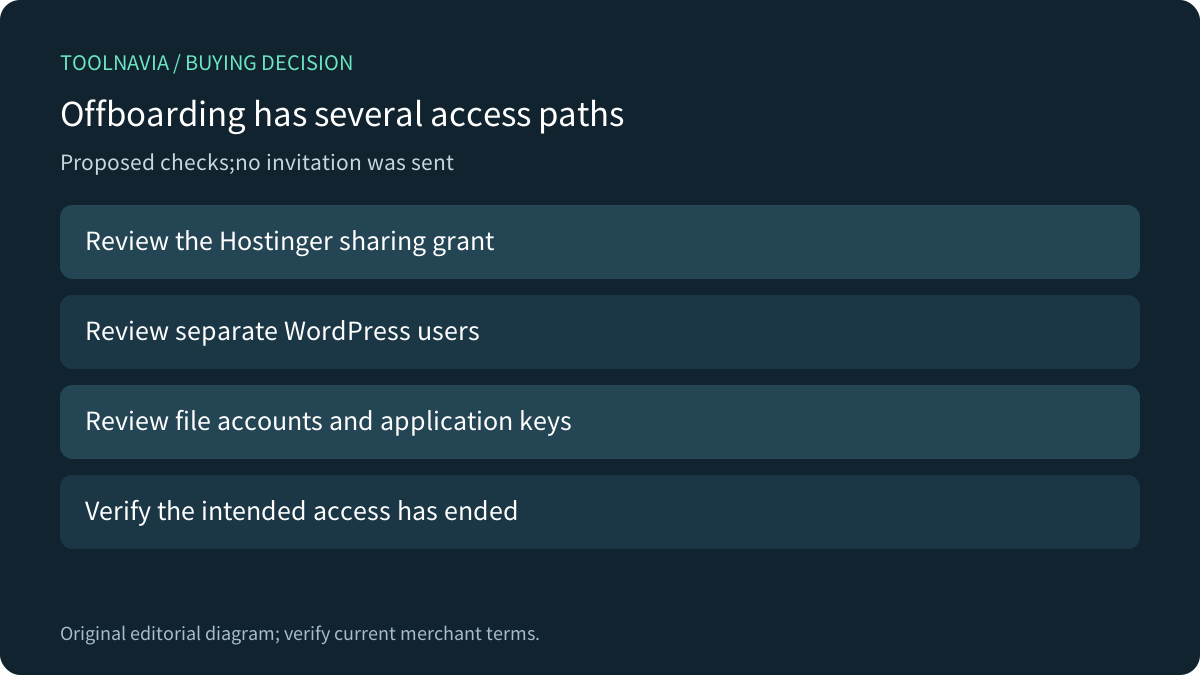
At handover, inspect the shared grant and any separate WordPress users, file accounts or application keys. Removing the hosting invitation should not be assumed to invalidate unrelated credentials. These checks were not performed here.
The current US Premium offer is US$95.52 prepaid for 48 months, equivalent to US$1.99/month, with displayed same-term renewal at US$10.99/month before applicable tax. Confirm the cart, ownership and isolation needs before committing. Hostinger has a public affiliate program, but this exact Toolnavia Premium offer remains unapproved for tracking; this guide uses ordinary official sources.