TOOLNAVIA / BUYING GUIDE
hosting.com Managed cPanel 4GB vs Bluehost Standard NVMe 4: Same Specs, Different Control
The short answer
At a glance
- Best for
- Small businesses choosing between constrained managed cPanel and root-enabled managed VPS control.
- Price model
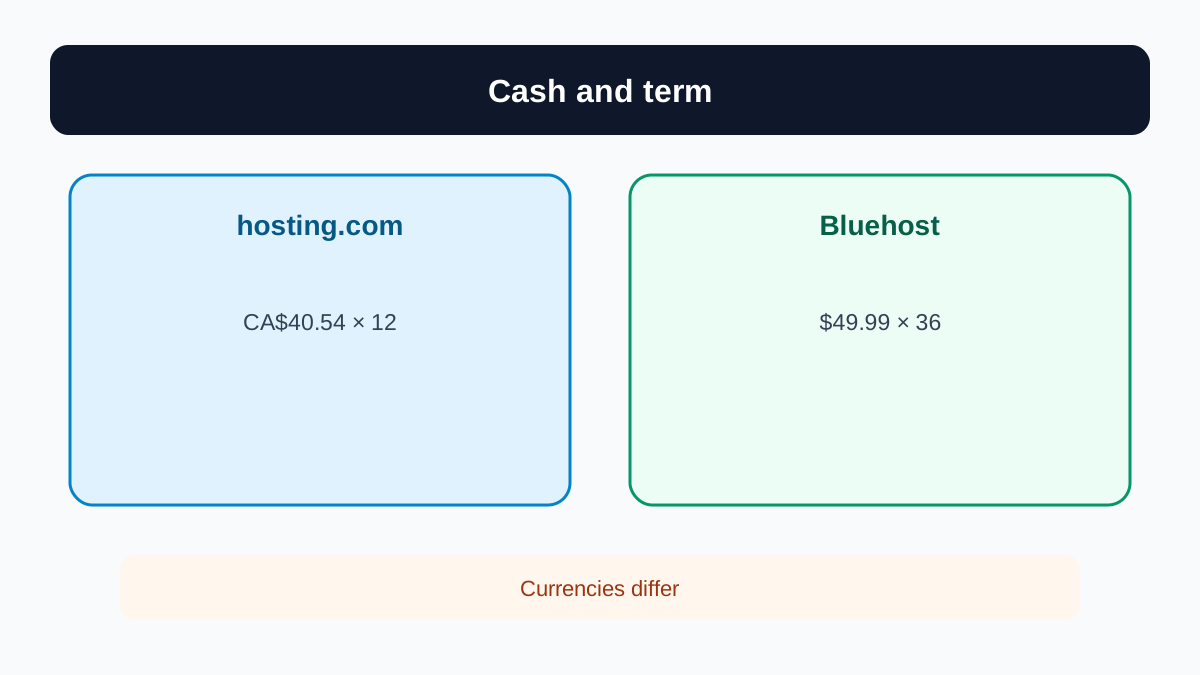
- hosting.com from CA$40.54/month for 12 months; Bluehost $49.99/month for 36 months; verify renewal
- Check first
- Currencies and terms differ; Bluehost renewal and backup documents conflict; specifications do not prove speed.
Quick verdict
Choose **hosting.com Managed cPanel 4GB** when the operating model is deliberately constrained: one cPanel account, no root access, provider-managed server work and advertised daily off-server backups. The Canadian surface currently starts the managed-cPanel category at **CA$40.54 per month for 12 months**, against **CA$81.09 regular**.
Choose **Bluehost Standard NVMe 4 Managed VPS** when root/WHM control, two dedicated IP addresses and a choice of nine locations are worth a longer commitment. The live page currently shows **$49.99 per month for 36 months**, renewing at **$68.99 per month**.
Three independent same-intent comparisons cover the two brands but not this exact managed 4GB pair; they support the purchase intent, while official plan pages control every price and scope claim.
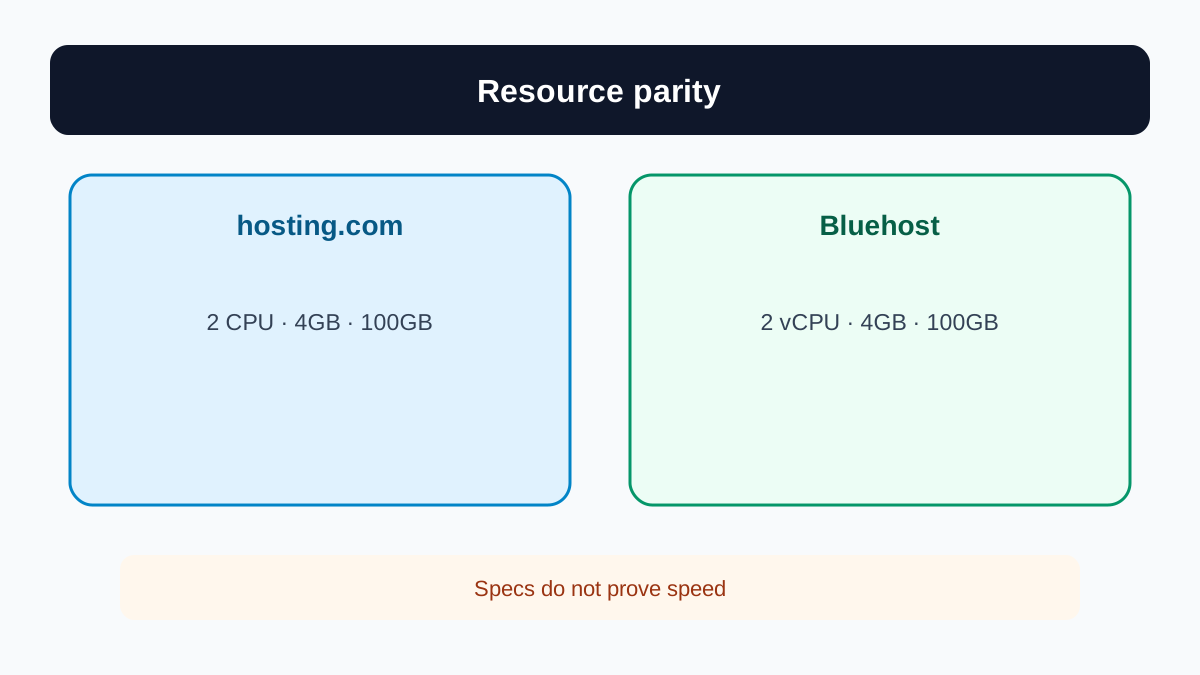
The headline hardware looks almost identical: 2 vCPU, 4GB RAM and 100GB NVMe. That does not make these equivalent purchases. Currency, term, cPanel licensing, root access, backup responsibility and public renewal evidence all differ.
Cash commitment: do not flatten CAD and USD
| Exact plan | Advertised term | Nominal cash for that term | Currency | |---|---:|---:|---| | hosting.com Managed cPanel 4GB | 12 months | CA$486.48 at CA$40.54/month | CAD | | Bluehost Standard NVMe 4 Managed | 36 months | $1,799.64 at $49.99/month | USD |
The hosting.com figure is a Canadian category-entry price. Its managed-VPS page says the promotion applies to a 12-month term and renews at the regular rate. Taxes and the final cart still control.
Bluehost's $49.99 figure requires 36 months, so it is a much larger upfront decision even before currency conversion. This guide does not convert CAD to USD because the exchange rate and checkout market can change. Compare the actual card charge in one currency on the day you buy.
Renewal: hosting.com is clearer; Bluehost has a conflict
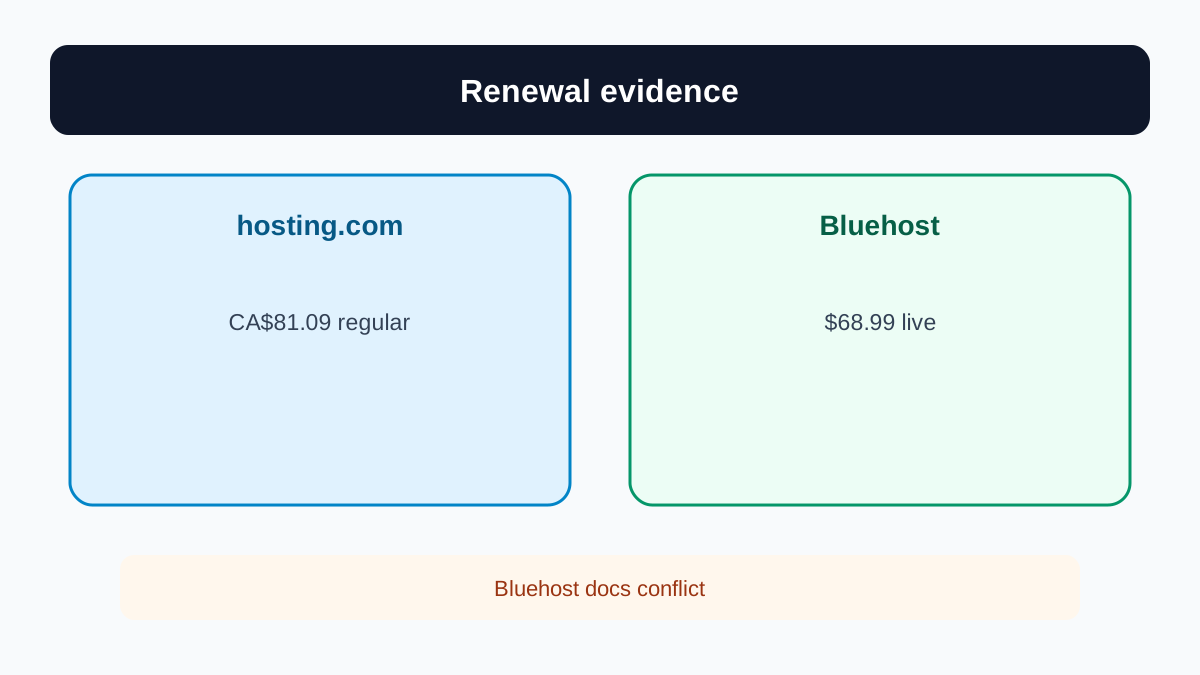
hosting.com pairs CA$40.54 with CA$81.09 regular and states that the 12-month promotion renews at the regular rate. At today's displayed amounts, the nominal second 12 months would be CA$973.08 before tax. That is a budgeting aid, not a price lock.
Bluehost's live managed-VPS page says Standard NVMe 4 renews at $68.99 per month. Its official help page publishes different totals, including $1,259.64 for three years and $59.99 monthly, while directing customers to the Renewal Center. An independent 2026 review matches the live $49.99/$68.99 surface.
Use the live checkout for today's cash, then save the renewal line from the order summary. Do not average conflicting Bluehost numbers or promise that one will apply three years later.
Same resources, different server rights
Both advertise two CPU cores, 4GB RAM and 100GB NVMe. hosting.com also lists 1TB bandwidth and one IP. Bluehost lists unmetered bandwidth and two IP addresses.
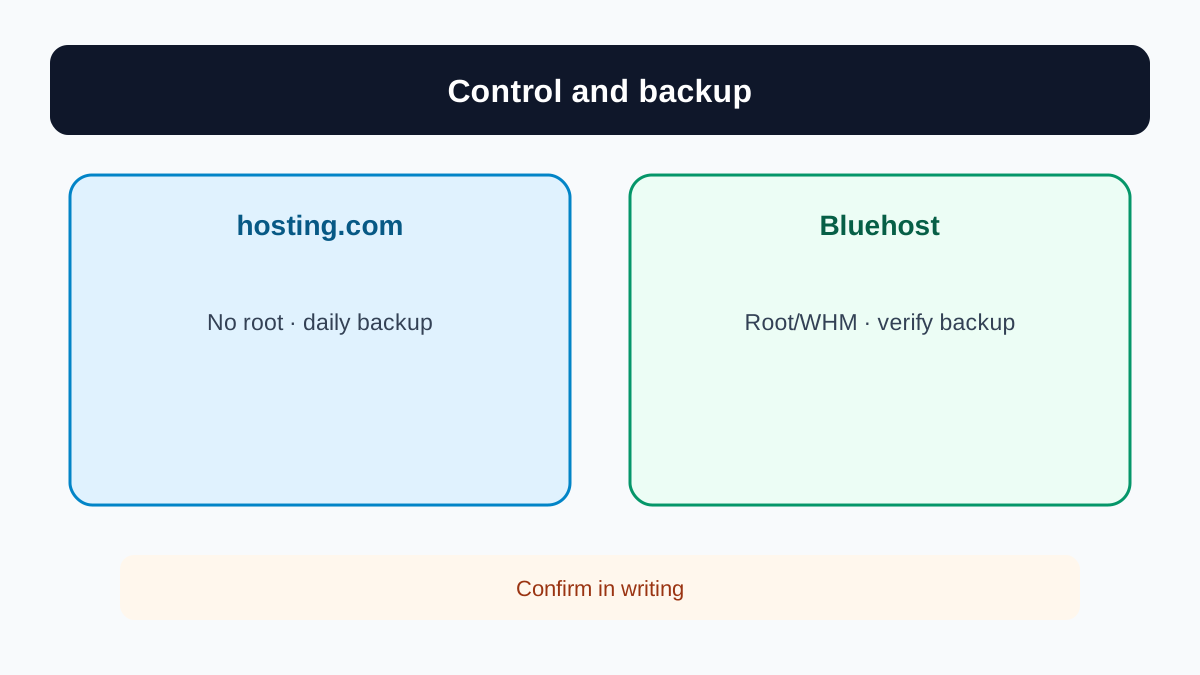
The bigger difference is control. hosting.com describes cPanel Solo with one included account and explicitly says there is no root access. That is a guardrail: the provider controls the base server while the customer runs sites through cPanel and WHM.
Bluehost documents cPanel/WHM and root access for its VPS environment. Root helps when a team needs custom packages, service-level changes or deeper troubleshooting. It also moves more risk to the customer. A managed label does not mean every root-level change is operated automatically.
What “managed” means
hosting.com's technical page groups CloudLinux, cPanel/WHM, security tooling and server management into the product. The one-account cPanel Solo limit matters for agencies: separate client accounts may require a license change or higher plan. Confirm the allowance in the cart rather than assuming WHM means unlimited accounts.
Bluehost markets expert management, but its support guide says many Managed VPS tasks are assisted on request rather than performed automatically. Ask who patches the operating system, who restores a broken service, and whether application debugging is included.
No specification proves application speed. CPU generation, isolation, web-server stack, cache configuration, database load and geography can outweigh the shared 2-core/4GB/100GB headline.
Backup responsibility is the biggest gap
hosting.com advertises daily off-server backups. That is useful, but the sales line does not answer retention length, restore granularity, restore time or whether a full-account restore is self-service. Keep an independent copy before migration.
Bluehost's public backup policy says KVM VPS customers are responsible for backups because courtesy backups are no longer maintained, and points to WHM/cPanel backup configuration. That wording sits awkwardly beside a managed-VPS sales promise. Until checkout or support confirms a plan-specific backup service in writing, budget for customer-owned remote backups.
This is not a small feature difference. A buyer choosing Bluehost for root flexibility should treat backup design as part of the project, not as an assumed bundle.
Refund, migration and exit risk
hosting.com's package comparison lists a 30-day money-back guarantee for the managed range. Verify exclusions, domains, licenses and whether the selected market changes the policy.
Bluehost's low rate is attached to a 36-month cash commitment. Before paying, confirm the refund window, license treatment and whether migration or setup work is refundable. Long terms make cancellation language more important than a small monthly difference.
For either host, export a full cPanel backup, database dumps, DNS records, mail-routing settings and a rollback copy before changing nameservers. A provider snapshot is not the same as a portable exit package.
Which plan fits?
Choose hosting.com if:
- one cPanel account is enough; - no root is an acceptable safety boundary; - advertised daily off-server backups reduce initial operations work; - a 12-month CAD term is easier to approve than three years in USD.
Choose Bluehost if:
- root and WHM flexibility are required; - two IPs or location choice materially help the deployment; - the team can verify and own remote backups; - the 36-month cash commitment and renewal risk are acceptable.
Delay both if the application still fits shared hosting or the team cannot name the workload that needs dedicated RAM and server-level control.
Checkout checklist
1. Capture currency, tax, amount due today, term and full renewal total. 2. Confirm the exact plan name and 2-vCPU/4GB/100GB allocation. 3. Record cPanel account count, license upgrade cost and WHM inclusion. 4. Get root-access and managed-support boundaries in writing. 5. Confirm backup frequency, retention, restore scope and off-server destination. 6. Confirm IP count, location, bandwidth and migration responsibility. 7. Export a portable backup and document rollback before DNS cutover.
Bottom line
These plans look like hardware twins but operate differently. hosting.com fits a buyer who wants a constrained, provider-run cPanel server with one account and advertised daily off-server backups. Bluehost fits an experienced operator who values root/WHM, two IPs and location choice enough to accept a 36-month USD term and verify backup obligations.
Use only the exact Toolnavia plan routes shown here. No coupon code is claimed, and the live cart controls price, tax, term and renewal.