TOOLNAVIA / BUYING GUIDE
hosting.com 4GB Email: Verify PTR Before You Trust Delivery
The short answer
# hosting.com 4GB Email: Verify PTR Before You Trust Delivery
The hosting.com Managed cPanel 4GB plan includes one dedicated IP, but that line item does **not** prove your cPanel server will send mail from that address, that you can edit its PTR record yourself, or that Gmail and Outlook will accept the messages. The buying decision is therefore not “Does the plan include an IP?” It is “Can I identify the real Exim egress IP, get provider-controlled reverse DNS aligned with the server hostname, and operate authentication and reputation safely?”
**Short answer:** the plan can be a reasonable web-hosting choice and may support low-volume server mail, but only after hosting.com confirms the outbound path and PTR workflow in writing. If transactional email is business-critical, high-volume, bursty, or difficult to warm, a dedicated mail provider is usually the cleaner operational boundary.
> Affiliate disclosure: Toolnavia may earn a commission if you buy through the hosting.com link in this guide. The editorial conclusion and the pre-purchase test are unchanged by that relationship.
At a glance
- Best for
- Managed cPanel VPS buyers who will verify mail route,PTR authority and sender identity.
- Price model
- No numeric price quoted; verify market,billing term and selector directly.
- Check first
- Included IP does not prove Exim egress,self-service PTR or inbox placement; Titan and local mail are separate.
What the plan actually proves
The current Canadian Managed Linux VPS page lists the 4GB tier with 2 CPU cores, 4GB RAM, 100GB NVMe storage, a managed server, one dedicated IP, SSL, and cPanel Solo. Those are useful hosting specifications. The official product comparison also lists reverse DNS (PTR) as available on request for the Cloud Server 4GB tier, along with flexible sending limits and SPF/DKIM/DMARC/BIMI. That still does not identify the source IP used by Exim, provide self-service PTR, or promise inbox placement.
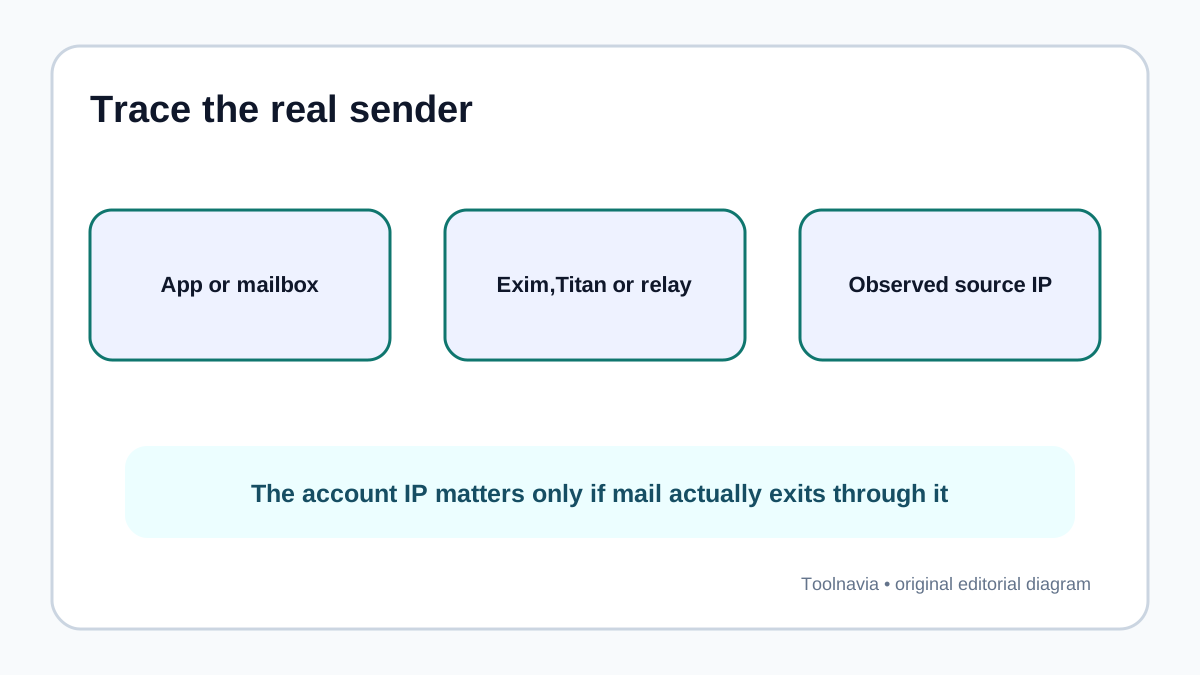
That distinction matters because cPanel states that Exim sends from the server’s primary IPv4 address by default. cPanel can also be configured to send from each account’s dedicated IP, but the relevant setting and files require root-level control. On a managed environment, the buyer should not assume this routing can be changed without provider involvement.
[Check the current hosting.com Managed cPanel offer](https://hosting.com?utm_source=fp_affiliate&utm_medium=15583168&utm_campaign=42825&utm_content=affiliates&fpr=sc1w5e)
Four identities that must agree
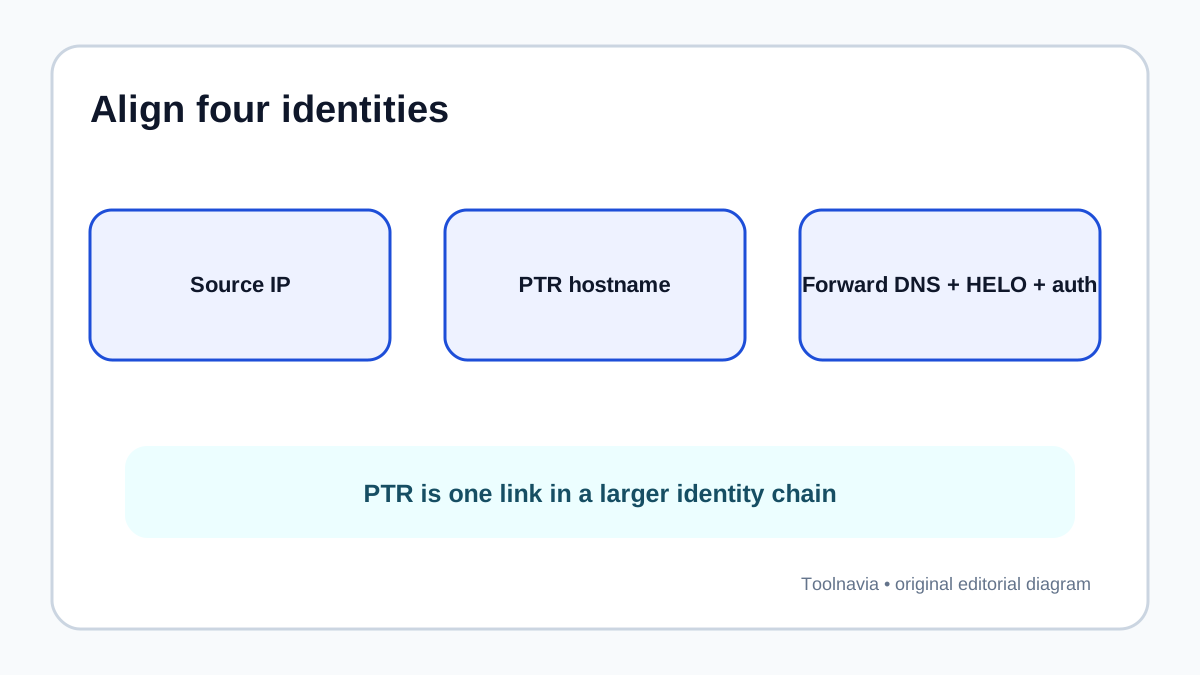
A trustworthy mail path is a chain, not a checkbox:
1. **Source IP:** the address recipients actually see when Exim connects. 2. **PTR/rDNS:** that source IP resolves to a mail hostname, such as `mail.example.com`. 3. **Forward DNS:** that hostname resolves back to the same source IP. 4. **SMTP identity and domain authentication:** HELO/EHLO, SPF, DKIM, and DMARC agree with the intended sender.
cPanel’s reverse-DNS documentation explains why customers often cannot create PTR themselves: only the organization authoritative for the reverse zone can publish the record. Editing ordinary forward DNS does not create reverse authority. If hosting.com controls the address block, support or a provider interface must perform the change.
Gmail’s current sender requirements reinforce the boundary. All senders need SPF or DKIM, valid forward and reverse DNS, TLS, and low spam rates; bulk senders have additional requirements. These are eligibility and trust signals, not a promise that every message reaches the inbox.
The dedicated-IP trap
A dedicated **web/server** IP and a dedicated **sending** IP can be the same address, but they are not interchangeable concepts.
| Question | Why it changes the decision | |---|---| | Which IP appears in a received message header? | That is the reputation-bearing SMTP source, not necessarily the marketing-page IP. | | Who owns the reverse zone? | Only that party can publish a valid PTR. | | Does Exim use the primary IPv4 or an account IP? | The answer determines which address needs rDNS and reputation monitoring. | | Does the hostname resolve back to the same IP? | Receivers compare forward and reverse identity. | | Is the traffic steady enough for a dedicated route? | A cold or erratic dedicated IP can perform worse than a well-run shared pool. |
Amazon SES documents the same operational trade-off from the mail-provider side: dedicated IPs isolate reputation, but they also add setup, warm-up, traffic-pattern, and management responsibilities. That comparison does not describe hosting.com’s infrastructure; it explains why “dedicated” alone is not an automatic quality upgrade.
Ask these questions before paying
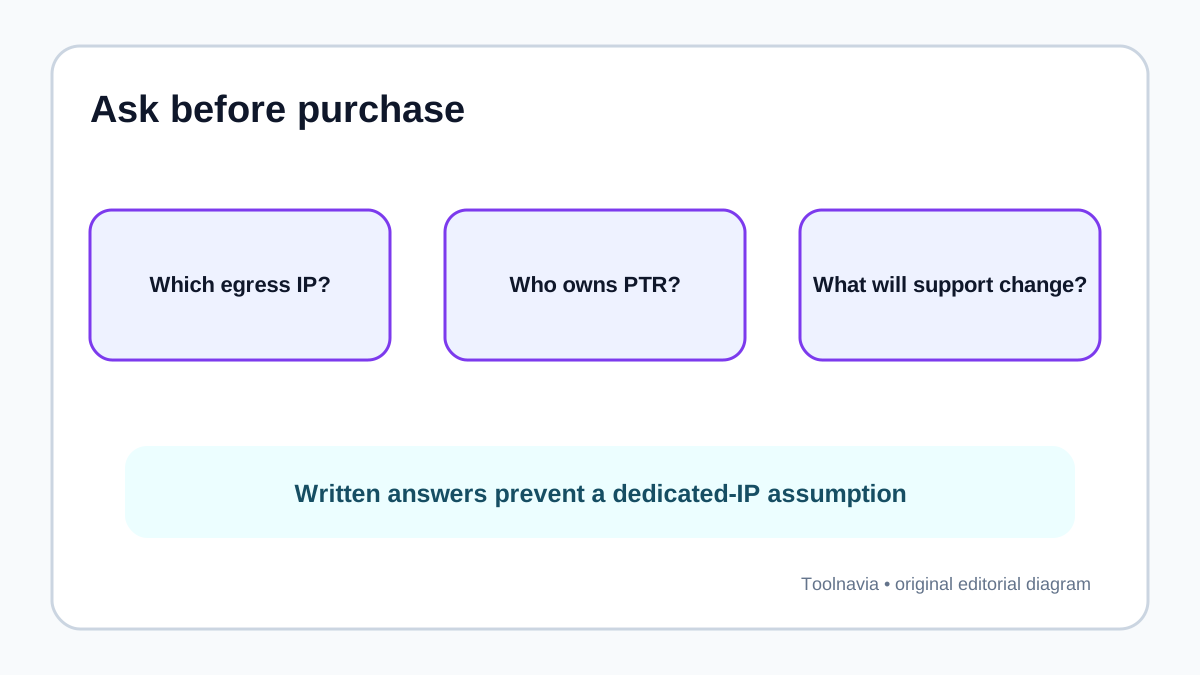
Send hosting.com support one concise pre-sales request:
- What IPv4 address will Exim use for outbound mail on the 4GB Managed cPanel plan? - Is that the included dedicated IP or the server’s primary/shared address? - Who controls the reverse DNS zone for that address? - Can support set a PTR to a customer-controlled hostname? - Can that hostname’s A record point back to the same IP? - What HELO/EHLO hostname will Exim present? - Are outbound SMTP ports, hourly rates, recipient counts, or abuse thresholds restricted? - Is the cPanel Email Deliverability interface enabled? - Does “managed” include Exim, hostname, and PTR configuration, or only diagnosis? - Is Professional Email/Titan a separate route with its own MX, SPF, and DKIM records?
Do not accept “one dedicated IP is included” as the answer to all ten questions. The plan page proves the IP entitlement; it does not document the live mail route.
Keep Titan and cPanel mail separate
hosting.com’s Professional Email documentation describes a Titan-based DNS path. That is a separate product architecture from mail generated locally by cPanel/Exim. Mixing their records can break authentication or send mail through an unexpected route.
Use a decision tree:
- **Titan mailbox:** follow the Professional Email MX/SPF/DKIM instructions and evaluate Titan’s sending rules. - **cPanel mailbox or website mail:** trace Exim’s real source IP, hostname, PTR, SPF, DKIM, DMARC, and TLS. - **Transactional provider:** authenticate the provider’s domain path and use its return-path, DKIM, IP, and suppression controls. - **Hybrid:** document exactly which system sends password resets, order receipts, support mail, and campaigns.
A green cPanel Email Deliverability screen is helpful, but cPanel itself warns that third-party mail services follow their own instructions. DNS can be syntactically valid while the application sends through a different provider.
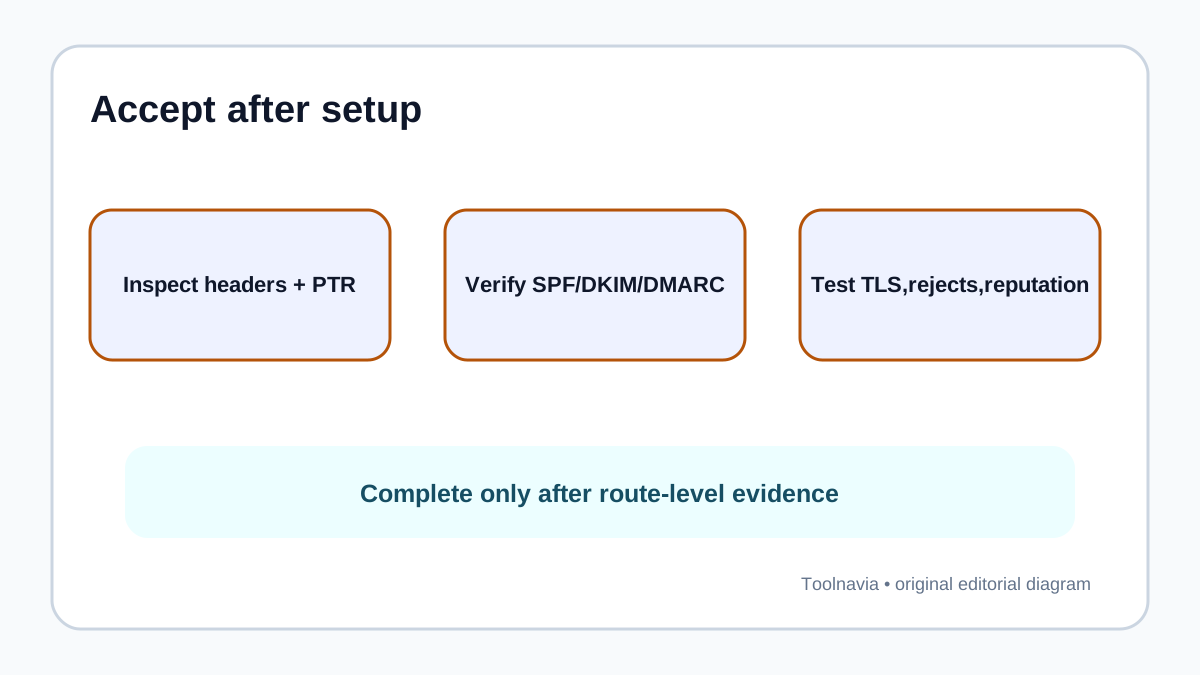
Post-provision acceptance test
Run this test before routing important mail:
1. Send a message to a controlled Gmail mailbox and another independent mailbox. 2. Inspect the raw headers; record the connecting/source IP and the HELO/EHLO name. 3. Query the source IP’s PTR. 4. Query the PTR hostname’s A/AAAA records and confirm they return to the same sending address. 5. Confirm SPF authorizes the actual route. 6. Confirm DKIM passes for the visible From domain. 7. Publish DMARC in monitoring mode first, then review reports before enforcement. 8. Confirm TLS was used. 9. Check Gmail Postmaster Tools where eligible and record complaint or spam-rate evidence. 10. Test password reset, receipt, alert, and bounce paths separately; one successful message is not a delivery guarantee.
Save the evidence with a date. A later server migration, IP change, hostname change, relay change, or DNS move can invalidate it.
What PTR fixes—and what it cannot fix
PTR helps a recipient associate an IP address with a stable hostname. It can remove an obvious source-identity failure. It cannot repair a bad IP or domain reputation, authorize a sender that fails SPF or DKIM, fix DMARC alignment, warm a new IP, reduce spam complaints, correct misleading content, or guarantee Gmail or Microsoft inbox placement.
Microsoft’s anti-spam documentation emphasizes that source IP is only one signal used at the edge. Google explicitly adds authentication, TLS, and spam-rate requirements. The safe editorial conclusion is therefore “PTR is necessary for a credible self-hosted path,” not “PTR guarantees delivery.”
When the plan is a fit
Choose the hosting.com 4GB Managed cPanel plan for email only when the web workload already justifies the VPS, hosting.com confirms the actual Exim source IP and PTR request path, volume is modest and predictable, you can maintain authentication and monitoring, and occasional support coordination is acceptable.
Do **not** choose it primarily for email when you need high-volume transactional delivery, automated warm-up, detailed event logs, suppression management, dedicated-mail compliance tooling, or fast route changes without provider tickets. Those requirements point toward a purpose-built transactional service.
Decision
The included dedicated IP is a useful server resource, not proof of a complete mail-delivery stack. Buy the 4GB plan for its confirmed managed cPanel hosting value. Before trusting it with transactional mail, obtain the real Exim source IP, provider-controlled PTR workflow, forward-confirmed hostname, HELO identity, and authentication evidence. If any link remains unknown, keep critical mail on Titan or a specialized provider.
[Review the current hosting.com Managed cPanel plan](https://hosting.com?utm_source=fp_affiliate&utm_medium=15583168&utm_campaign=42825&utm_content=affiliates&fpr=sc1w5e)
Evidence map: the current managed cPanel plan provides a managed server and one dedicated IP, but does not identify the live mail egress or promise PTR self-service. Titan uses its own DNS route. cPanel Email Deliverability exposes authentication diagnostics, while reverse-DNS authority normally belongs to the reverse-zone owner. SPF, DKIM, DMARC and PTR are trust controls rather than inbox guarantees. Exim source-IP selection is a separate root-level configuration. Gmail requires forward/reverse DNS, authentication, TLS and complaint control; Microsoft also treats the source IP as only one filtering signal. Dedicated sending adds warm-up and reputation-management duties. The official hosting.com comparison specifically marks PTR for the 4GB cloud server as available on request.