TOOLNAVIA / BUYING GUIDE
HostArmada Web Warp vs InterServer: $118.44 or $144 for 3 Years?
The short answer
HostArmada Web Warp and InterServer Standard are both multi-site shared-hosting choices, but they spend your budget differently. HostArmada currently shows **US$3.29/month on a 36-month view**—US$118.44 by arithmetic—with 30GB NVMe, 4 CPU cores, 4GB RAM and 14 daily backups. InterServer Standard offers a **US$60 24-month first term** and a monthly path that starts at US$2.50 for month one before US$7 renewals.
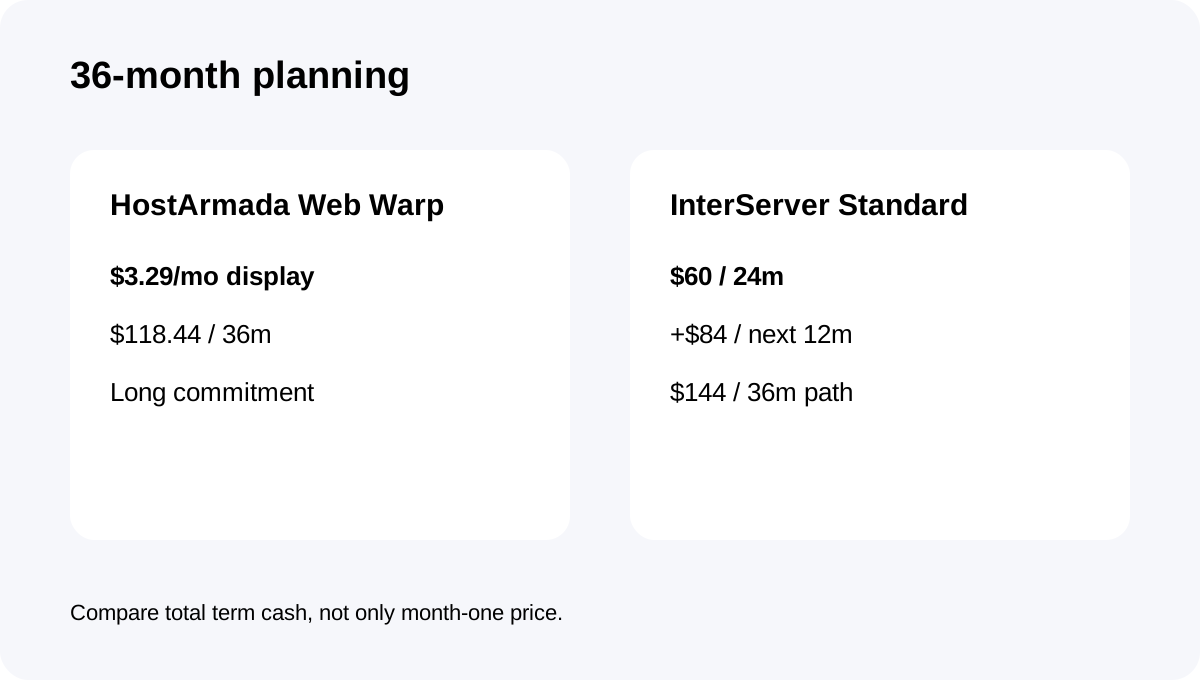
The tempting conclusion is that InterServer is always cheaper. Over the first 36 months, though, one rational long-term InterServer path is US$60 for 24 months plus a 12-month renewal shown at US$84, or **US$144** before tax. HostArmada's 36-month promotional arithmetic is **US$118.44**. The bigger difference is not US$25.56; it is the resource and backup model you receive before the next renewal.
At a glance
- Best for
- Multi-site buyers comparing long commitment with higher published compute against shorter terms and storage flexibility.
- Price model
- HostArmada US$3.29/mo 36m display; InterServer US$60/24m first term with published renewals
- Check first
- No benchmark; future renewal and taxes are checkout-controlled; both remain shared hosting.
Quick verdict
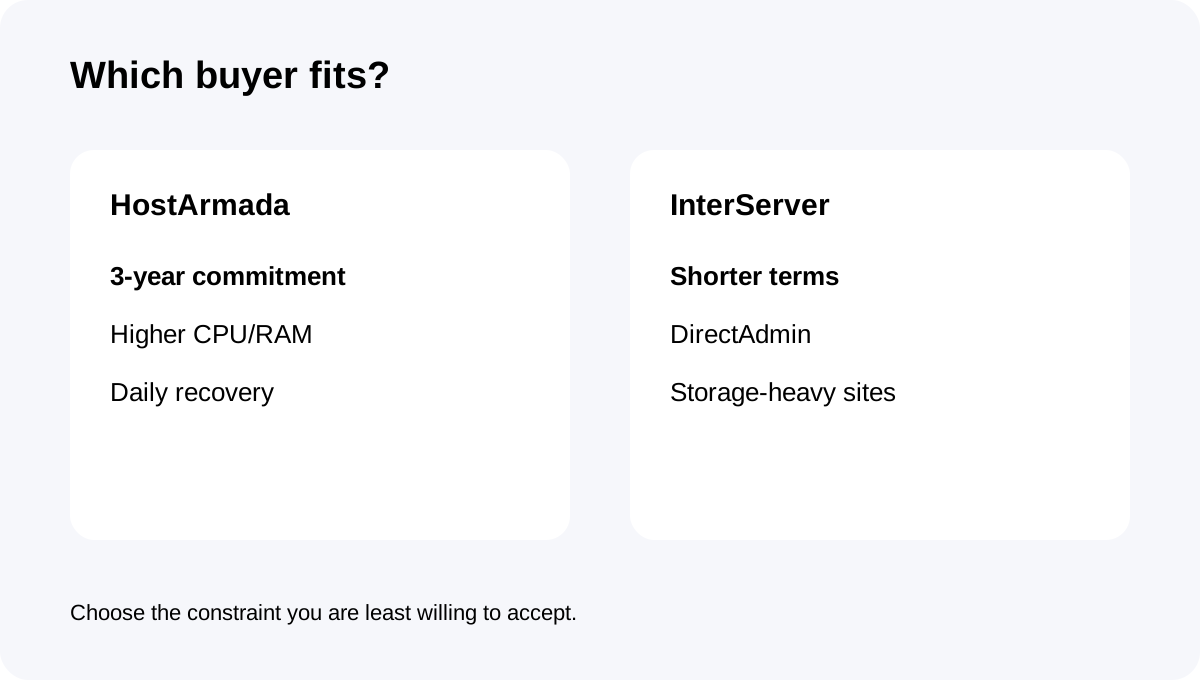
Choose **HostArmada Web Warp** if you can commit for three years, want explicit 4-core/4GB shared-account limits, and value 14 rolling daily restore points.
Choose **InterServer Standard** if you prefer shorter commitments, DirectAdmin, unlimited storage/transfer for normal website use, and are comfortable with a lower published baseline of 1 CPU/2GB and weekly backups.
Do not call either plan “faster” from these limits alone. No controlled benchmark was run, and shared-hosting performance depends on workload, caching, concurrency and provider-level scheduling.
The cheapest-looking month is not the useful comparison
HostArmada's current 36-month Web Warp display is US$3.29/month, which produces US$118.44 for the paid 36 months before any checkout-specific tax or free-month handling. The same page displays a regular price of US$16.45/month. Treat that as a renewal reference, not as a guaranteed future invoice; confirm the actual next-term cycle and amount in checkout.
InterServer publishes more explicit term totals: 24 months US$60 initially and US$168 at the corresponding renewal, or 12 months US$30 initially and US$84 at renewal. The monthly plan starts at US$2.50 and then shows US$7/month.
This means HostArmada can be cheaper across the promotional three-year window, while InterServer gives you a much smaller initial cash commitment if you do not want to prepay 36 months.
Resource limits favor different workloads
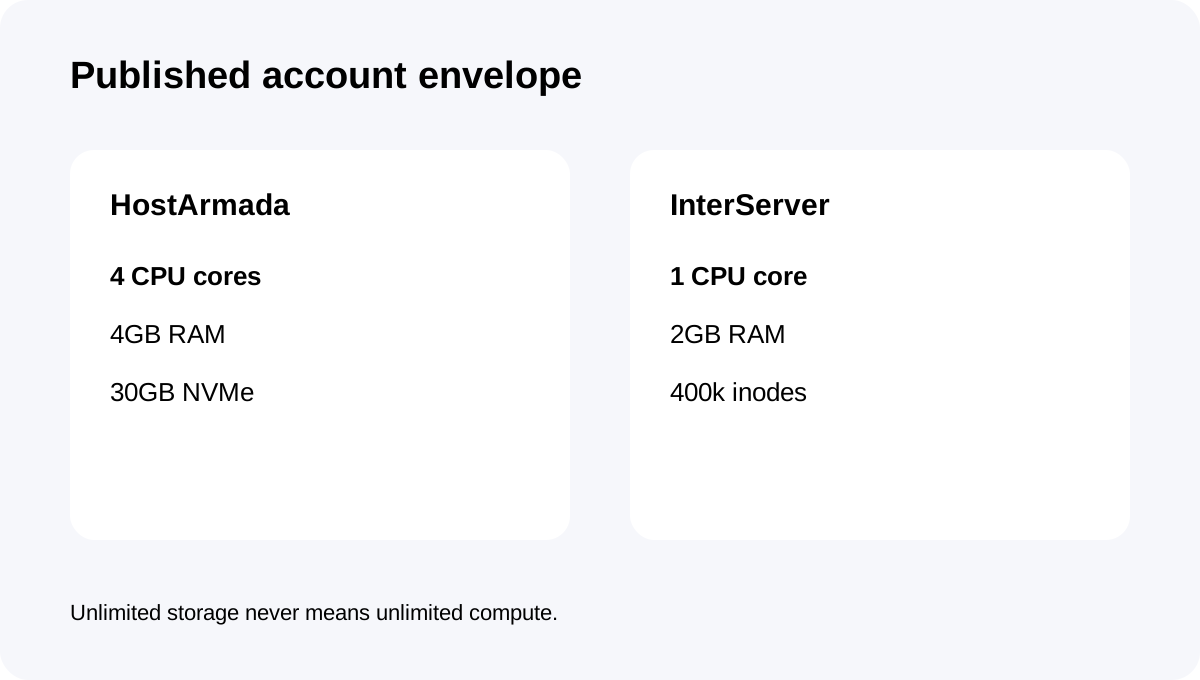
Web Warp publishes 4 CPU cores, 4GB RAM and 30GB NVMe. Those numbers are useful when you are deciding whether several WordPress sites can share the account, because you have a visible CPU/memory ceiling.
InterServer Standard publishes a baseline of 1 CPU core, 2GB memory, 100 processes, 30 entry processes and 400,000 inodes. Its main plan page simultaneously advertises unlimited storage and transfer for ordinary website/email use. “Unlimited” therefore describes quota policy, not unlimited compute.
A portfolio with lots of static media but modest concurrency can prefer InterServer's storage policy. A smaller number of dynamic PHP sites with burstier application work may value HostArmada's higher published CPU/RAM allowance more.
Backup cadence is a real purchase difference
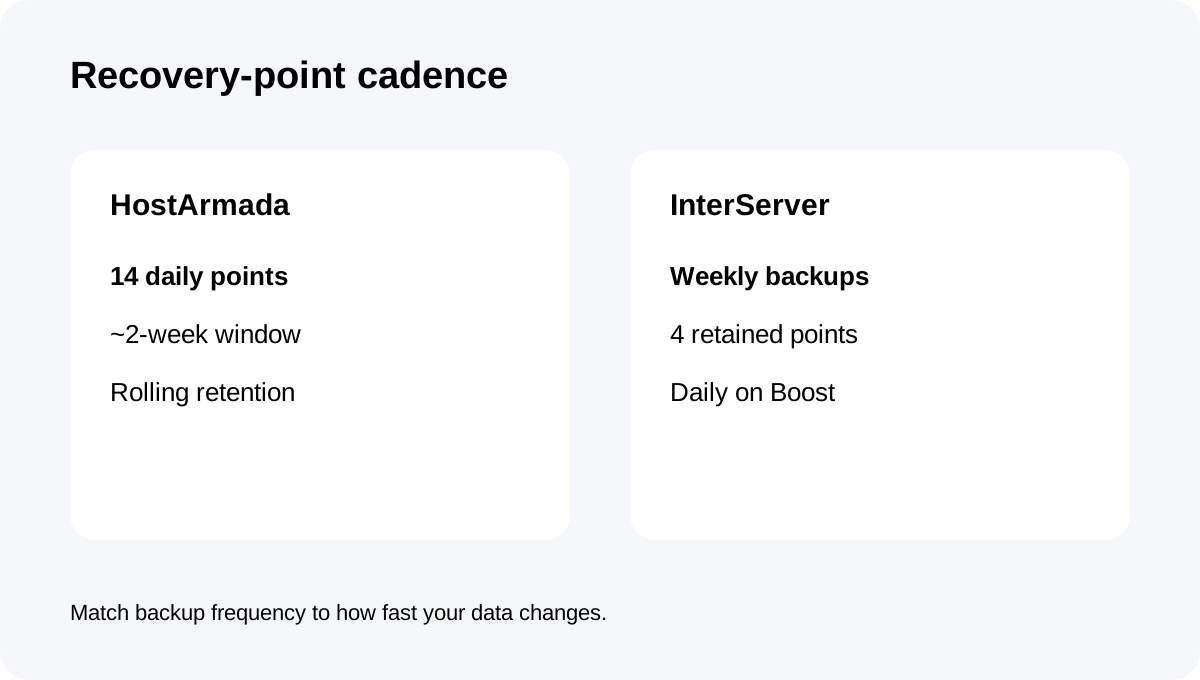
HostArmada Web Warp keeps **14 daily backup points** on a rolling basis. Day 15 replaces the oldest point, so the practical recovery window is about two weeks.
InterServer Standard uses JetBackup on a weekly schedule with four retained backups, or roughly four weekly restore points. Its documentation says daily backups are part of Boost upgrades rather than Standard.
For a site that changes every day—orders, memberships, editorial work—the difference between daily and weekly recovery points can matter more than storage size. But neither schedule removes the need for an independent backup before major updates or migrations.
Security bundles do not erase recovery responsibility
HostArmada lists free SSL, malware scanning/removal, WAF and IP firewall features for Web Warp.
InterServer Standard includes InterShield protections, virus scanning, SSL support, LiteSpeed/Cloudflare tooling and normal shared-hosting management.
Those controls reduce common risk but do not guarantee that a broken plugin, bad deployment or compromised administrator account will be harmless. A buyer should still test an actual restore, keep domain/DNS credentials separate, and save at least one backup outside the hosting account.
Commitment length can outweigh the resource gap
HostArmada asks you to lock the best displayed rate into a long 36-month term. That is attractive when the workload is stable and you are confident in the platform.
InterServer's published 6-, 12- and 24-month prices make it easier to buy a shorter horizon. The trade-off is that renewal totals rise materially, and the Standard resource baseline is lower.
Independent comparison pages confirm that buyers frequently evaluate these two brands directly, but their ratings and speed claims are not decision evidence here. Current official plan and policy pages control the numbers.
Checkout checklist
For **HostArmada**, verify Web Warp, the 36-month total, any free-month handling, next-term renewal amount/cycle, 4-core/4GB limit, 30GB NVMe, 14-day backup window and migration/domain conditions.
For **InterServer**, verify DirectAdmin Standard, selected term, exact first invoice and renewal total, 1-core/2GB baseline, weekly/four-point backups, 400,000 inodes and whether your storage use counts as normal website data.
**Bottom line:** HostArmada Web Warp can actually cost less over the first three years while publishing more CPU/RAM and more frequent backups. InterServer Standard wins when shorter commitment and generous normal-use storage matter more than those limits.