TOOLNAVIA / BUYING GUIDE
GreenGeeks Premium Redis: Setup Checks and Black Friday Upgrade Costs
The short answer
GreenGeeks Premium is a reasonable upgrade candidate when a WordPress site has repeated database work that persistent object caching can reduce. Buy it only after confirming Redis on the assigned server and checking the renewal budget. A Premium badge alone does not prove a working cache or a faster checkout.
This is an official-documentation review, not an account benchmark.
At a glance
- Best for
- Confirmed Redis workload and renewal budget
- Price model
- $6.95/mo prepaid12months; renewalreference$30.95/mo
- Check first
- Redis availability varies; cache memory unverified
Check the server before paying for Redis
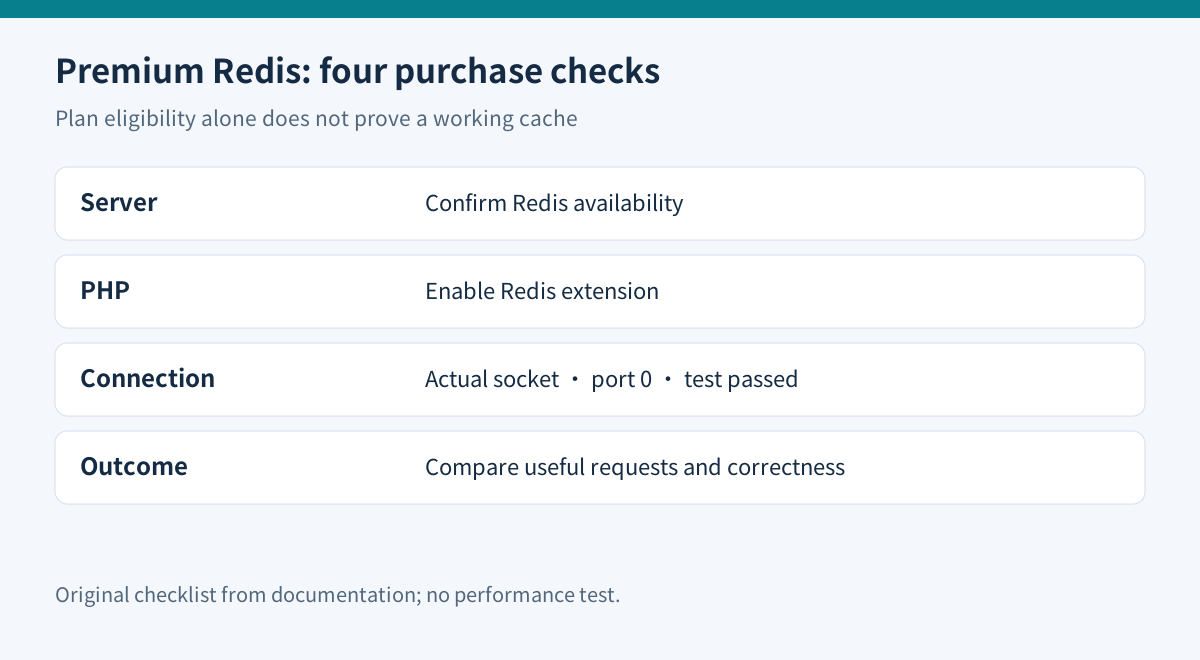
GreenGeeks lists Redis and object caching for EcoSite Premium, rather than Lite or Pro. Its setup article also says deployment is still rolling out and availability differs by server. Ask support to confirm the destination server before buying or upgrading. The same article describes a Redis instance per Premium customer; that is not a dedicated physical hosting server.
Get three answers in writing: Is Redis available for this account? What memory ceiling applies to the cache? What migration or upgrade charge will appear now? The plan's published memory allowance should not be treated as a promise that all of it belongs to Redis.
Separate three kinds of caching
WordPress normally retains its object cache only during a request. A persistent backend can reuse suitable stored results across requests; simply adding a cache constant is not sufficient.
Full-page caching serves a generated page, while object caching reuses underlying data. Browser caching keeps static assets on the visitor's device. LiteSpeed documents these separately and relies on an external service for its object-cache connection. A mostly static brochure site may already be adequately served by its current page cache. That is a reason to measure first, not an automatic argument for a higher plan.
Verify a connection before judging the upgrade
The documented GreenGeeks route is to enable Redis in cPanel, record the account's actual socket path, and enable the Redis PHP extension through the PHP selector. Its native PHP option does not include that extension. In LiteSpeed Cache, enable Object Cache, choose Redis, use the supplied socket path and set port to zero. Check for a passed connection test.
Do not copy the example username or socket into a different account. Disable temporary debugging after diagnosis. Connection success establishes reachability, not speed, correctness or sufficient capacity.
For a practical acceptance exercise, record comparable uncached and logged-in tasks before and after activation: loading an admin list, updating a product and completing a permitted test purchase. Keep the content, plugins and request mix consistent. Inspect stale data as well as response time. These are suggested checks; Toolnavia has not performed them.
More resources are still finite
| Published support-table allowance | Pro | Premium | |---|---:|---:| | CPU allocation | 3 CPUs | 4 CPUs | | Account memory | 2 GB | 3 GB | | Disk throughput | 15 MB/s | 20 MB/s | | Inodes | 400,000 | 600,000 |
The support table is a plan reference, not measured dedicated hardware. Confirm current account limits. Its older introductory prices conflict with the live campaign, so those prices are not used below.
Redis can evict cached keys when a configured memory threshold is reached, depending on policy. Ask which threshold and policy the host applies; do not assume that a cache can hold the whole database. Cache data is also not an independent backup of orders or customer records.
Compare the recurring gap, not just the first year
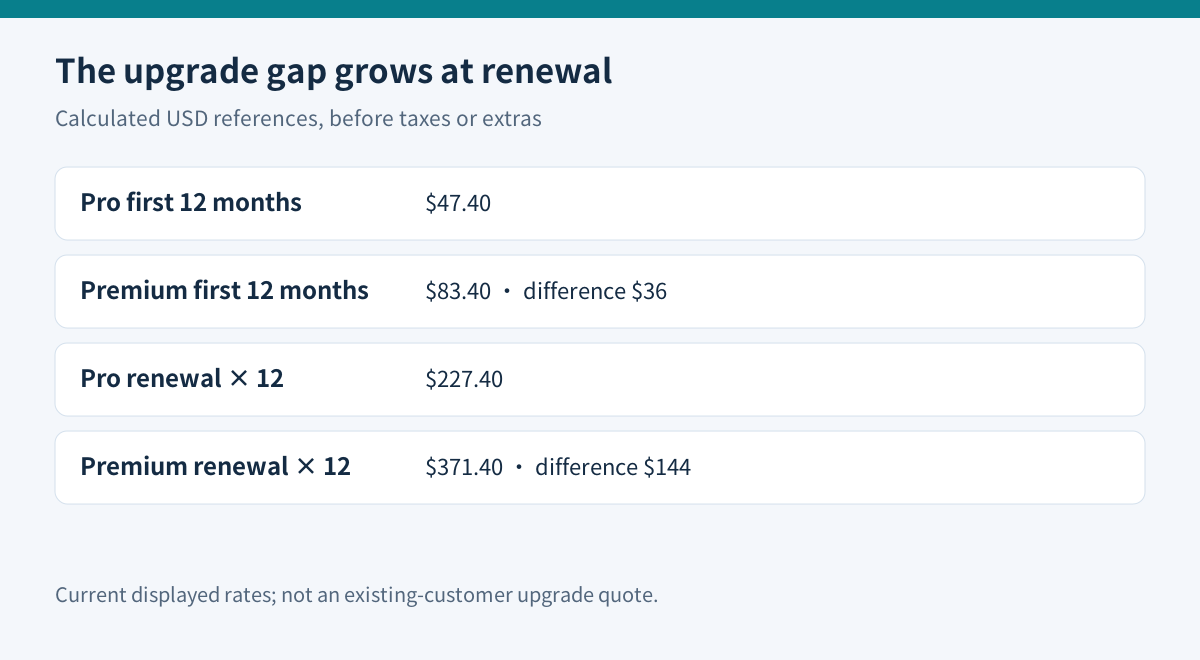
The current early Black Friday page shows Premium at $6.95/month prepaid for twelve months, with a $30.95 monthly renewal reference. Pro shows $3.95 and $18.95 respectively.
| Calculated reference before tax | Pro | Premium | Premium costs more | |---|---:|---:|---:| | First twelve months | $47.40 | $83.40 | $36 | | Twelve renewal months at displayed rates | $227.40 | $371.40 | $144 |
These are calculations from displayed rates, not checkout invoices or an existing customer's upgrade quote. Premium includes 100 GB storage; unlimited website counts do not make storage unlimited. Check optional extras and billing selections before payment.
Initial hosting purchases have a conditional thirty-day refund policy; renewals and specified extras are excluded. Turning off auto-renewal requires at least five business days' notice under the terms. The annual price should not be treated as a month-to-month experiment.
A clear buying threshold
Stay on Pro if the current site meets its needs or the expensive work cannot benefit from persistent object caching. Consider Premium when Redis availability is confirmed, measured work justifies it, and the renewal difference fits your budget. For larger needs, request a separately specified hosting comparison rather than treating this shared plan as a dedicated server.
Disclosure: Toolnavia may receive commission from qualifying purchases through its official GreenGeeks referral. Promotional purchases can have different commission eligibility; no additional cashback or invented coupon is offered.