TOOLNAVIA / BUYING GUIDE
GreenGeeks Lite with Cloudflare: DNS Ownership and Full (strict) SSL
The short answer
At a glance
- Best for
- Named external DNS owner and valid origin certificate.
- Price model
- Lite display: US$1.95/mo prepaid 12 months; renewal US$13.95/mo. Help-page price/site limits conflict.
- Check first
- Retired cPanel plugin; no measured speed claim; checkout and site entitlement require confirmation.
Verdict: buy the operating model, not the CDN badge
GreenGeeks Lite can work with Cloudflare, but a buyer must accept direct Cloudflare DNS management. The former cPanel partner plugin was discontinued; a current compatibility listing does not bring it back. If your team expects one host dashboard to own every DNS change, settle that responsibility before buying.
This is an analysis of current official documentation, not a live migration or speed test. The useful purchase question is who can maintain the active DNS zone, preserve email records and keep the origin certificate valid. Cloudflare does not remove those jobs.
Check the current exact GreenGeeks Lite offer.
*Affiliate disclosure: Toolnavia may earn a commission through this approved direct link. The link does not resolve the price and entitlement discrepancy below.*
What changes after the cPanel plugin retires
GreenGeeks says new domains must be configured directly in Cloudflare. Its deprecation notice also says existing Cloudflare-pointed domains are not affected merely by removal of the plugin. Those are different situations: an existing working zone does not need an unnecessary migration, while a new zone needs a deliberate setup and an accountable administrator.
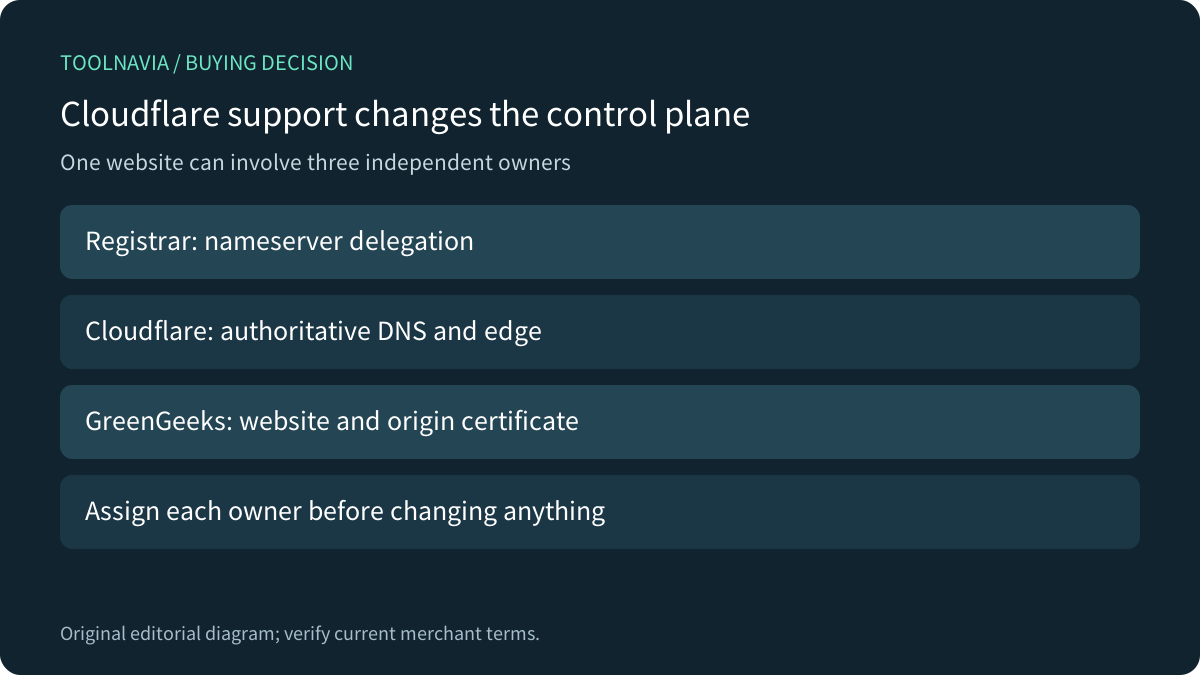
Write down three owners: the registrar account that delegates nameservers, the Cloudflare account that publishes authoritative records, and the hosting account that serves the website. One person may own all three, but the roles remain separate. After delegation, editing an old cPanel DNS zone may do nothing publicly. Kinsta and Namecheap guidance reinforces the need to update the currently authoritative zone rather than whichever dashboard is familiar.
Lite has four relevant documented strengths: compatibility with an external Cloudflare zone; a documented Full (strict) origin-SSL path; continuity for previously configured Cloudflare zones; and a current supported-software matrix. None proves a speed improvement for your site, an integrated activation button or a guaranteed recovery time.
Validate both TLS legs
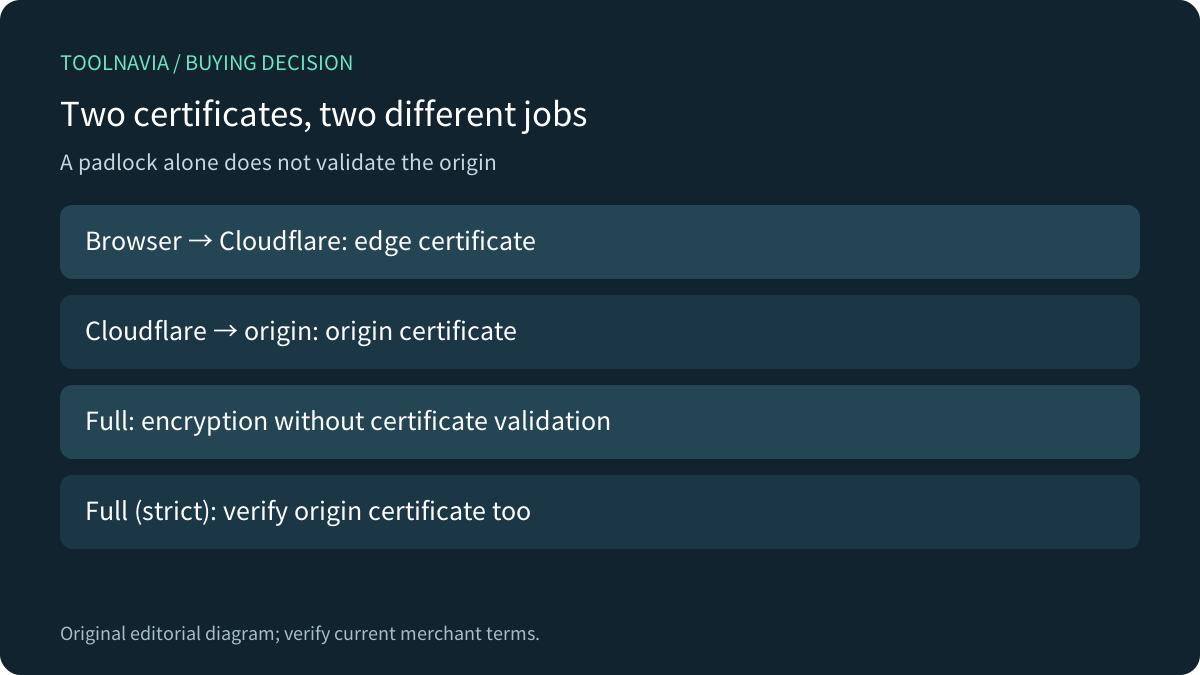
There are two connections: visitor to Cloudflare, then Cloudflare to GreenGeeks. An edge certificate protects the first connection. The origin certificate and SSL mode determine the second. GreenGeeks warns against Flexible because the origin leg remains HTTP. Its guide calls Full recommended and also explains that Full (strict) works with a valid origin certificate.
Cloudflare's current documentation prefers Full (strict) whenever possible. Strict checks that the origin certificate is unexpired, trusted through a public authority or Cloudflare Origin CA, and matches the hostname; the origin must accept HTTPS on port 443. A failed check can cause 526. Treat that as a certificate or configuration problem to diagnose, not as a reason to make insecure settings permanent.
For a small GreenGeeks site that might later bypass Cloudflare during recovery, a publicly trusted origin certificate is the simpler planning choice. Cloudflare Origin CA trust is specific to the Cloudflare-origin route; do not assume a direct browser connection will trust it. Confirm apex and www coverage, expiry and renewal ownership before the cutover. No certificate was installed or tested for this article.
Move records, not just the homepage
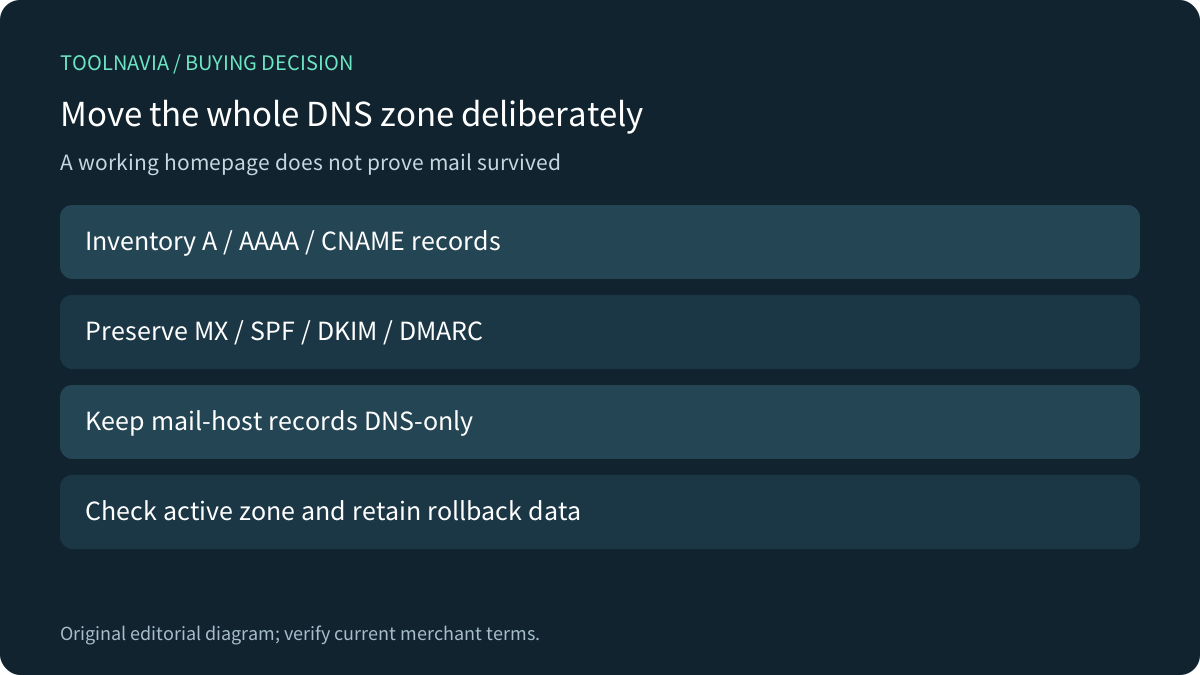
Inventory the existing A, AAAA and CNAME records, then mail and verification records: MX, SPF, DKIM, DMARC and relevant TXT entries. Record the current nameservers and values before any change. Imported DNS scans are a starting point; compare them with the known-good zone instead of assuming completeness. GreenGeeks describes recreating records, and Namecheap warns that future DNS changes belong at Cloudflare after delegation.
Cloudflare web proxying and DNS hosting are separate choices. Eligible A, AAAA and CNAME records can be proxied; MX and TXT are DNS-only. A mail-server hostname should also remain DNS-only for ordinary mail service. An orange cloud on a web hostname does not prove SMTP or IMAP will work.
Plan the cutover with a recovery owner and a preserved zone export. Compare authoritative answers, apex/www behavior, HTTPS, redirect loops, forms and mail delivery. These are proposed acceptance checks, not tests we performed. Avoid deleting the previous zone or canceling another service as part of the same irreversible step. DNS cache behavior varies, so a provider's typical propagation estimate is not a fixed completion promise.
Price the current Lite offer and the administration
The directly opened canonical sale page currently shows Lite at **US$1.95 per month, prepaid for 12 months**, renewing at **US$13.95 per month**. That is US$23.40 for the first 12 months before tax and optional items. If the displayed renewal rate applied for a full subsequent year, the arithmetic would be US$167.40; confirm the actual renewal invoice rather than treating this calculation as a quote.
There is an unresolved official-source discrepancy. The help pricing table still shows US$2.95 for the12-month introductory term and one hosted domain, while the canonical sale page shows US$1.95 and five websites. Both list25GB. We have not completed checkout or obtained written reconciliation. Plan this guide around one website and require confirmation of the exact invoice and site entitlement before buying for multiple sites.
Include any paid Cloudflare features, domain renewal, migration labor and the time needed to maintain two dashboards. A free DNS tier does not make operational work free. Buying a larger GreenGeeks plan does not itself restore the retired plugin.
Buy, ask first or choose another workflow
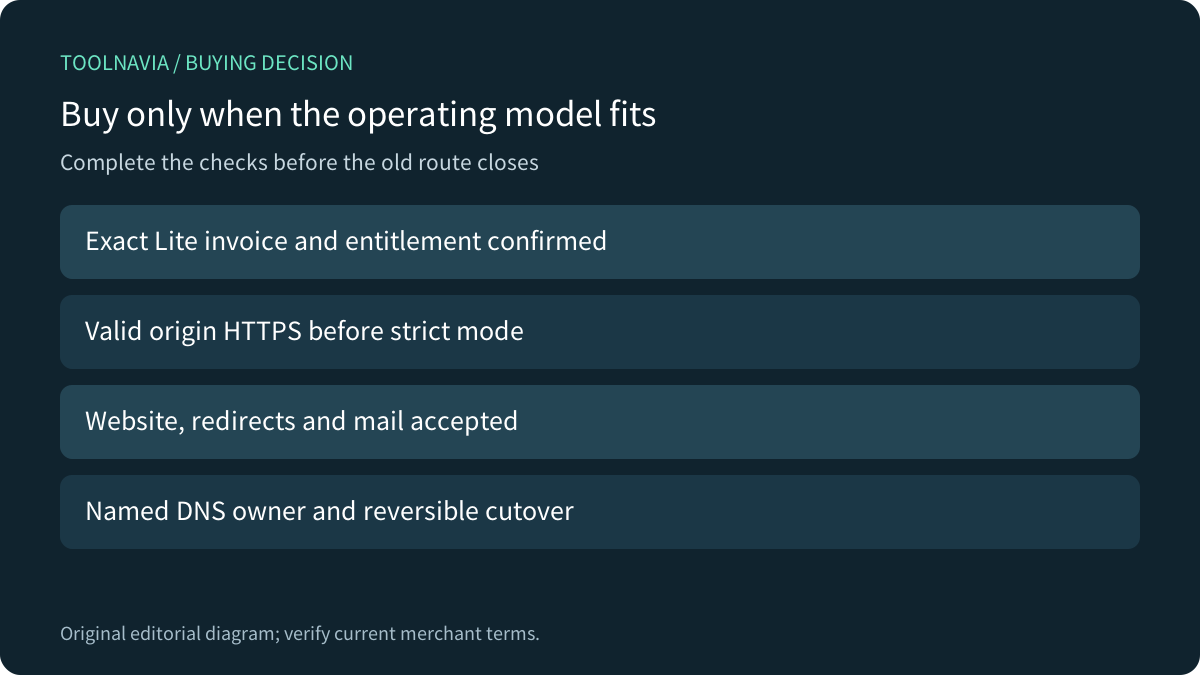
Buy Lite for this use case when one site's requirements fit the confirmed plan, a named person controls the authoritative zone, origin HTTPS validates and the team can test mail separately from the website. Ask GreenGeeks first if the price or website allowance decides the purchase. Choose a different operational workflow if nobody can own DNS and certificate renewal.
The purchase gate is concrete: a confirmed invoice, a known-good record inventory, valid origin TLS, separate website/mail acceptance and a recovery owner. With those in place, external Cloudflare can be a manageable architecture. Without them, a CDN badge is an incomplete buying argument.
Review current GreenGeeks Lite terms through the approved direct link.