TOOLNAVIA / BUYING GUIDE
Writesonic Starter vs Basic: Is 10 More Articles Worth $120/Month?
The short answer
Affiliate disclosure: Toolnavia does not currently have an approved Writesonic offer for either plan. No commercial button or tracking link is enabled in this guide. Prices and limits were checked on October 20, 2026.
At a glance
- Best for
- Solo operators and small teams deciding whether recurring content, monitoring, audit and seat constraints justify Basic.
- Price model
- $79 vs $199 monthly equivalent on annual billing
- Check first
- Official sources conflict on Basic entitlements; no output benchmark; prices require checkout confirmation.
Quick verdict
Choose **Writesonic Starter** when one person manages one project, 15 AI articles per month is enough, and 50 tracked prompts with 50 answers checked daily covers the monitoring brief. Choose **Writesonic Basic** when a second named user, 25 articles, 100 tracked prompts, 300 daily answers, or much deeper site audits will be used every month.
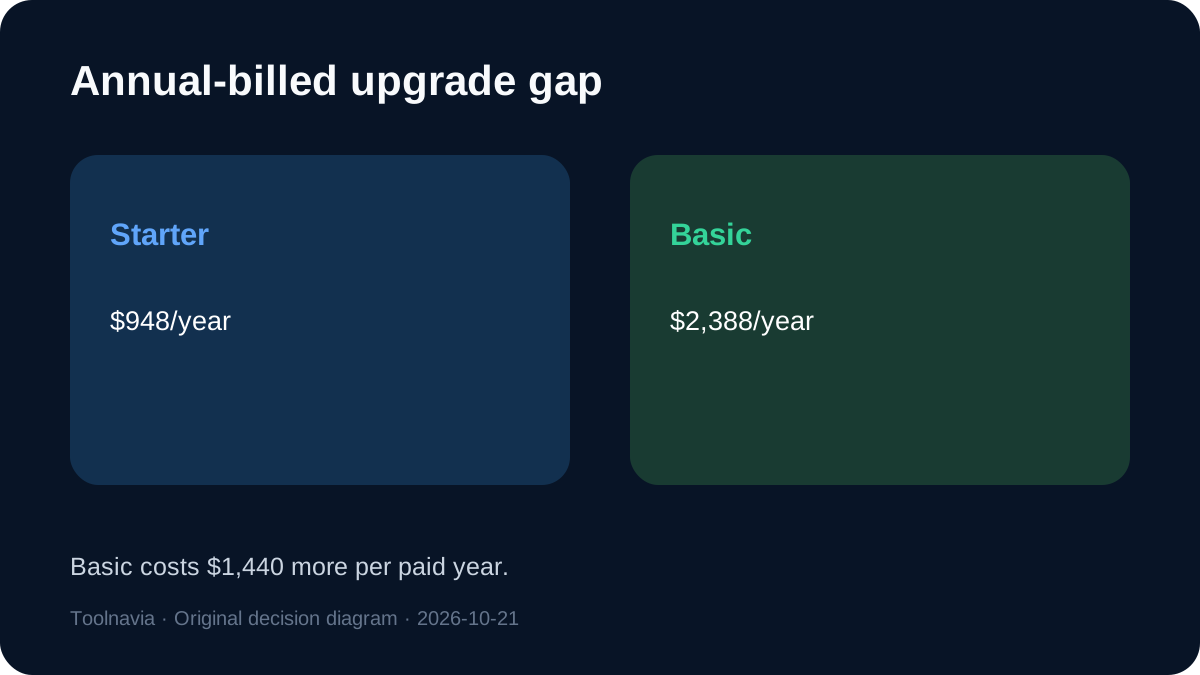
On annual billing, Starter is advertised at **$79 per month** and Basic at **$199 per month**. That is a $120 monthly-equivalent upgrade, or **$1,440 more for a paid year**. The upgrade adds 10 article slots, but treating the whole $1,440 as an article purchase would mean $12 per added slot each month. Basic only makes economic sense when the team also values its second seat, larger monitoring allowance, deeper audits and additional workflow capacity.
Put the upgrade on a full-year cash basis
The pricing page displays $79 for Starter and says annual billing saves $240 per year. That implies a $948 annual charge versus $1,188 across twelve $99 monthly payments. Basic displays $199 on annual billing and a $600 annual saving, implying $2,388 upfront versus $2,988 across twelve $249 monthly payments. Current official and independent sources consistently show the $99 and $249 month-to-month figures, but the checkout remains the controlling source.
Both annual options cross their simple cash break-even during month ten: nine monthly Starter payments total $891, while ten total $990; nine monthly Basic payments total $2,241, while ten total $2,490. Annual billing therefore becomes cheaper only if the team expects to keep the plan for at least ten paid months and can accept the larger upfront commitment.
Do not call the annual saving “free months.” It is a term trade-off. The terms provide a seven-day initial-purchase refund window for self-serve subscriptions, after which fees are generally non-refundable except where law requires otherwise.
What the extra $120 per month actually adds
The current pricing page lists these Starter limits: 50 tracked prompts, 50 answers tracked daily, 15 AI articles per month, 10 site audits covering 100 pages each, 10 agentic-workflow trial runs, one user and one project.
Basic lists 100 prompts, 300 answers tracked daily, 25 AI articles, 20 site audits covering 1,200 pages each, 50 agentic-workflow trial runs, two users and one project.
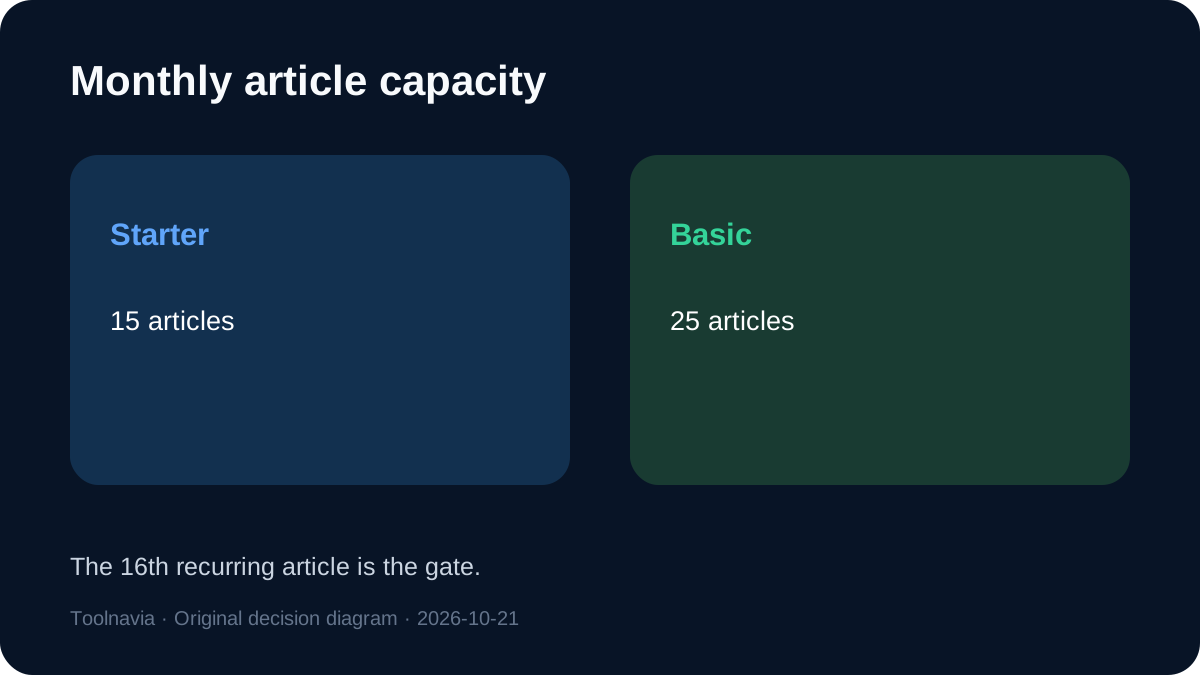
The article allowance rises by 66.7%, from 15 to 25, while the annual-billed price rises by 151.9%, from $79 to $199. That does not make Basic poor value; it shows that the real upgrade product is a bundle of monitoring, auditing, workflow and collaboration capacity. A buyer who needs only 16 articles should first price the marginal work another way instead of assuming every Basic feature is valuable.
Article economics: the 16th article is a gate, not the whole case
At full use, Starter's annual-billed price is about **$5.27 per included article slot** ($79 ÷ 15). Basic is about **$7.96 per slot** ($199 ÷ 25). The higher plan costs more per slot because it is not sold as a content-only tier. Independent pricing analyses reach the same practical warning: teams that already employ writers may pay for bundled capacity they do not use.
If monthly output normally stays between 8 and 15 articles, Starter has headroom. If a production calendar repeatedly requires 16 to 25 articles and the skipped pieces have measurable value, Basic removes the cap. But occasional spikes do not automatically justify $1,440 more per year. Compare the cost of scheduling overflow into the next cycle, buying outside writing capacity, or improving the editorial acceptance rate.
An “AI article” is also a usage unit, not a guarantee of a publish-ready page. Human fact-checking, brand review, legal review, original evidence and editing still consume time. We did not test output quality, so this guide compares published commercial limits rather than claiming one tier creates better articles.
Prompt tracking and answer volume may justify Basic first
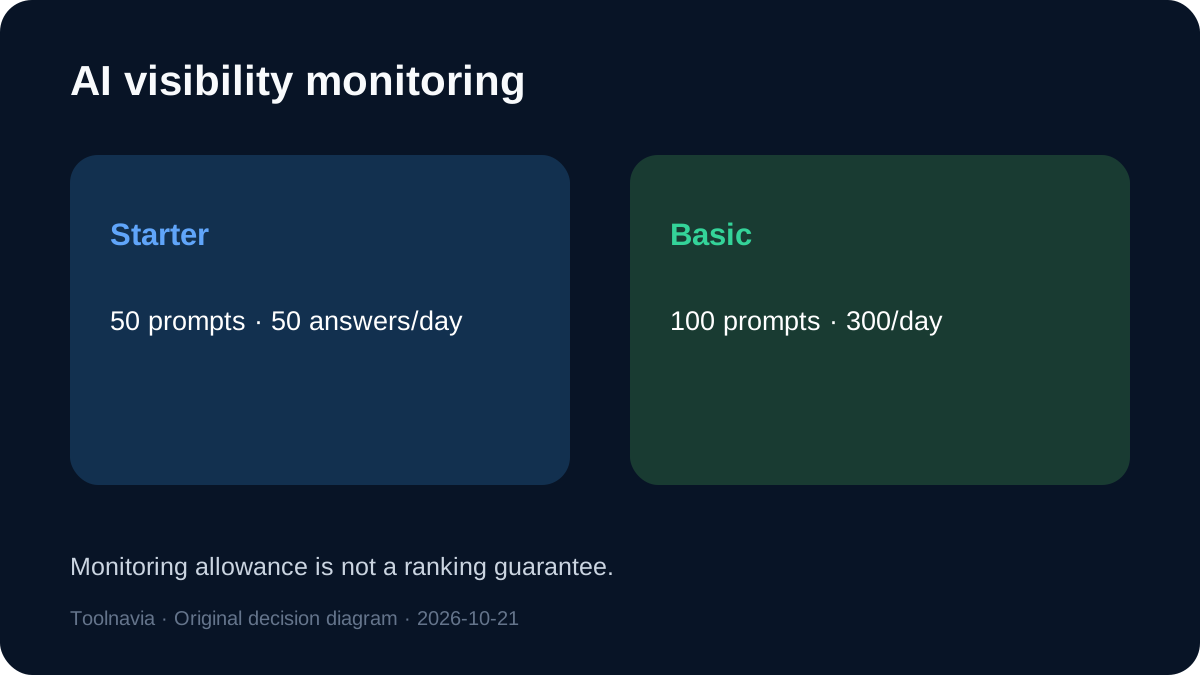
Starter tracks 50 prompts and checks 50 answers daily. Basic doubles the prompt allowance to 100 and increases daily answer tracking sixfold to 300.
This distinction matters when a team monitors multiple product categories, buyer stages or markets. Fifty carefully selected prompts can be enough for one narrow brand. A broader program may exhaust the prompt list before it exhausts article generation. Basic becomes easier to justify when the extra 50 prompts replace manual monitoring work or when 300 daily answers materially improve coverage of the same prompt set.
Do not translate these limits into search volume, rankings or guaranteed citations. They are monitoring allowances. The product can observe where a brand appears; it cannot guarantee that an AI system will cite or recommend that brand.
Site audits and the second seat are the strongest non-article triggers
Starter lists 10 audits of up to 100 pages each. Basic lists 20 audits of up to 1,200 pages each. For a small site, Starter's page depth may be sufficient. For a large catalog, documentation hub or publication, 100 pages can omit important templates, while 1,200 pages can cover a much larger technical footprint.
Basic also includes two named users instead of one. Writesonic's terms say a user seat belongs to one named individual and cannot be shared concurrently. If two people need direct access, credential sharing is not a compliant substitute for the second seat.
Basic still lists one project on the current pricing page. It should not be purchased as a multi-brand workspace without checkout confirmation. If the use case involves client separation, several brands or more than two people, compare higher plans or an agency structure before paying.
Important official-source conflict: 25 or 100 articles?
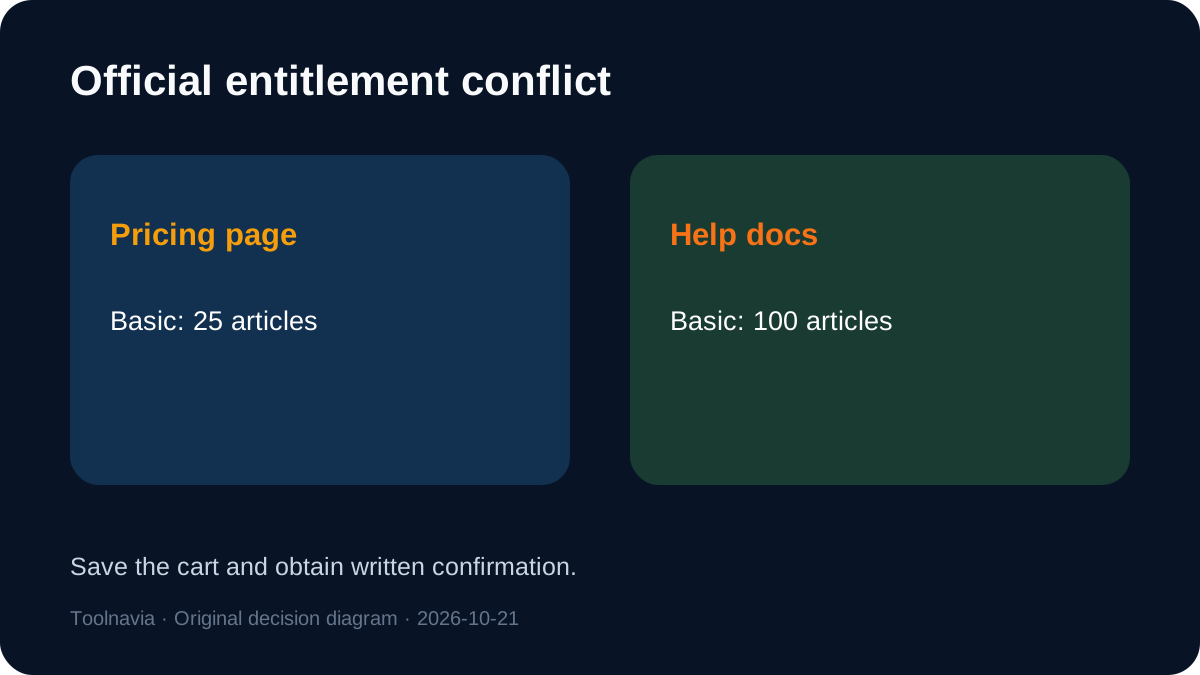
The current pricing page says Basic includes **25 AI articles and 20 audits**, with one project. However, Writesonic's current documentation table still says Basic includes **100 articles, 40 audits and two projects**, while an older official comparison article says Starter includes 100 articles.
These claims cannot all describe the same current self-serve entitlement. This guide therefore uses the live pricing page's 25-article and 20-audit limits for the purchase model, keeps the conflict unresolved, and advises buyers to save the checkout and entitlement screen. The discrepancy is decision-changing: a buyer expecting 100 articles could overpay or choose the wrong tier.
Do not rely on a blog or help-center number when the cart shows something different. Before purchase, ask Writesonic support to confirm in writing the article count, audit count, project count and any overage or upgrade path attached to the exact account.
Usage resets make unused capacity perishable
Writesonic's credit documentation says unused credits do not roll over, remaining credits expire at the end of the cycle, and the allocation resets on the billing date.
That makes average use more important than peak use. A team that publishes 25 pieces once per quarter but 10 pieces in ordinary months may waste Basic capacity during most cycles. Track at least six to eight weeks of accepted articles, prompts and audited pages before upgrading. Count completed, approved outputs—not every generation attempt—because rework can consume capacity without increasing published volume.
Build a small utilization sheet: articles accepted, prompts actively reviewed, answers inspected, pages audited, workflow runs used and named users. Upgrade only when two or more Basic-only capacities are consistently constrained.
Who should choose each plan?
Choose Starter when one operator manages one project; accepted output stays at or below 15 articles; 50 prompts and 50 daily answers cover the monitoring set; the site fits within 100-page audits; and a second account is unnecessary.
Choose Basic when two named users need access, accepted output repeatedly reaches 16–25 articles, more than 50 prompts are genuinely reviewed, 300 daily answers improve monitoring coverage, or the site needs audit depth beyond 100 pages.
Stay on Starter when the only reason to upgrade is one busy month, when writers already supply the content capacity, or when the team will not review the additional monitoring data. Basic's value comes from using the bundle, not merely possessing higher limits.
Checkout checklist
1. Confirm the cart shows Starter $99 monthly or $948 annually, and Basic $249 monthly or $2,388 annually. 2. Save the exact entitlement screen for articles, audits, projects, prompts, daily answers, users and workflow runs. 3. Ask support to resolve the 25-versus-100 Basic article conflict in writing. 4. Measure eight weeks of accepted article output rather than requested drafts. 5. Verify that two named users—not shared credentials—are required. 6. Check whether one project is sufficient for every brand or client. 7. Model annual cash only if at least ten paid months are likely. 8. Note that unused recurring credits do not roll over. 9. Use the seven-day initial-purchase refund window only as stated in the current terms; do not assume later refunds.
Final recommendation
Starter is the better default for a single operator with a focused monitoring set and no more than 15 accepted articles per month. Basic is worth the $120 monthly-equivalent premium when the second seat, 16th through 25th article, doubled prompts, sixfold daily answer tracking or 1,200-page audits solve a recurring bottleneck.
The safest decision is to use current pricing-page limits, preserve a screenshot of the cart, and obtain written confirmation of the conflicting Basic article allowance before paying.