TOOLNAVIA / BUYING GUIDE
Descript Creator vs Business: When Is the $312 Upgrade Worth It?
The short answer
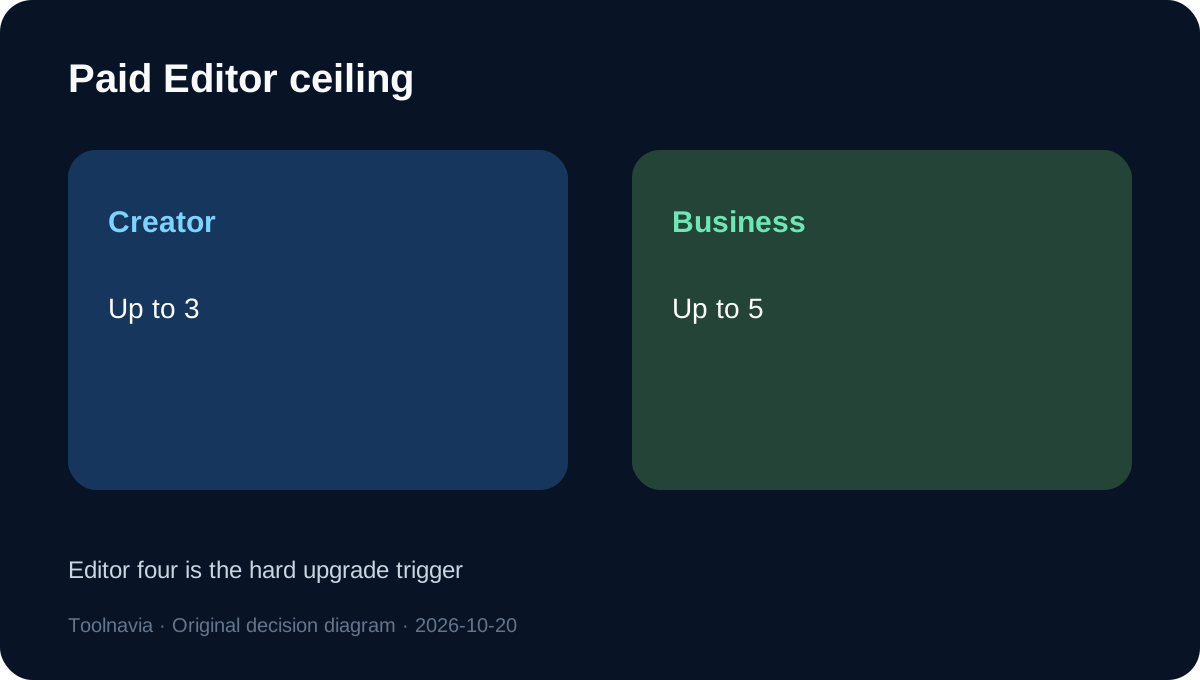
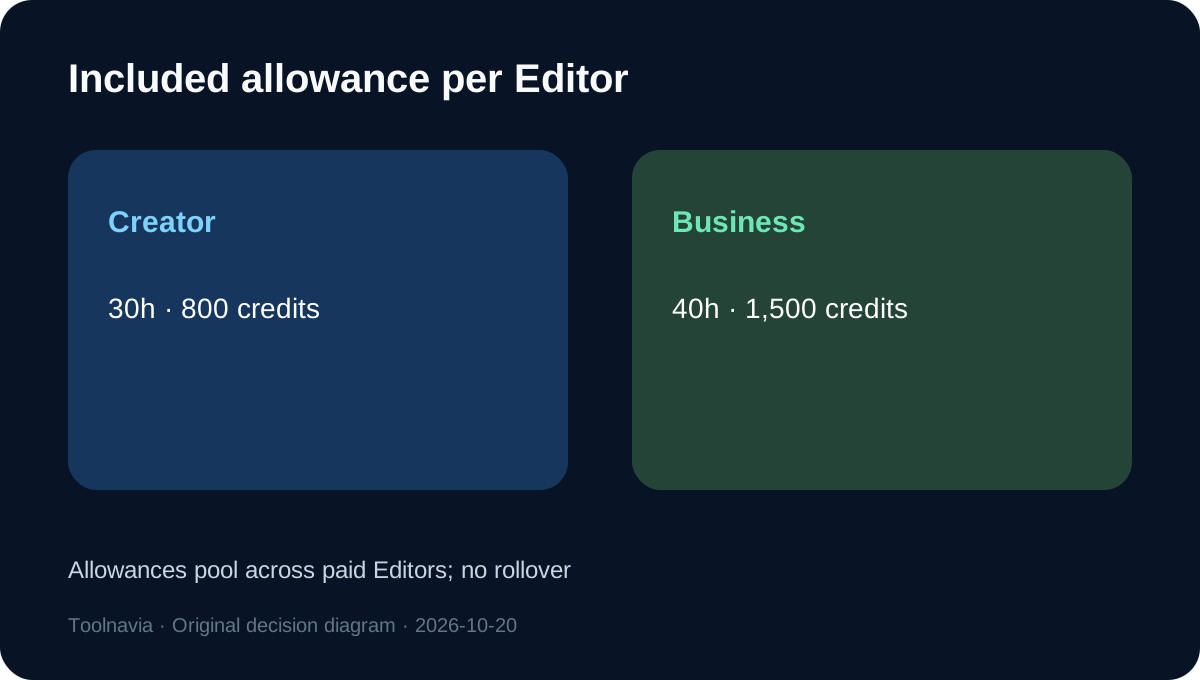
Descript Creator and Business are separated by an exact per-person price, a hard team-size ceiling, a modest allowance increase, and a short list of workflow features. Creator is **$24 per person per month when billed yearly or $35 monthly**, supports up to **three paid Editors**, and includes 30 media hours plus 800 AI credits. Business is **$50 yearly-billed or $65 monthly per person**, supports up to **five paid Editors**, and includes 40 media hours plus 1,500 AI credits.
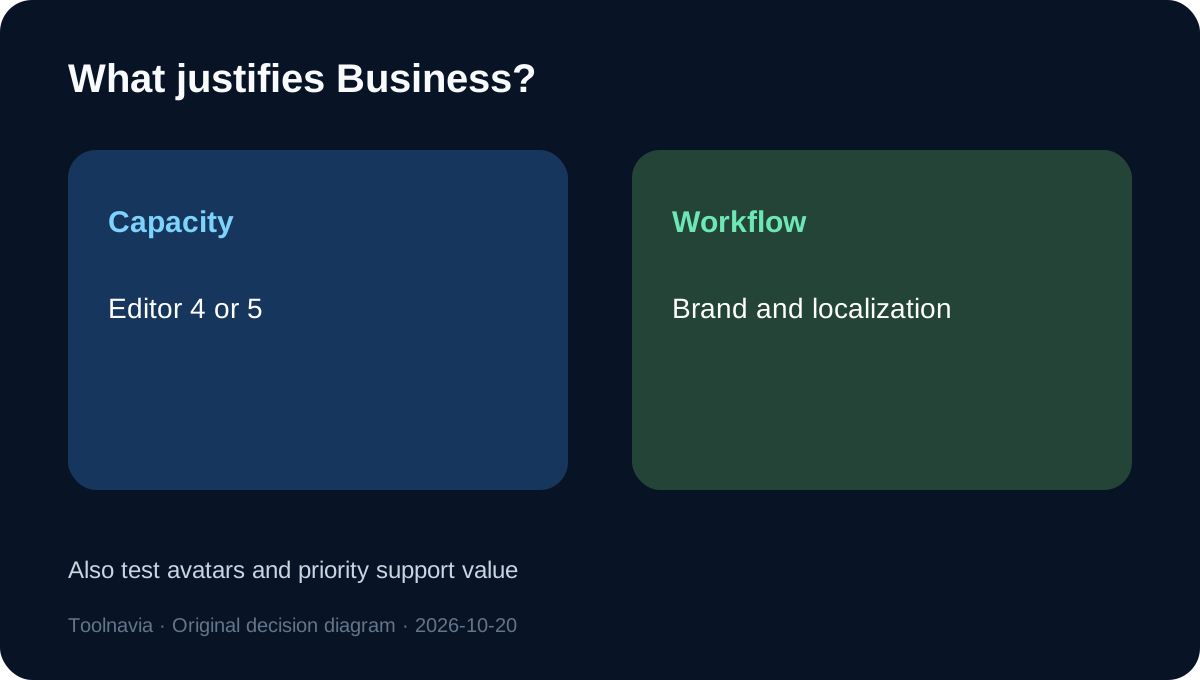
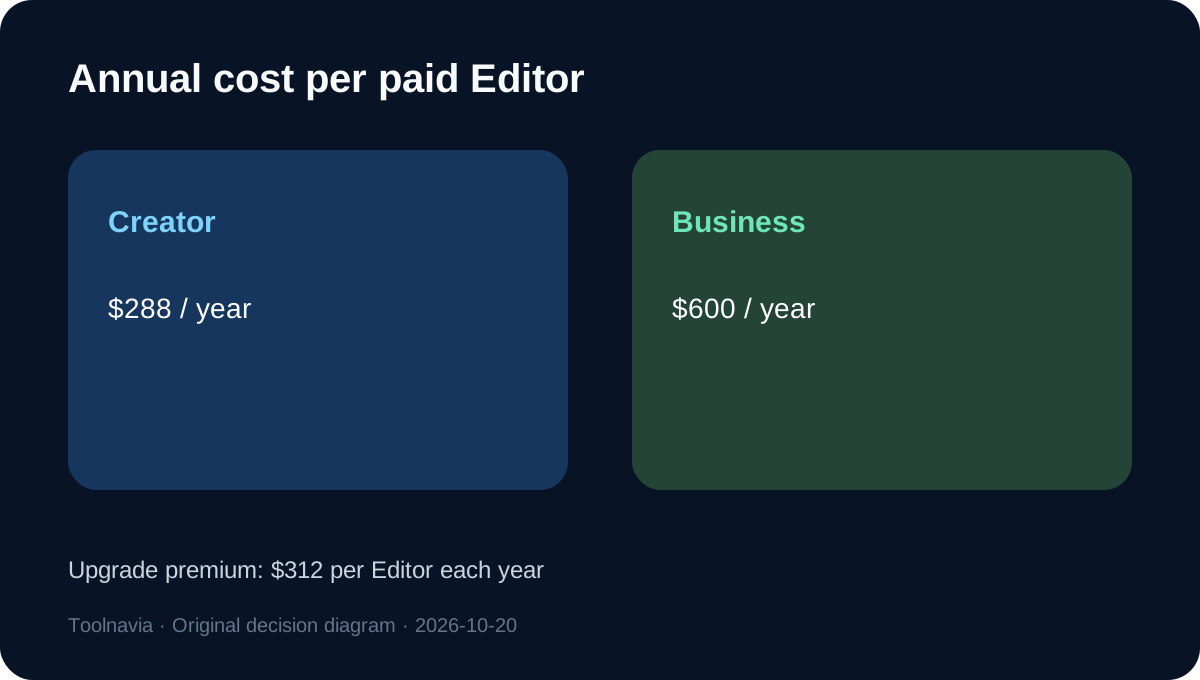
That makes the annual upgrade premium **$312 per paid Editor**: $600 for Business minus $288 for Creator. On monthly billing, the difference is $30 per month, or $360 across twelve payments. The upgrade is usually rational only when a team needs editor four or five, Brand Studio, proofread translation and dubbing, custom avatars, or the priority support SLA. Ten extra media hours alone are a weak reason to pay the premium.
Affiliate disclosure: Toolnavia has no approved Descript affiliate relationship. The exact offers are disabled, no tracking link or commercial CTA is shown, and every buyer should verify the current checkout price directly with Descript.
At a glance
- Best for
- Teams deciding whether a fourth or fifth paid Editor, Brand Studio, localization, custom avatars or priority support justifies Business.
- Price model
- Creator $24 yearly-billed or $35 monthly per person; Business $50 yearly-billed or $65 monthly per person
- Check first
- No hands-on output benchmark, negotiated discount, tax estimate or affiliate CTA; prices and allowances must be rechecked before purchase.
Quick verdict
Keep Creator when one to three paid Editors can share a workflow without Business-only controls. Upgrade when a fourth paid Editor is operationally necessary or when a Business feature replaces a recurring outside cost worth at least **$26 per month per paid Editor** on annual billing.
Do not use “more AI” as the whole case. Creator already provides 30 media hours and 800 AI credits; Business raises those to 40 and 1,500. Because the higher plan costs $26 more per person each month on annual billing, the allowance-only economics are worse: Creator is about **$0.80 per included media hour**, while Business is about **$1.25**.
Put the premium on one clock
The cleanest comparison is annual cash per paid Editor:
- Creator: $24 × 12 = **$288 per year**. - Business: $50 × 12 = **$600 per year**. - Upgrade premium: **$312 per year**, or $26 per month. - Monthly billing premium: ($65 − $35) × 12 = **$360 per year**.
For three Editors, annual Creator is $864 and annual Business is $1,800, a $936 difference. For four Editors, Creator is not a valid configuration because its published ceiling is three; Business is $2,400 per year. At that point there is no honest price break-even between equivalent configurations. The fourth Editor is a capability trigger, and the decision becomes whether the fourth paid seat is necessary.
Taxes, local currency, top-ups, and later price changes are outside this arithmetic. Recheck checkout before authorizing spend.
Extra hours are not the reason alone
Business adds 10 media hours and 700 AI credits per paid Editor. That matters for teams that regularly approach both ceilings, but allowances reset at the start of each billing cycle and unused capacity does not roll over. Every paid Editor adds allowances to a shared account pool, while viewers and project-level editors cannot use metered features.
This creates two lessons. First, adding a paid Editor increases both collaboration capacity and the shared allowance pool; do not model seats and usage as independent purchases. Second, a contractor who only comments may not need a paid seat. A project-level editor can make timeline edits, but cannot upload media, record, or use AI. If that person must do those tasks across the Drive, a paid Editor seat becomes appropriate.
Before upgrading, measure two full billing cycles: media hours used, AI credits used, people who actually need upload/record/AI access, and top-up cost. If Creator remains below its limits, Business needs a workflow justification rather than an allowance justification.
Editor four is the hard boundary
Creator permits up to three paid Editors; Business permits up to five. A team of four people does not automatically need four paid Editors, because commenters and restricted project collaborators can participate without the same metered capabilities. But once four named people each need persistent upload, recording, AI, and Drive-level work, Creator no longer fits.
Use this role audit:
1. Map every collaborator to the exact work performed. 2. Keep reviewers and commenters in non-paid roles where sufficient. 3. Count only people who need metered production actions as paid Editors. 4. If that count reaches four, price Business at $600 per person per year before tax.
This avoids buying Business merely because a stakeholder wants visibility.
Shared pools change capacity planning
Descript pools the allowances contributed by paid Editors at the account level. Two Creator Editors therefore bring 60 media hours and 1,600 AI credits to the shared pool; three bring 90 hours and 2,400 credits. Two Business Editors bring 80 hours and 3,000 credits; five bring 200 hours and 7,500 credits.
Those are arithmetic scenarios, not promises about future pricing or productivity. Uneven teams rarely consume capacity equally. A producer may use most media hours while a manager uses almost none. A shared pool absorbs that imbalance, but a new seat should not be justified by one heavy user's consumption without comparing a top-up or process change.
Business features that can justify the premium
The current pricing page lists Brand Studio, proofread translation and dubbing in more than 30 languages, custom avatars, and a priority support SLA. Each should be tied to a recurring avoided cost.
- **Brand Studio:** value time saved correcting layouts, fonts, and brand consistency. - **Proofread translation and dubbing:** compare the $312 annual per-seat premium with the external localization bill, while retaining human review for sensitive material. - **Custom avatars:** treat them as a production option, not guaranteed audience lift. - **Priority support SLA:** value it only if delayed editing affects launches, client delivery, or revenue.
Upgrade only when annual value of required Business-only features exceeds $312 per paid Editor, or when the three-Editor ceiling blocks a necessary fourth or fifth producer.
Cancellation and seat-change risks
Descript says cancellation or downgrade takes effect at the end of the current billing cycle, so access continues through that period. Its refund policy says unused time is generally not prorated. Upgrades can take effect immediately with a prorated charge or credit, and a newly added Editor seat may be eligible for a refund request within seven days.
Annual prepayment is therefore a commitment. Before upgrading:
- confirm paid Editors rather than total collaborators; - document who owns Brand Studio and localization workflows; - record the renewal date and internal cancellation owner; - verify whether top-ups, taxes, and seat changes alter the total; - keep a dated screenshot or invoice of checkout terms.
Upgrade checklist
Choose Creator if all five statements are true:
- no more than three people need paid Editor capabilities; - 30 media hours and 800 AI credits per seat are adequate after observing real use; - project-level editors and commenters cover limited collaboration; - Brand Studio, proofread localization, custom avatars, and priority SLA are optional; - a $312 annual premium per person would not replace a larger recurring cost.
Choose Business if any hard trigger is true:
- four or five people each need full paid Editor capabilities; - standardized brand production is mandatory across a recurring team; - proofread multilingual output replaces a larger measured external workflow; - custom avatars are a required production input; - priority support has documented operational value.
Final recommendation
For one to three Editors, Creator is the cost-efficient default. Its $288 annual per-person price, shared allowances, and project collaborator roles are capable enough for many small teams. Business should not be bought for ten extra media hours alone. Its best case is a team that crossed the three-Editor ceiling or can name a Business-only workflow worth more than $312 per paid Editor each year.
Independent pricing guides broadly confirm the current per-seat prices and the idea that the Business premium pays for team capabilities rather than raw hours. One independent review describes extra “bonus” allowances beyond the official 40 hours and 1,500 credits. This article does not use that claim because the current Descript pricing page is the controlling source.