TOOLNAVIA / BUYING GUIDE
MailerLite Comfort 500: Will 5,000 Emails Last a Month?
The short answer
At a glance
- Best for
- Small marketing teams with known monthly send usage
- Price model
- Public USD reference $12/mo or annual $129.60 for 500 tier; verify live
- Check first
- 5,000 sends; auto-tier upgrade; variable taxes and billing
What you are buying: 500 contacts, not unlimited newsletters
MailerLite's Comfort plan has a useful entry tier for up to 500 subscribers and advertises 50 active automations. But a small business that sends frequent newsletters may encounter a different ceiling first. At this subscriber tier, Comfort currently provides 5,000 emails per month. Its definition is precise: one email sent to one subscriber consumes one email send. A broadcast delivered to 500 people spends 500 of those sends, not one. The practical question before paying is therefore not simply how many workflows you can create, but how many recipient-level messages those workflows and campaigns will generate together.
**Our short verdict:** Comfort 500 fits a modest permission-based newsletter operation that stays comfortably below 5,000 monthly sends and values the paid features. It is less obviously economical for a team planning several full-list broadcasts each week plus welcome sequences. The number of active automations does not increase your monthly email allowance. Decide from an actual campaign calendar, not an appealing feature count.
How quickly eight newsletters can use 4,000 sends
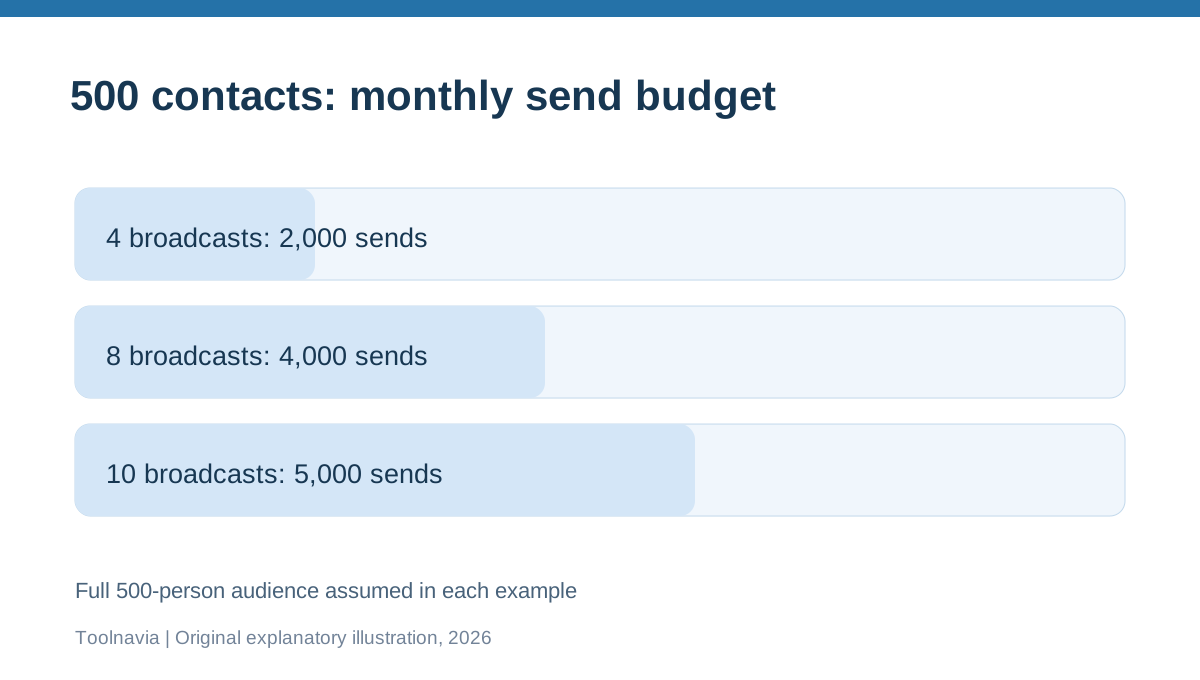
Treat each campaign as the number of recipients actually mailed multiplied by the number of times that campaign runs. On a full 500-person list, four newsletter editions in a billing cycle consume 2,000 messages and leave 3,000. Eight editions consume 4,000 and leave only 1,000 for welcome email steps, targeted promos and unexpected extra editions. Ten editions at 500 recipients consume 5,000, exhausting the allowance before any automation email is sent.
For a more complete hypothetical example, suppose your 500-person list receives eight newsletters and 200 new signups each receive a three-message onboarding sequence within the same billing period. Newsletter volume is 500 × 8 = 4,000; onboarding volume is 200 × 3 = 600; total expected sending is 4,600, with a 400-message margin. This is arithmetic for buyer planning, not a measurement from a live account. If you send an edition to a segment of 120 instead of the full 500, that edition consumes 120 sends. If people do not progress through all automated steps, the true number is lower. The unit being charged against the quota is the individual email sent, not a workflow or campaign object.
A calendar may contain more than eight editions in a month if you normally send twice a week. Plan against the actual renewal-to-renewal billing period, and give yourself room for a seasonal promotion or product launch. A safe buffer is a budgeting choice, not a vendor-promised grace allowance.
The 50-automation claim is a different limit
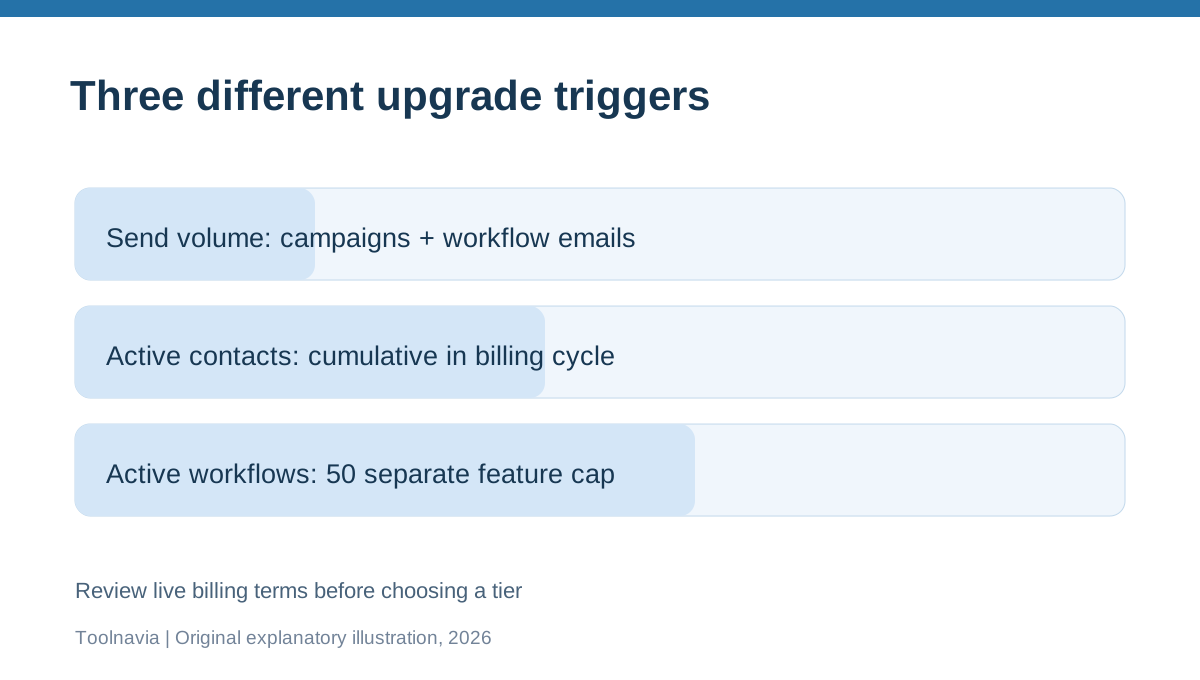
MailerLite's current Comfort documentation sets a limit of 50 active automations. Draft workflows outside that active limit do not consume those 50 slots. However, messages generated by email steps inside active automations consume the same sending allowance as broadcasts. A workflow that never sends an email adds no monthly email count simply by existing; a single workflow that sends hundreds of welcome messages can use hundreds of sends.
Build a simple inventory: count active workflows separately from recipients of each email step. Then review the triggers, conditional branches, delays and unsubscribes so that you do not assume that all contacts travel through every branch. The sender-facing system's actual recent campaign and automation metrics are better evidence than our theoretical examples. Official guidance explains that trigger eligibility determines which subscribers enter individual email steps. The way a workflow is built changes volume; it does not turn ten actual emails into one billable email.
Why exceeding a threshold can affect the bill
The current MailerLite paid-plan guidance warns that subscriber-tier and email-sending thresholds can trigger automatic plan upgrades. If the sending quota is exceeded, the account may move to a higher tier so sending can continue. Depending on the subscription cycle, upgrades can produce prorated additional charges. Exceeding a *feature-count* limit, such as the number of active automations, instead may block activation or editing until features are reduced or the plan changed. Those are separate mechanisms, and neither should be described as a guaranteed automatic no-cost extension.
Contact billing has its own subtlety. MailerLite counts unique addresses that held Active status at any point during a billing cycle. Removing a contact halfway through that cycle does not necessarily erase its contribution to that cycle's subscriber tier. Before a campaign takes you over a threshold, check Plan and billing in the account, the active-subscriber counter, any upgrade notification, and whether the payment method could be charged for a tier increase. For an annual subscription, inspect the potential prorated adjustment against remaining months.
Some older paid accounts will transition to the 2026 Comfort/Power structure on renewal or when changing plans, rather than simultaneously. If you have a legacy subscription, check your own displayed terms. Do not rely on an article or screenshot from before the June 2026 pricing change to infer your current entitlements.
Free, Comfort 500 or Power?
Under MailerLite's updated rules, Free includes up to 250 active subscribers, 2,500 monthly emails and fewer active automations. An early-stage creator comfortably within those limits should test Free before paying. Comfort 500 offers 5,000 monthly emails, 50 active automations and three seats. The public USD 500-subscriber reference currently displays $12 monthly or an annual-payment equivalent of $10.80 per month ($129.60 charged for the year). These figures are illustrative public starting prices, not a global guaranteed renewal price. Currency, tax, subscriber tier and special eligibility change the actual checkout.
Power advertises unlimited monthly email sending subject to fair-use rules, plus more feature capacity. At the same public 500-subscriber reference, its displayed starting price is $25 monthly or $22.50 per month equivalent when paid annually. More sending can make it worth evaluating if your measured use routinely exceeds Comfort's effective limit. But "unlimited" is subject to policy, not permission to send unsolicited mail, and it says nothing about a promised deliverability or revenue improvement. Compare live quotes at the *same subscriber tier* and billing period before deciding.
Brevo and Campaign Monitor organize email and contact allowances differently. A tempting lower headline rate is not automatically cheaper for the same subscriber count, campaign frequency and workflow needs. Klaviyo likewise counts active profiles and sent emails in its email-plan billing, with different account rules. Their billing documents are contextual reference points, not the results of our own platform tests or a like-for-like ranking.
Five-minute purchase checklist that prevents a bad surprise
First forecast each campaign's expected recipient count for your next paid billing cycle. Multiply that by the planned number of repetitions and add estimated actual welcome, promotion and automation emails. Include likely resend activity, then leave a discretionary margin. For instance, a forecast of 4,000 sends with a 20% planning buffer becomes 4,800, already close to the 5,000 ceiling. That buffer is our risk-management suggestion; it is not a MailerLite billing threshold.
Second inspect your highest cumulative Active-contact count in the cycle rather than just the list size at today's instant. Third count active workflow items separately from generated emails. Fourth compare your estimated volume against actual live terms for Free, Comfort and Power, and check whether an automatic subscriber or sending upgrade can create a prorated charge. Fifth review the payment period, renewal, tax and currency shown for your region. For material uncertainty, request written clarification from MailerLite support.
**Purchase recommendation:** Select Comfort 500 when the list and email budget fit and you need paid features. Stay on Free while it fits; investigate Power or another legally usable provider when repeated email volume makes the higher tier a better match. Toolnavia's direct MailerLite referral is an approved affiliate link. Clicking it does not guarantee a special discount. We have not simulated sending in a paid account or audited real invoices, and we make no claim about inbox placement or campaign revenue.