TOOLNAVIA / BUYING GUIDE
MailerLite A/B Testing: Is Comfort Worth It for a Small List?
The short answer
MailerLite Comfort can unlock useful testing controls, but a small newsletter should not pay merely to display a winning version. Basic A/B testing is available to all users; paid Comfort and Power add multivariate testing. The useful buying question is whether you need a different workflow, not whether eight versions sound more advanced than two.
This guide reviews documentation, not a campaign we ran. It separates product eligibility from evidence strong enough to change your next send.
At a glance
- Best for
- Paid testing workflows with a clear review owner
- Price model
- Comfort from $12/month; verify tier and billing
- Check first
- Small event counts; variant-count documentation differs
Choose the testing job before the plan
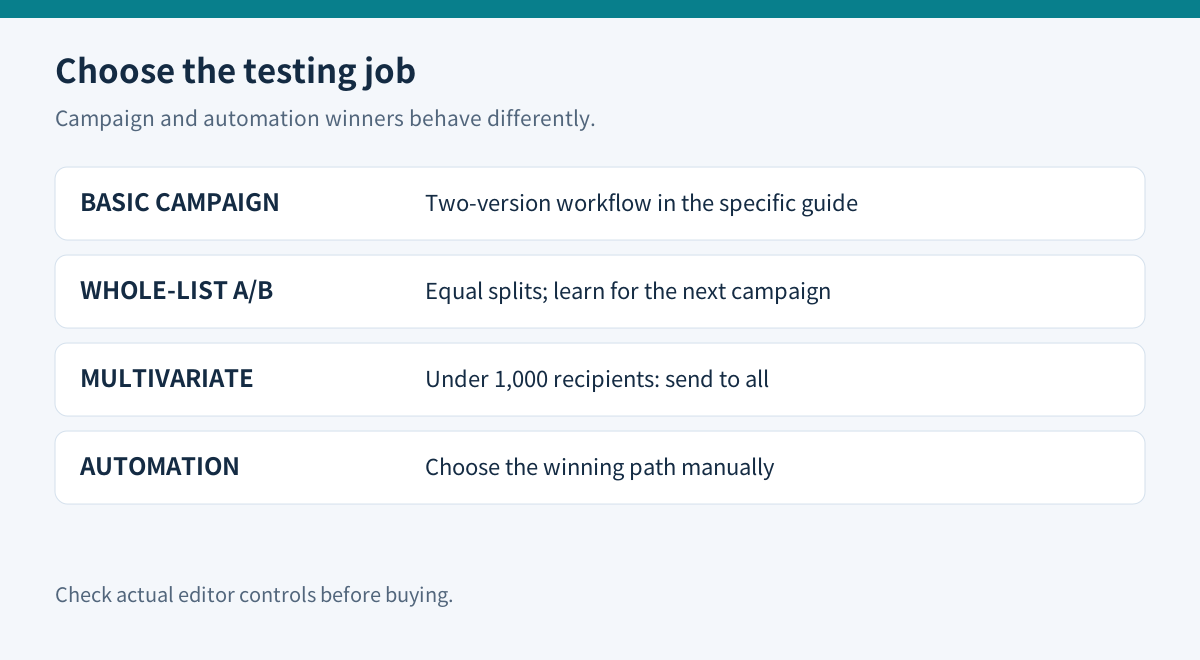
A basic campaign test compares alternatives and can reserve part of the list for a later winning version. MailerLite also offers an entire-list option: recipients receive equal A/B splits, with no automatic winner sent halfway through the campaign. That is a way to learn for a future edition.
Comfort's benefits include multivariate combinations, workflow tests, configurable email or delay alternatives, and reports that help you decide what to keep. These are useful controls, not promises of extra sales. Both Comfort and Power include the relevant paid tools, so Power is not automatically necessary.
Documentation differs on variant counts. The general feature page says up to five A/B versions, while the specific campaign guide describes two and the automation guide describes three. We use the specific workflow guides here. Check the actual editor during the trial before buying on the assumption that five versions are available everywhere.
Eight versions divide the evidence
Multivariate testing supports up to eight combinations. With fewer than 1,000 recipients, MailerLite requires sending variations to the entire selected audience; you cannot assume a large remainder will receive the winner during that same send.
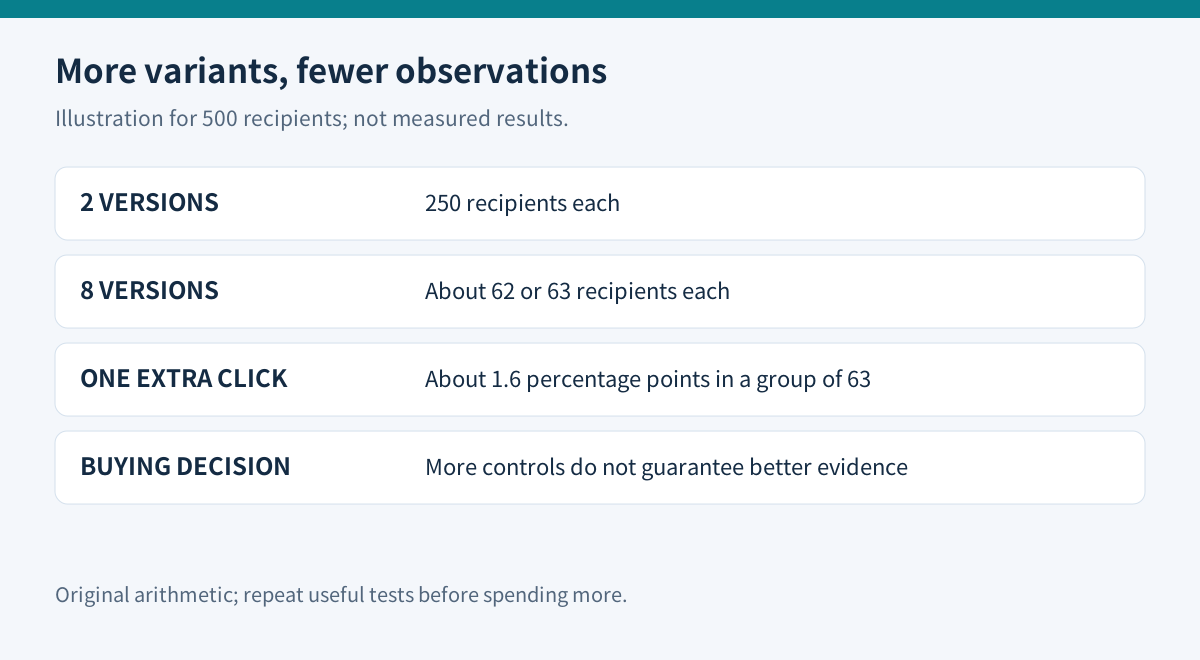
Consider an illustrative 500-person list. Two equal versions receive 250 people each. Eight versions leave roughly 62 or 63 each. In a group of 63, one extra click changes the click rate by about 1.6 percentage points. These calculations describe group sizes, not observed MailerLite results.
A winner badge can therefore overstate what a tiny experiment teaches. If one 250-person group gets six clicks and the other gets eight, the rates are 2.4% and 3.2%. A two-click difference deserves follow-up; it is not, by itself, proof that a paid feature earned its cost.
Mailchimp recommends 5,000 contacts per combination, while Brevo recommends 5,000 campaign recipients. Their different recommendations are not MailerLite requirements or universal guarantees. Examine actual event counts rather than copy a minimum number.
Pick a metric that answers the question
For a content or button test, use clicks and inspect the downstream action. Mailchimp likewise recommends click-based selection for content because opening occurs before someone sees the content.
Apple's privacy protection prevents reliable visibility into whether a recipient opened the message. MailerLite explains that preloaded tracking content can look like an open. Disabling open tracking still permits click-based A/B campaigns. Clicks remain a signal to check against conversions, not a substitute for them.
Write the outcome down before sending: registrations, qualified visits or purchases, plus unsubscribes. Keep the offer and audience definition comparable. If you change the subject, design and promotion simultaneously, interpreting the outcome becomes harder.
Campaign and workflow winners use different clocks
A timed campaign winner uses statistics available at the end of its configured test period. Later interactions can change the report without changing what was already sent. Automation tests require manual winner selection; future entrants then follow that path.
Assign an owner and review date before activating a workflow split. A test left running without a decision is continuing work, not a finished optimization. For campaigns, choose a window long enough for the response you care about, and record it before inspecting results.
Price the workflow you actually need
The current public pricing FAQ starts Comfort at $12/month and Power at $25/month. Annual billing advertises 10% savings: if the same $12 entry quote applies, that implies $129.60 prepaid versus $144 across twelve monthly payments, before tax. Confirm your subscriber tier and invoice rather than treating that arithmetic as a universal quote.
Comfort's allowance is ten times the selected subscriber-tier ceiling. A 500 tier therefore provides 5,000 monthly sends. Dividing one 500-recipient campaign into variants does not itself mean sending all eight versions to each person. Extra campaigns and automated messages still use the allowance.
Stay with free basic tests while the free list and send limits fit. Choose Comfort when a specific paid workflow saves useful work and its capacity fits. Consider Power for capacity or support needs, not because Comfort lacks multivariate testing. Start with a simple comparison, document uncertainty and repeat useful questions over comparable campaigns before committing more budget.
For volume planning, see our [Comfort send-budget guide](/en/software/mailerlite-comfort-500-send-budget-vs-50-automations). Toolnavia may earn a commission through its approved MailerLite link; no extra discount or campaign-performance guarantee is promised.