TOOLNAVIA / BUYING GUIDE
ClickFunnels Launch UTM Tracking: Is Funnel Analytics Enough?
The short answer
At a glance
- Best for
- Teams deciding whether Launch's funnel-level UTM filters are enough before annual billing or a higher stack.
- Price model
- Launch $97 monthly/$970 annual; Scale $197 monthly/$1,970 annual; verify checkout.
- Check first
- Launch does not list Full API/Webhooks; contact-level and cross-channel attribution need live verification or another layer.
Short verdict
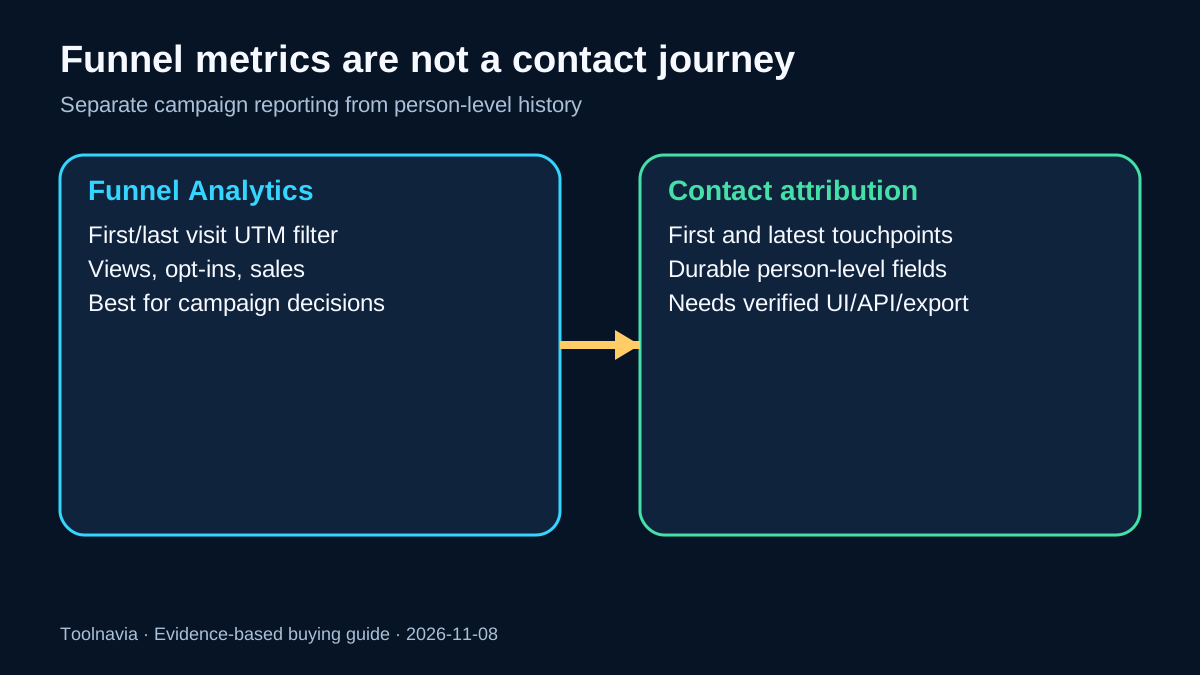
ClickFunnels® Launch can answer a useful campaign question: which tagged source or campaign produced funnel views, opt-ins and sales? The current Funnel Analytics documentation includes a UTM filter that can switch between First and Last visit, alongside conversion and revenue metrics. If that is the decision you need, the included dashboard may be enough.
It is not automatically the same as a durable contact-level journey. ClickFunnels' current contact API documentation exposes first_visit, last_visit and last_visit_with_utm fields, but the public plan matrix lists Webhooks/Full API Access on Scale rather than Launch. A developer changelog also introduced those visit fields as private beta. Treat the dashboard, API schema and plan entitlement as three separate facts, and verify the exact behavior in your workspace before committing.
Affiliate disclosure: Toolnavia may earn a commission if you choose Launch through our approved direct link, at no extra cost to you. That does not make Launch the right attribution stack. The current plan matrix, checkout, account permissions and live trial evidence control.
Start with the reporting question
Choose Launch when your question is funnel-level: Which UTM source produced more opt-ins? Which campaign generated more upfront or recurring sales? Which first-visit or last-visit filter changes the funnel result? Those are campaign and funnel optimization questions.
Demand a contact-level layer when your question follows one person: What was this lead's first recorded source? What was the most recent tagged visit? Can a salesperson see or export those values? Can an order be reconciled to the same contact after email, retargeting and sales follow-up?
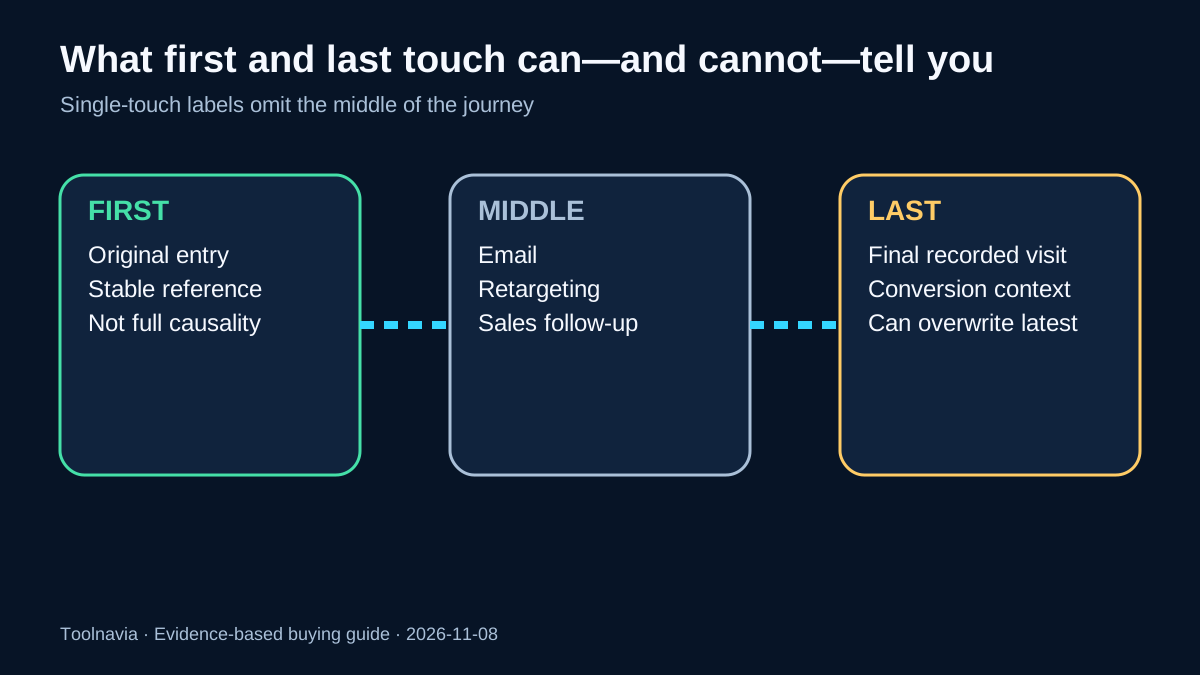
Demand a cross-channel attribution layer when you need to allocate credit across the middle of the journey. First-touch and last-touch are useful labels, but each assigns attention to one endpoint and can omit the channels between them.
What the included funnel dashboard proves
The current Funnel Analytics page says the dashboard tracks views, opt-ins, upfront sales, recurring sales, earnings per click and average cart value. Its UTM filter works with First or Last visit. That is meaningful evidence for tagged campaign comparison inside a funnel.
ClickFunnels Classic documentation also explains standard UTM source, medium, campaign, term and content tags, and its stats filter supports UTM parameters, date, device and other dimensions. These pages show that disciplined tagging matters; they do not promise a complete person-level attribution record.
For external pages, the ClickFunnels SDK documentation says visit tracking captures UTMs from the landing URL and can carry contact and visit identity across registered funnel steps and domains. That supports a stronger capture path, but it still requires you to test the actual page, identity and plan configuration.
The plan gate: dashboard versus API
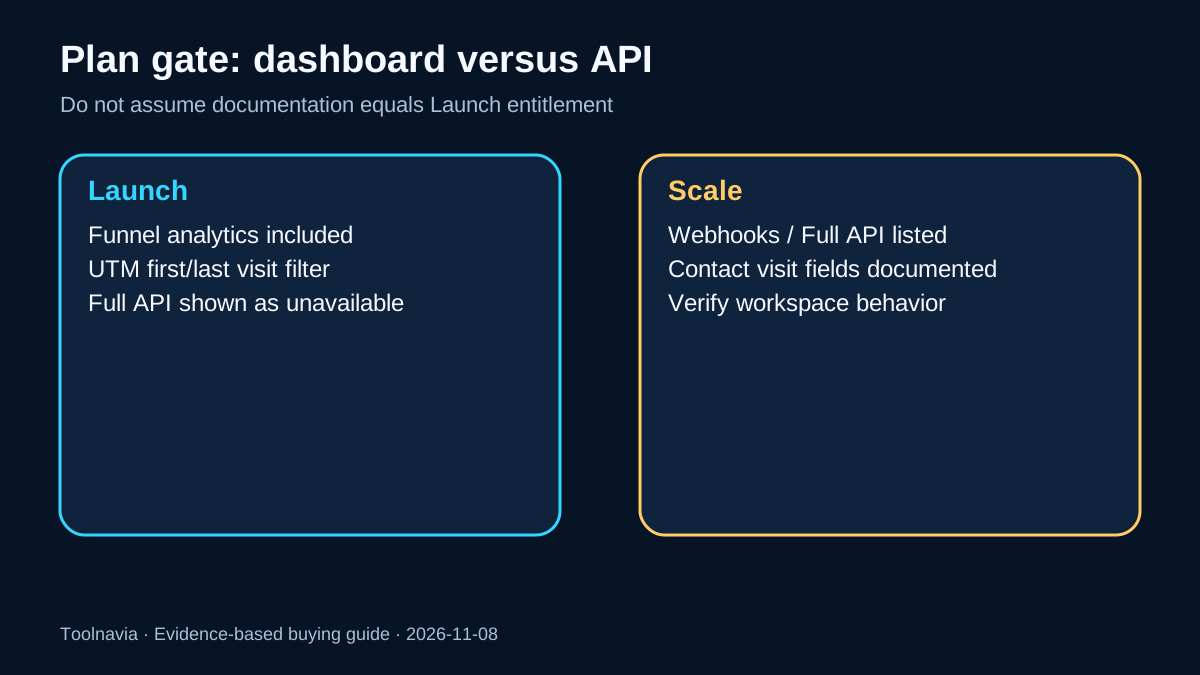
The current public plan comparison includes Analytics on Launch. It separately marks Webhooks/Full API Access as unavailable on Launch and available on Scale. The current monthly prices shown are $97 for Launch and $197 for Scale; official support also lists $970 and $1,970 annual totals. That creates a $100 monthly or $1,000 annual plan difference before tax and future changes.
The contact API reference documents visit objects for first visit, most recent visit and most recent visit containing UTMs. Do not assume that a public endpoint reference grants your Launch workspace access, and do not assume every documented field appears in the contact UI or export. The earlier changelog's private-beta wording is a reason to test, not a reason to claim the fields are absent.
Run a seven-day attribution trial
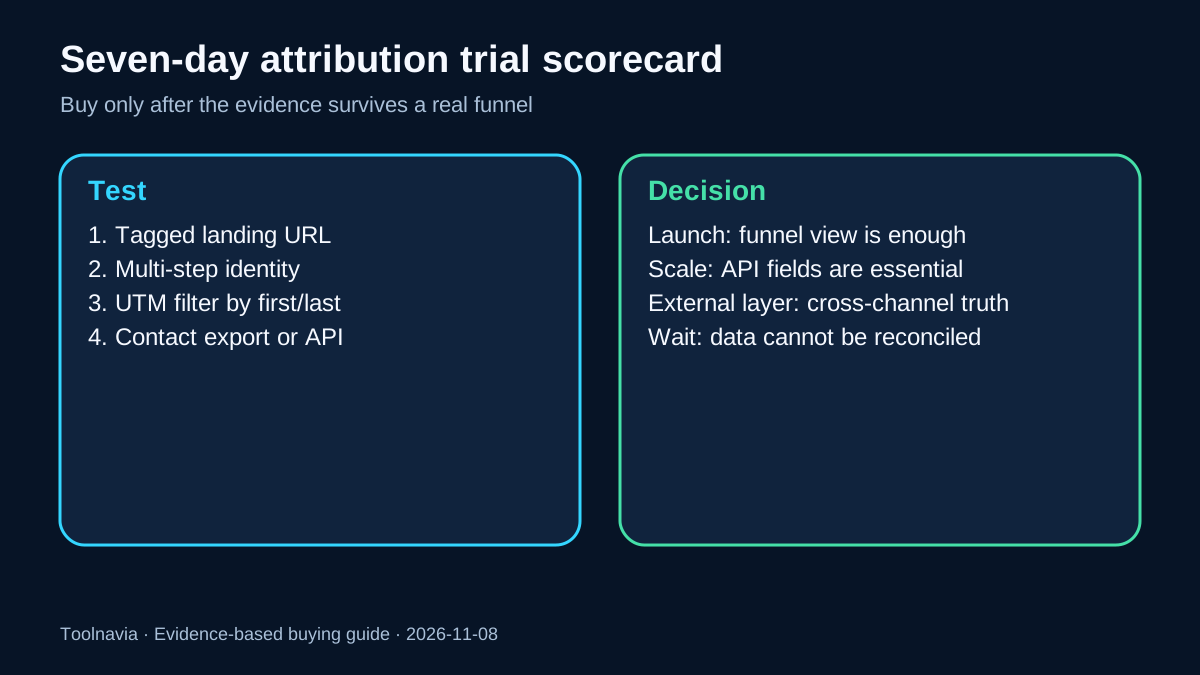
Create at least two tagged URLs with distinct source, medium and campaign values. Send controlled traffic to the same funnel, let one test contact convert on the first session, and let another return through a different campaign before converting.
Then verify four things:
1. Funnel Analytics separates the tagged traffic and changes when you switch First versus Last visit. 2. Identity survives every page, checkout and domain hop you actually use. 3. A contact record, export or authorized API response preserves the first, latest and latest-with-UTM values you need. 4. The contact, order and payment can be reconciled without manual guesswork.
If only the first test passes, Launch may still be a good funnel analytics purchase—but it is not your complete contact attribution system. If the API or webhook tests are essential, verify Scale entitlement and the exact fields before upgrading. If cross-channel reconciliation remains weak, keep ClickFunnels for funnel execution and send clean events to a CRM, warehouse or attribution tool.
Use competitors as a capability benchmark
HighLevel documents first and latest attribution on each contact, exposes the values in the contact record and supports first/latest UTM filters in reporting widgets. ClickDimensions documents UTM first-touch and last-touch fields carried into a contact record. These are comparison benchmarks, not proof that either product is universally better.
The benchmark is operational: can a user inspect the values, can the values be exported, and can the team explain what changes the latest touch? A field hidden behind an unavailable plan or unstable integration is not equivalent to an auditable workflow.
Buy Launch, upgrade, add a layer—or wait
Choose **Launch** when funnel-level UTM filters, conversions and revenue answer the decision, and a seven-day trial proves identity continuity. Start monthly; move to the $970 annual commitment only after the workflow is repeatable.
Consider **Scale** when authorized API/webhook access and contact visit fields are mandatory. Toolnavia does not have an approved exact Scale offer, so this article does not attach a Scale affiliate CTA. Verify the current plan matrix and cart directly.
Add an **external attribution layer** when you need durable cross-channel contact history, intermediate-touch analysis, warehouse reconciliation or governance beyond a single funnel.
**Wait** when tagged visits cannot be reconciled to contacts and orders, or when your team cannot state which report is authoritative.
Verdict
Launch is enough when you are buying funnel execution plus first/last-visit UTM filtering at the funnel level. It is not enough merely because an API reference contains contact visit fields. Prove the dashboard, identity path, contact visibility and plan entitlement in one controlled trial; then pay for the smallest stack that preserves the evidence your decisions actually require.