TOOLNAVIA / BUYING GUIDE
ClickFunnels® Email Domain: Verify SPF, DKIM and DMARC Before You Buy
The short answer
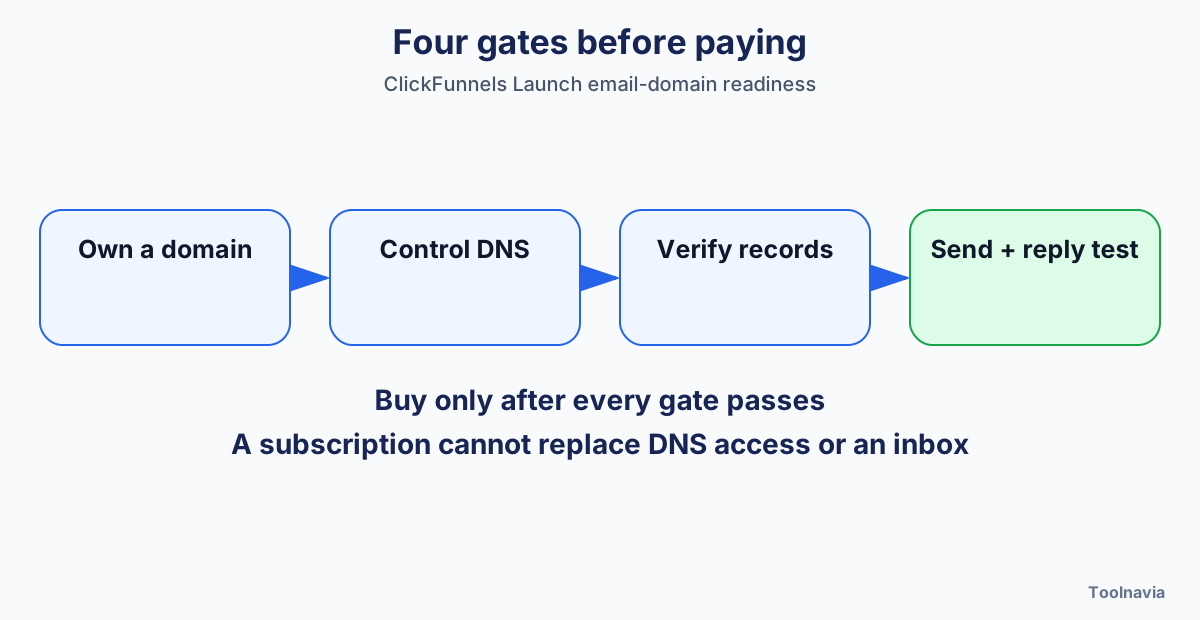
A custom From address is not the same thing as a production-ready sending domain. Before paying for ClickFunnels® Launch, make sure you control a domain, can edit its DNS, can publish or merge the required authentication records, and can receive replies somewhere outside ClickFunnels. If any of those four gates fail, the $97 monthly plan does not remove the infrastructure problem.
At a glance
- Best for
- Teams that control DNS and need a funnel-plus-email stack, but want to verify authentication and replies before a longer commitment.
- Price model
- Launch $97 monthly or $970 annually; verify checkout and pass the four-gate preflight
- Check first
- Requires an owned domain, authoritative DNS access, external reply inbox and careful preservation of existing records; authentication does not guarantee inbox placement.
Start with the real buying boundary
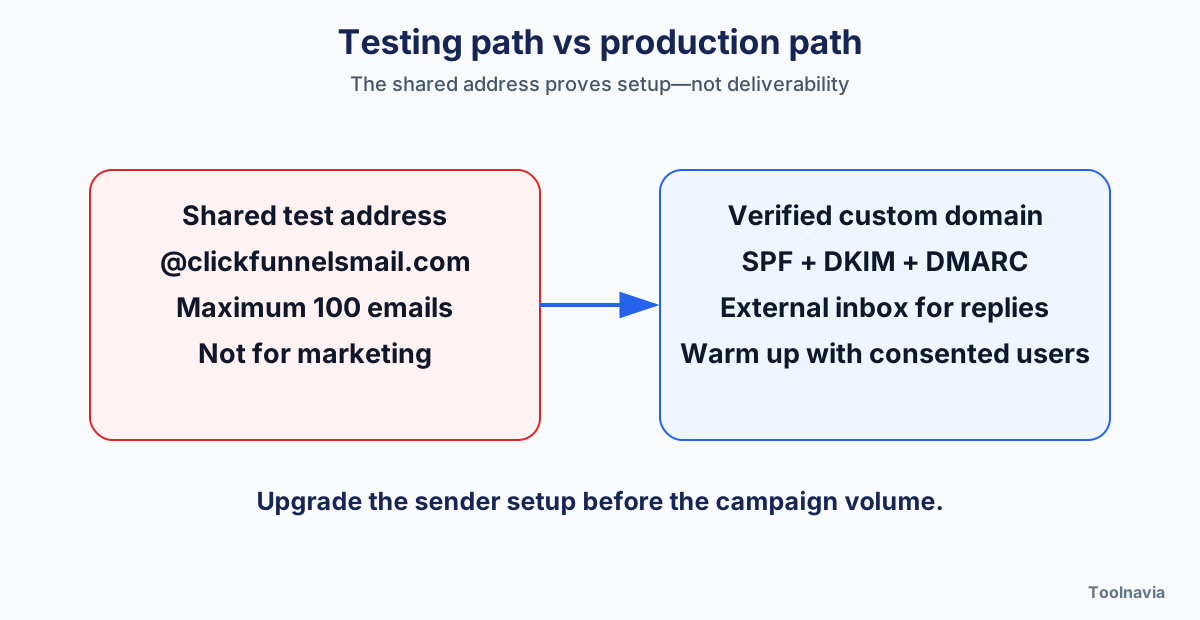
ClickFunnels provides a shared @clickfunnelsmail.com address for testing, but its own documentation limits that path to 100 emails and says it is not intended for marketing. It is useful for proving that a workflow fires; it is not a substitute for a branded production sender. A real launch therefore needs a custom sending domain authenticated through DNS.
The current public price is $97 month to month or $970 annually. The annual figure equals about $81 per month and saves $194 over twelve monthly payments, before tax and future price changes. That saving matters only after the domain workflow passes. Paying annually before DNS verification converts a technical unknown into a longer commitment.
Pass four gates before you subscribe
**Gate 1 — ownership:** use a domain you control. A free mailbox address is not the same as owning the DNS zone.
**Gate 2 — access:** confirm that you can edit DNS at the authoritative provider. A registrar login alone may not help if nameservers point elsewhere.
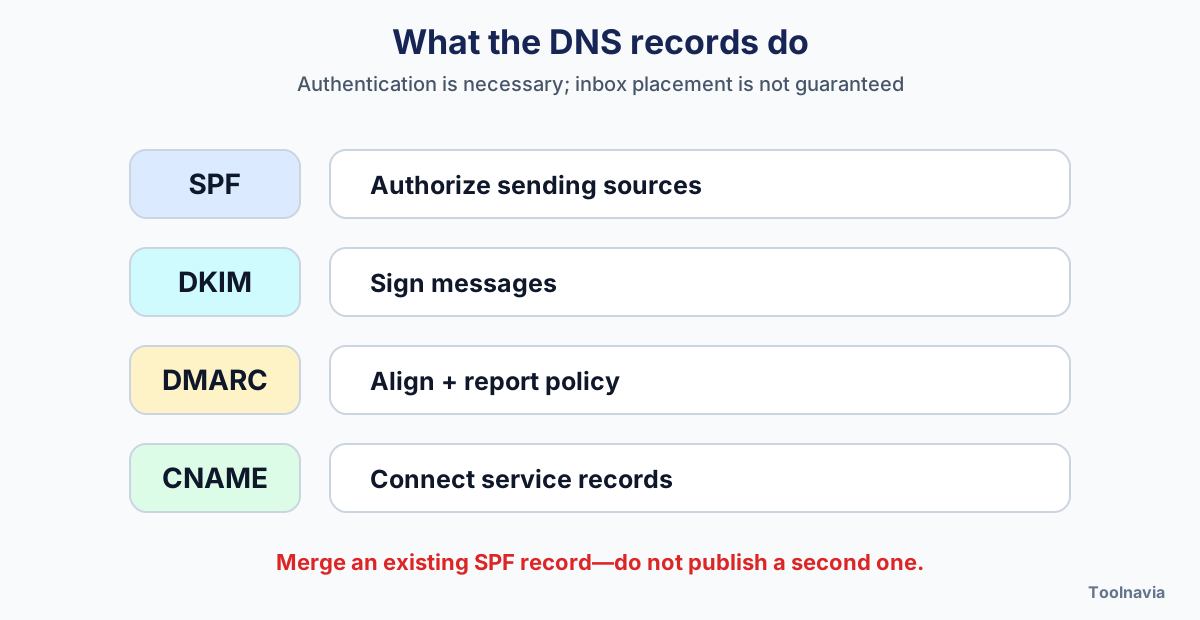
**Gate 3 — authentication:** publish the ClickFunnels-provided DKIM, SPF, DMARC and CNAME values, then wait for verification. ClickFunnels warns that DNS propagation can take up to 72 hours. If an SPF record already exists, merge the required mechanism into the existing record rather than publishing a second SPF record.
**Gate 4 — operations:** send a test to multiple mailbox providers, open links, reply, and confirm the reply reaches a monitored inbox. Authentication proves domain alignment; it does not guarantee inbox placement.
Choose root domain or sending subdomain deliberately
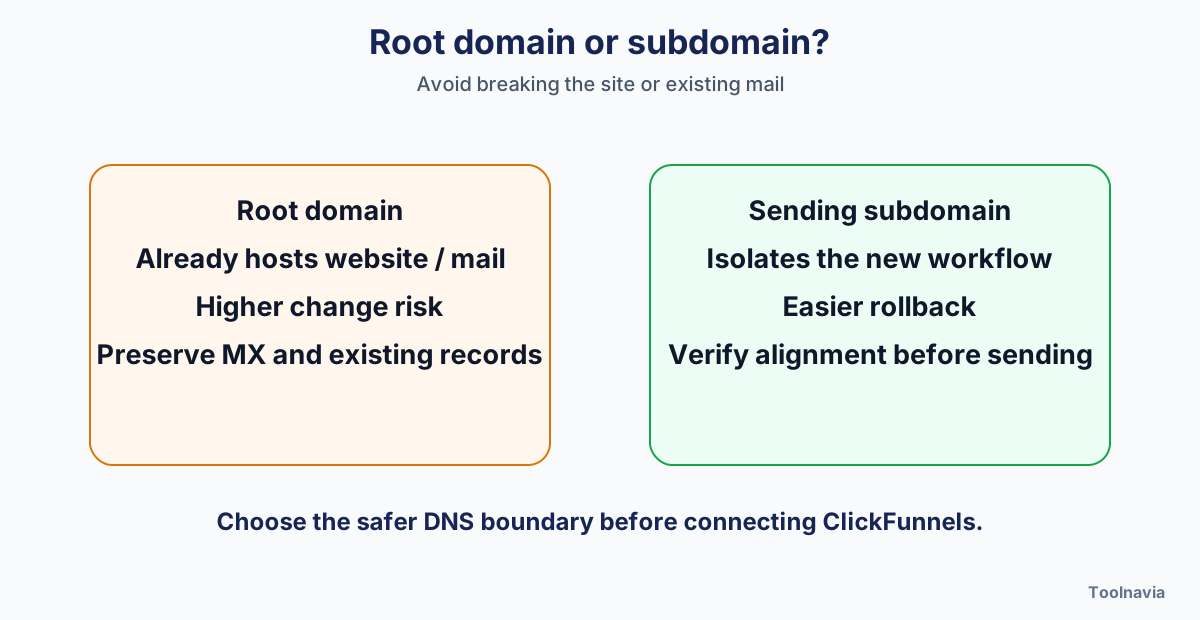
ClickFunnels documentation describes an automated root-domain route and a manual route for domains that already have records. That creates a practical conflict for buyers whose root domain already hosts a website, business mail or another sender. The safe default is not to delete working MX, SPF or site records just to make a setup wizard turn green.
A controlled sending subdomain such as mail.example.com or updates.example.com can isolate marketing authentication from the root domain. It is not automatically superior, and the exact records still depend on the values ClickFunnels gives your account, but it reduces the chance of replacing an unrelated production record. Record the current DNS state before every change and keep rollback values.
Separate sending identity from the reply inbox
A verified From domain does not create a mailbox. ClickFunnels states that replies require an external inbox, so budget for and test that mailbox separately. Use a Reply-To address that a person or team monitors; otherwise a technically authenticated campaign can still fail the customer-support test.
This distinction also changes the external-SMTP decision. ClickFunnels says you normally do not need external SMTP to send platform email. Consider it only when you have a specific requirement—such as centralized sender governance, an existing delivery provider or a documented compliance workflow—not as a generic cure for poor inbox placement.
Treat authentication as admission, not a deliverability guarantee
Google requires senders to Gmail accounts to authenticate email and applies stricter SPF, DKIM and DMARC requirements to bulk senders. It also asks senders to keep spam rates low and provide easy unsubscribe paths. Those rules support the value of authentication, but they do not turn a valid DNS record into guaranteed delivery. List consent, complaint rate, content, cadence and reputation still matter.
The FTC's CAN-SPAM guidance also requires accurate headers, a valid physical address and a working opt-out process for commercial email. Platform features do not transfer that responsibility away from the sender.
Run a zero-regret preflight
Before the first campaign, capture screenshots or exports of the DNS zone, verify the platform's exact record names and values, and check that only one SPF TXT record exists at each hostname. After propagation, use the platform verifier and an independent header check. Send to at least one Gmail address and one mailbox on another provider, then test unsubscribe, link tracking and a human reply.
Do not warm a new domain by blasting the full list. Start with a smaller, consented and engaged segment, inspect bounces and complaints, and expand gradually. Competitor guidance from Kit and MailerLite points to the same operational boundary: authenticate a domain, preserve existing records, understand DMARC alignment, and verify before scaling.
Verdict: buy only after the domain path is proven
Choose monthly Launch when the funnel and email workflow fit, the four gates pass, and you want to observe a real campaign before a longer commitment. Choose annual Launch only when the same workflow is already stable and the $194 saving outweighs flexibility. Wait if DNS access, reply handling or existing record conflicts are unresolved.
Toolnavia may earn a commission if you subscribe through our approved ClickFunnels link. That does not change the price or the recommendation: the strongest reason to delay purchase is an unproven sender-domain workflow, and the strongest reason to buy is a verified, repeatable one.