TOOLNAVIA / BUYING GUIDE
WPX Agency vs Cloudways Flexible: 200 Sites or Pay Per Server?
The short answer
At a glance
- Best for
- Agencies choosing between a prepaid 200-site WordPress pool and incremental managed cloud servers.
- Price model
- WPX exact $23,999.60/5y vs Cloudways from $11/server/mo
- Check first
- WPX requires five-year cash and shares resources; Cloudways needs server planning and can add variable costs. Billing crossover is not equal capacity.
Quick answer
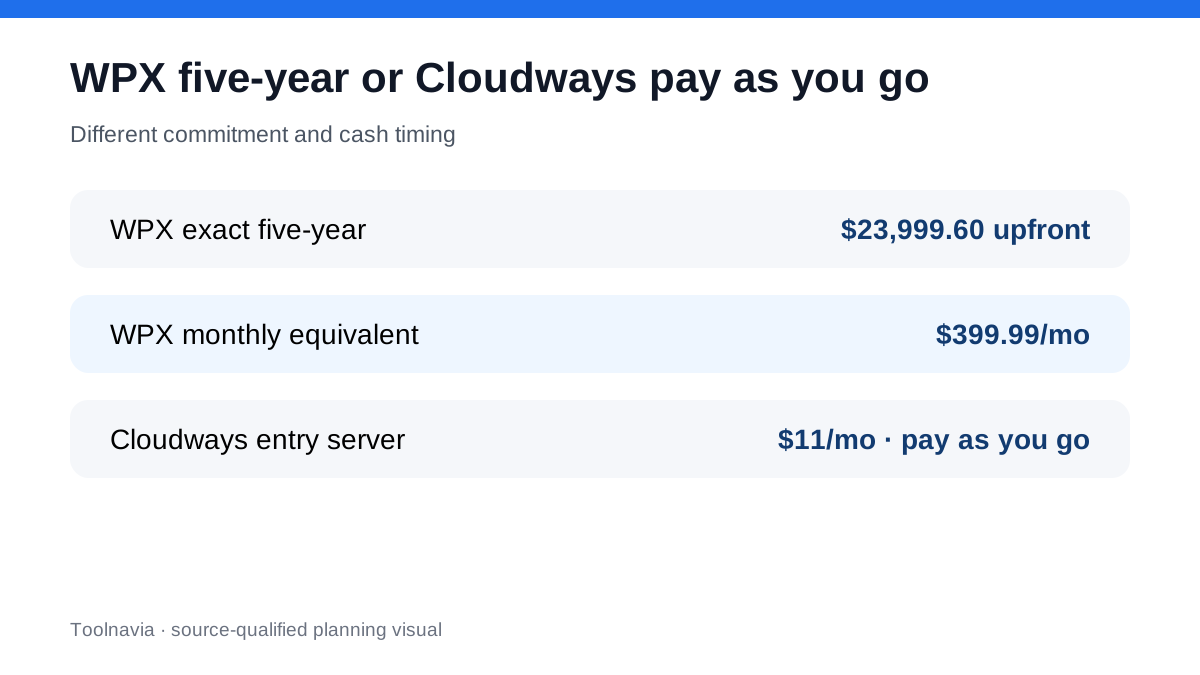
The decision is not “$399.99 versus $11.” WPX Agency sells one large managed WordPress portfolio pool and requires an exact **$23,999.60 five-year prepayment**. The published plan allows up to 200 sites and lists 300GB storage, 100GB RAM, six CPU cores and 300 PHP workers in the shared account.
Cloudways Flexible sells managed cloud servers. Its current official DigitalOcean entry point is **$11 per server per month**, with pay-as-you-go billing and multiple WordPress or PHP applications allowed on a server until that server's resources become the constraint.
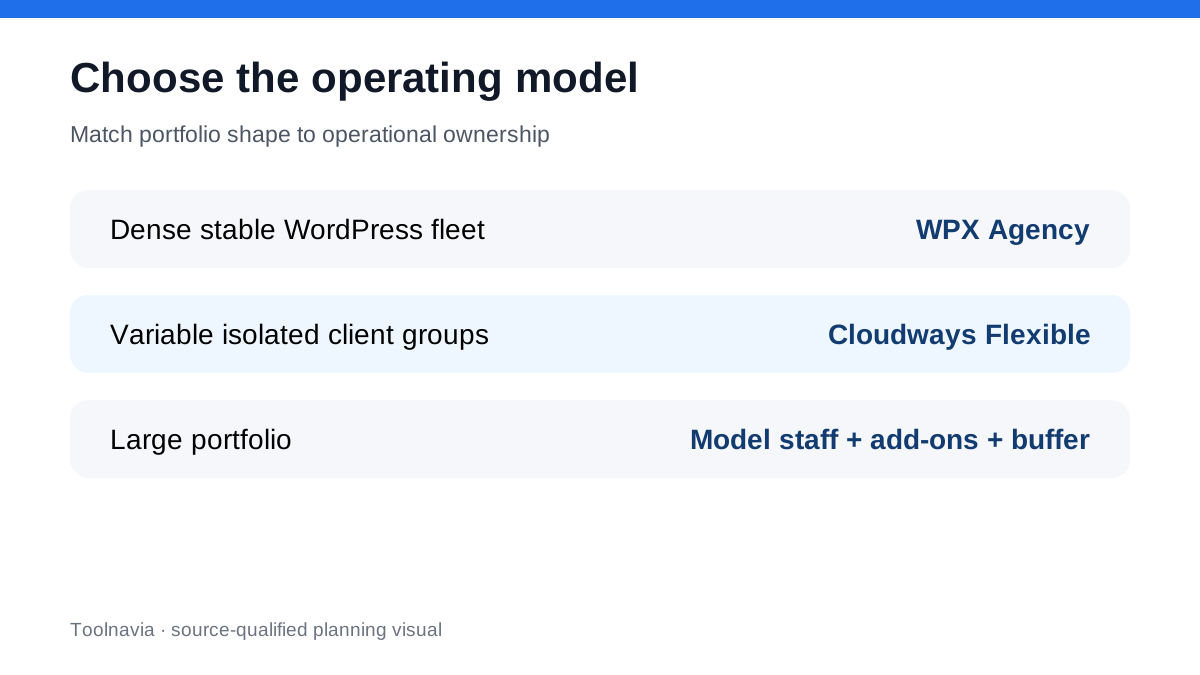
Choose **WPX Agency** when the portfolio is predominantly WordPress, demand is measured and predictable, central support matters, and the agency can put the prepaid capacity to work. Choose **Cloudways Flexible** when preserving cash, isolating client groups, selecting infrastructure and adding or removing servers gradually matter more.
The products sell different billing units
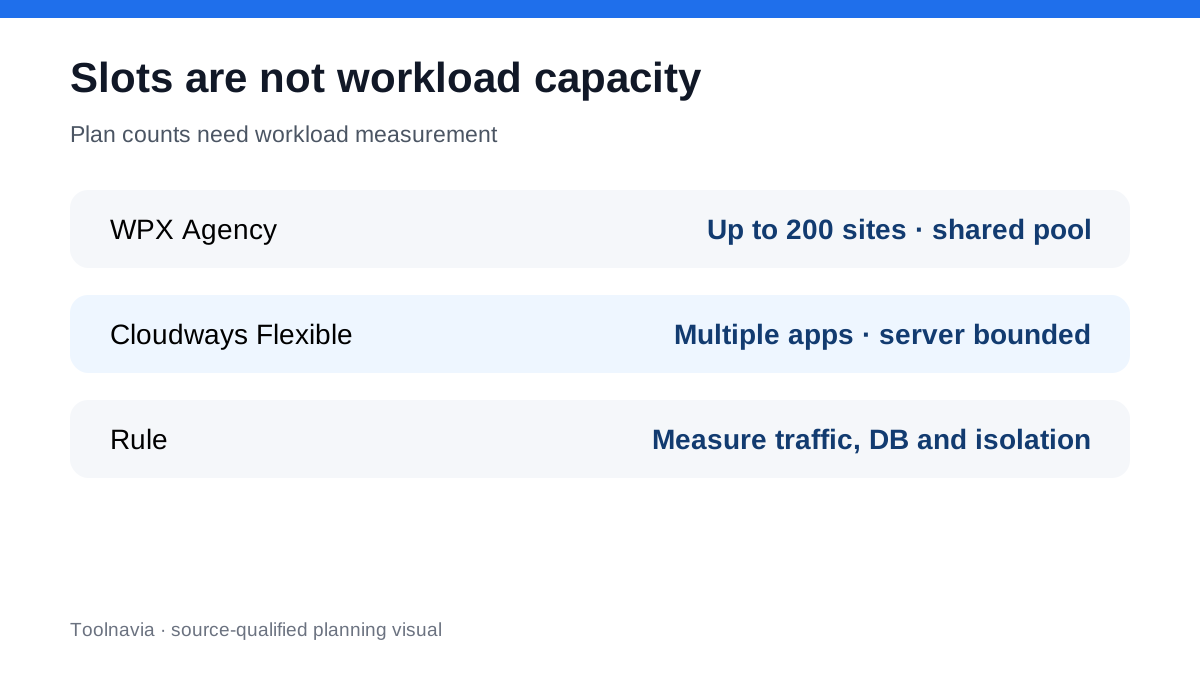
WPX's unit is an account with up to 200 website slots. The “$2 per client site” illustration on its official page assumes all 200 slots are used for the full five-year term.
Utilization changes the economics: at 200 sites the equivalent is about $2 per site per month; at 100 sites it is about $4; at 50 sites it is about $8. Those figures divide the prepaid price by occupied slots. They do not promise that every possible set of 200 workloads fits the shared resources.
Cloudways Flexible's unit is a server, not a website. Cloudways says agencies pay per server and can host as many client projects as the server can handle. That last clause matters. Ten brochure sites and ten busy WooCommerce stores are not the same capacity problem. “Unlimited apps” means no per-app license count on the server; it does not mean unlimited compute, memory or storage.
Five-year cash model and the 37-server crossover
WPX takes $23,999.60 upfront for five years. Its $399.99 figure is the monthly equivalent of that term, not a month-to-month checkout price. The benefit is a known base cost. The cost is concentrated cash and utilization risk.
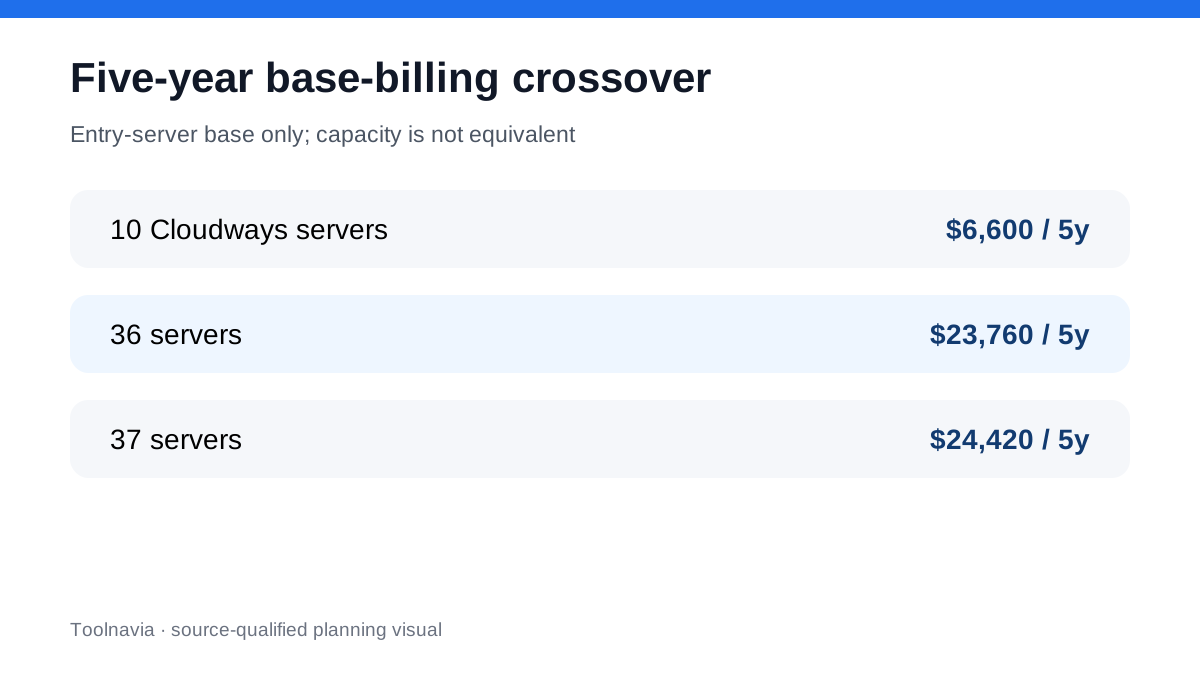
One continuously running $11 Cloudways baseline server models to $660 over 60 months before backups, email, bandwidth, tax or optional services. Four model to $2,640; ten to $6,600; 36 to $23,760; and 37 to $24,420. Therefore the base-billing lines cross between 36 and 37 entry servers.
That crossover is useful for budgeting and dangerous as a capacity claim. A $11 server is not a fractional WPX Agency account, and 36 small servers are not automatically equivalent to WPX's published aggregate pool. Provider choice, server size, traffic, database intensity, redundancy and isolation policy can move the real Cloudways bill substantially.
Site slots are not workload capacity
WPX publishes a portfolio ceiling and aggregate resources. That makes procurement simple, but the agency must still test whether its actual mix fits. A portfolio of cached marketing sites may use the 200 slots very differently from a smaller fleet of stores, learning platforms or membership sites. “Unlimited visitors” and “unlimited bandwidth” should be read with the plan terms and fair-use boundaries, not as infinite processing capacity.
Cloudways makes the infrastructure boundary more visible. Each server has an explicit size, and the team chooses when to resize, split clients or add another server. This can improve isolation: a noisy client can be moved instead of competing with the entire portfolio. It also shifts more architecture decisions to the agency.
Isolation, scaling and operational ownership
WPX bundles a more opinionated WordPress service. Its current Agency pages include migrations, CDN, SSL, daily backups, malware handling and business email/unlimited mailboxes in the plan description. For an agency that wants one support relationship and a standardized WordPress stack, those inclusions reduce tool and vendor sprawl.
Cloudways Flexible supports WordPress and other PHP applications and exposes more cloud and server choice. Agencies can organize client projects across servers, change server sizes and scale by adding infrastructure. The tradeoff is operational ownership: someone must decide server topology, monitor headroom and know when a client should be isolated. Email is not equivalent to WPX's included mailbox bundle, and optional backup, support or protection lines can increase the bill.
Commitment and cancellation
WPX publishes a 30-day money-back guarantee for hosting plans. That reduces early purchase risk, but it does not remove the need to confirm refund scope and the post-term renewal basis at checkout. No TOOLNAVIA coupon is claimed active.
Cloudways advertises a three-day trial for Flexible and pay-as-you-go billing without a long-term contract. Deleting a server normally stops its future server charge, while merely stopping some AWS or Google Cloud resources can leave storage charges. The checkout decision should include the chosen infrastructure provider and deletion policy, not only the headline monthly rate.
Three agency scenarios
**Fifty stable WordPress sites.** WPX's five-year equivalent is about $8 per occupied site per month. If the sites fit the shared resource pool and the agency values included operations, WPX can be the cleaner purchase. Cloudways may still win if client-by-client isolation is contractual.
**Ten isolated client clusters.** Ten $11 baseline servers model to $110 per month and $6,600 over five years before extras. Cloudways preserves cash and separates failure domains. Do not infer comparable performance from that price gap.
**A large, variable portfolio.** At roughly 36–37 continuously running entry servers, the five-year base bills cross. By that scale, average server size, redundancy, staff time and add-ons matter more than the entry count. Measure the current portfolio and model at least a 20% resource buffer before choosing.
Checkout checklist and verdict
For WPX, verify the exact $23,999.60 charge, five-year term, refund terms, post-term renewal basis, site count and whether the real workload fits the shared resources. For Cloudways, verify the selected provider, server size, hourly/monthly estimate, backups, bandwidth, email, support and the number of isolation groups.
The practical verdict: **WPX Agency is the portfolio-bundle choice; Cloudways Flexible is the infrastructure-control choice.** Buy WPX when utilization and operational simplicity justify the five-year cash commitment. Buy Cloudways when optionality and server-level isolation justify ongoing architecture work. Use Toolnavia's exact internal offer routes for either provider; raw tracking URLs and unconfirmed coupon claims are intentionally excluded.
Research landscape
Current direct comparisons consistently frame the purchase around managed simplicity, technical control, support and entry price, but none of the reviewed pages models this exact Agency/Flexible five-year server-count decision. Buyer-review and managed-hosting roundups add administration and category context without replacing the official plan facts.