TOOLNAVIA / BUYING GUIDE
WPX Agency vs Cloudways Growth: 5 Apps or 200 Sites?
The short answer
**Quick answer:** use **WPX Agency** for a dense, predictable WordPress portfolio when you can prepay five years. Use **Cloudways Autonomous Growth** only for individual volatile applications that justify per-app autoscaling.
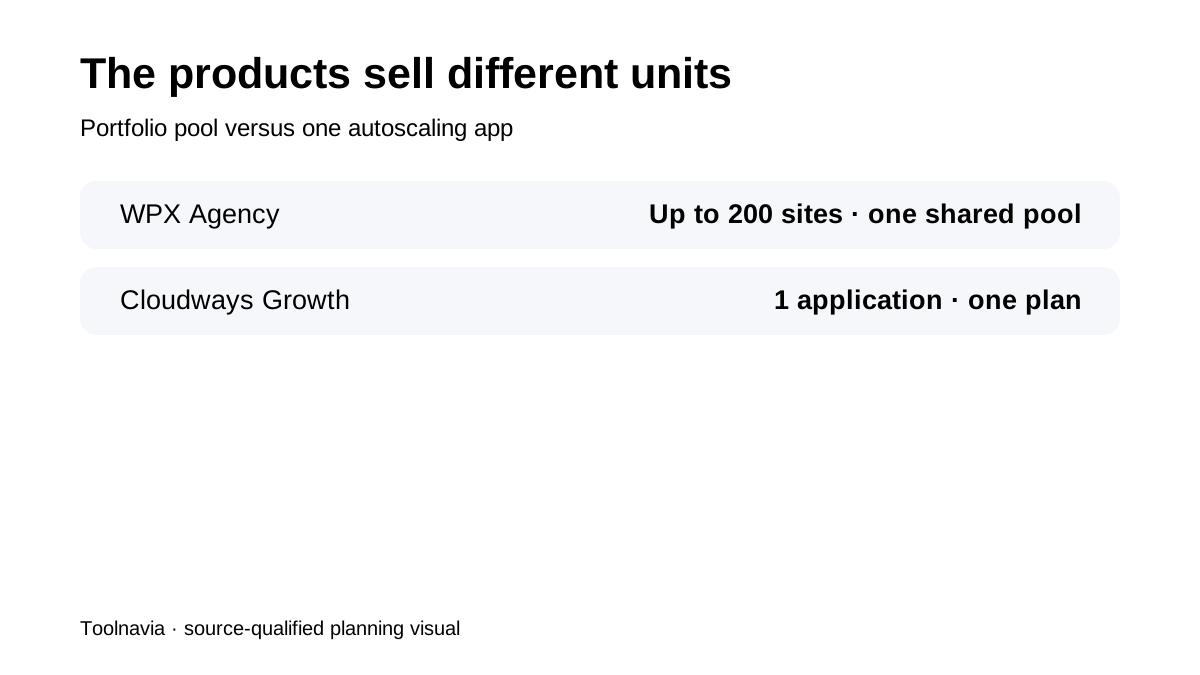
WPX covers up to 200 sites in one shared pool; every Growth subscription covers one application and starts at $99/month before usage charges.
At a glance
- Best for
- Agencies choosing between a dense 200-site pool and selective per-app autoscaling.
- Price model
- WPX $23,999.60 exact 5y prepay vs Cloudways $99/mo per app
- Check first
- WPX requires five-year cash for the lowest equivalent rate; Cloudways multiplies per app and adds usage charges; site/resource ratios are not benchmarks.
The decisive difference is the billing unit
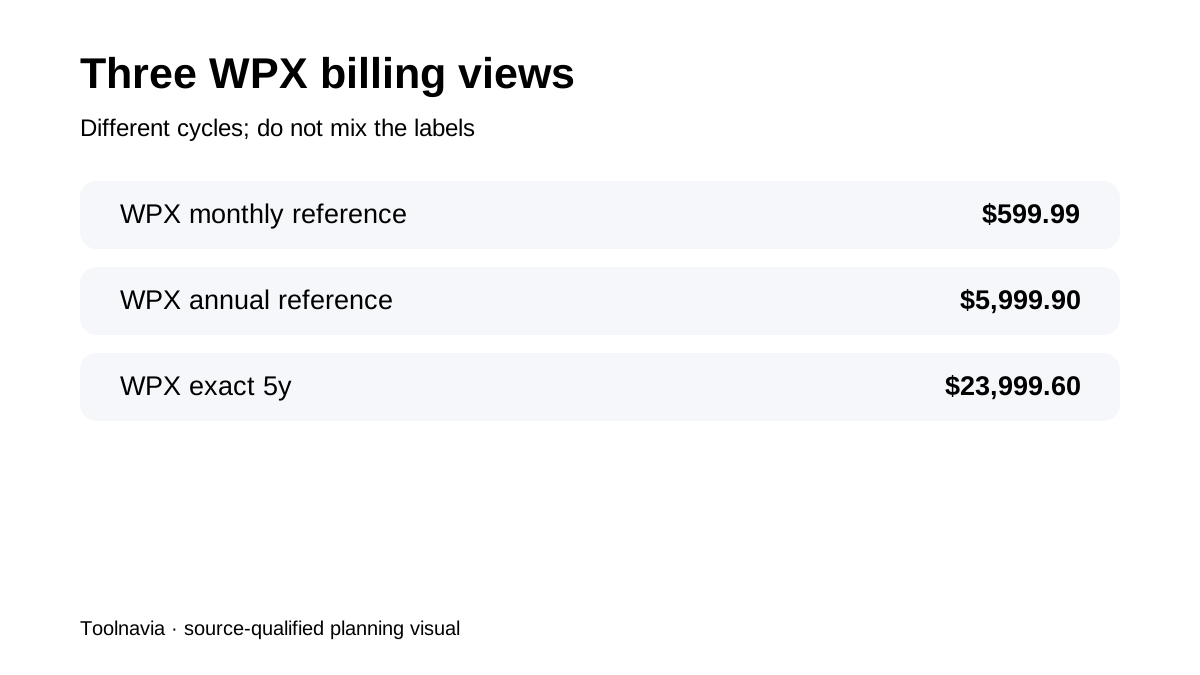
WPX Agency is one plan for up to 200 WordPress sites. Its current five-year choice is shown as **$399.99/month equivalent**, collected as **$23,999.60 upfront**. WPX also publishes a **$599.99 regular monthly** reference and a **$5,999.90 regular annual** reference. Those numbers belong to different billing cycles and should not be mixed.
Cloudways Autonomous Growth is **$99/month per active application**, calculated hourly. Adding another application activates another plan and another base charge. Extra autoscale capacity, disk and bandwidth can raise the bill further.
This means a comparison that says only “$399.99 versus $99” is misleading. The correct first question is: **how many applications need their own Growth plan?**
The five-application crossover
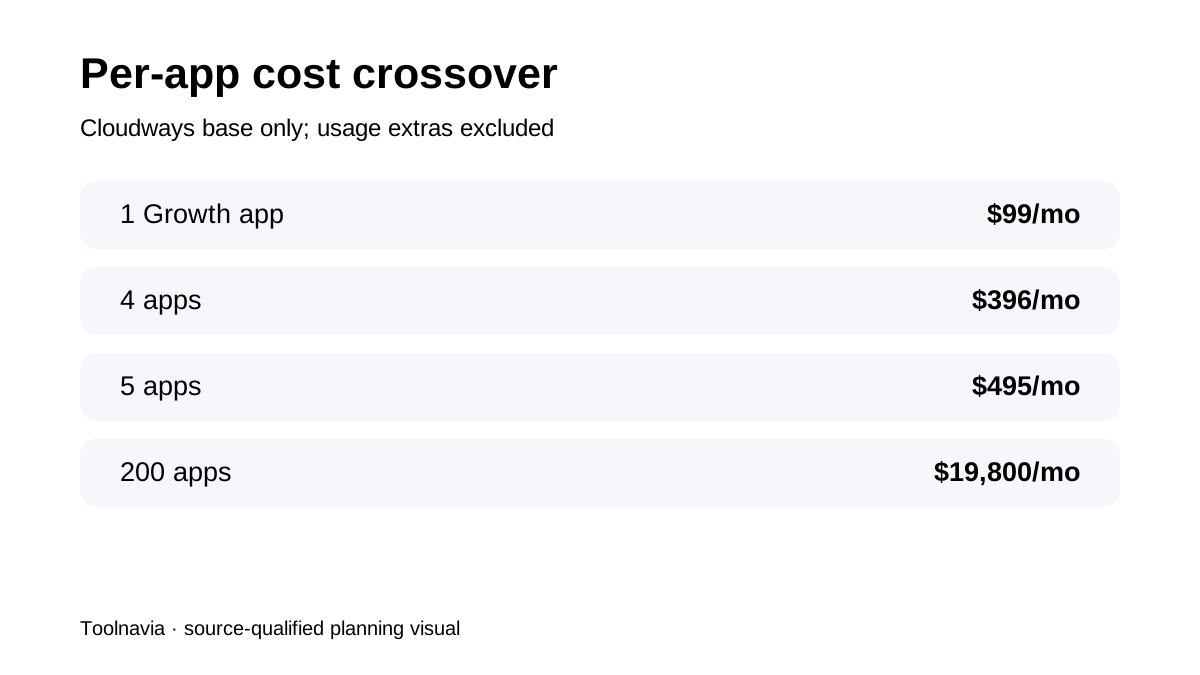
At continuous base rates before Cloudways usage extras:
- 1 Growth app: **$99/month** - 4 Growth apps: **$396/month** - 5 Growth apps: **$495/month** - 200 Growth apps: **$19,800/month**
WPX's five-year equivalent is **$399.99/month**. Four Growth apps are $3.99 lower; five are $95.01 higher. Over five continuous years, four Growth apps model to **$23,760**, just below WPX's exact **$23,999.60** prepayment. Five Growth apps model to **$29,700**, already **$5,700.40 above** WPX before autoscaling or overages.
These are planning models, not equivalent contracts. WPX takes five years of cash upfront. Cloudways retains hourly activation and deactivation flexibility. A buyer who values reversibility may rationally pay a higher long-run base.
“Up to 200 sites” is not unlimited capacity
WPX publishes a shared Agency envelope of **300GB storage, unlimited visitors and bandwidth, 100GB RAM, 6 CPU cores and 300 PHP workers**.
At full 200-site utilization, WPX illustrates an effective base near **$2 per site per month**. At 100 active sites it is about **$4**, and at 50 about **$8**. But those figures divide the same plan price by a site count; they do not prove that 200 demanding sites will fit.
A portfolio of brochure sites, local-business pages and lightly used client blogs can be very different from 200 membership, LMS or ecommerce applications. Before buying, total storage, peak dynamic requests, backup size, admin concurrency and the busiest sites' PHP demand. Site slots are an organizational ceiling, not a performance benchmark.
What each Cloudways Growth app buys
Growth starts one application with **one baseline autoscale server**, **20GB disk** and **150GB bandwidth**. Additional capacity costs **$0.07 per active server-hour**. Disk beyond the allowance costs **$1 per GB per month**, prorated hourly; bandwidth overage is **$0.04 per GB**.
Cloudways adds complete application replicas as demand rises, then removes them as traffic falls. That is a materially different risk-control mechanism from placing many sites inside a fixed shared pool.
The isolation can matter. One Growth application's traffic spike does not consume another Growth subscription's base envelope. The cost consequence is equally important: every quiet application still needs its own $99 plan while active.
Why a 200-plan Cloudways model is usually the wrong design
If an agency bought one Growth plan for each of 200 sites, the base would model to **$19,800/month** or **$1,188,000 over 60 continuous months**, before variable charges. WPX Agency's five-year prepayment is **$23,999.60**.
That giant difference does not prove WPX is faster or that its fixed pool can carry any 200 workloads. It proves that Autonomous Growth is priced as a specialized application-level platform, not as a cheap density product for hundreds of quiet sites.
Cloudways Flexible can place multiple applications on one server, but this article intentionally compares the exact approved **Autonomous Growth** offer. Substituting Flexible's multi-app model would answer a different buying question.
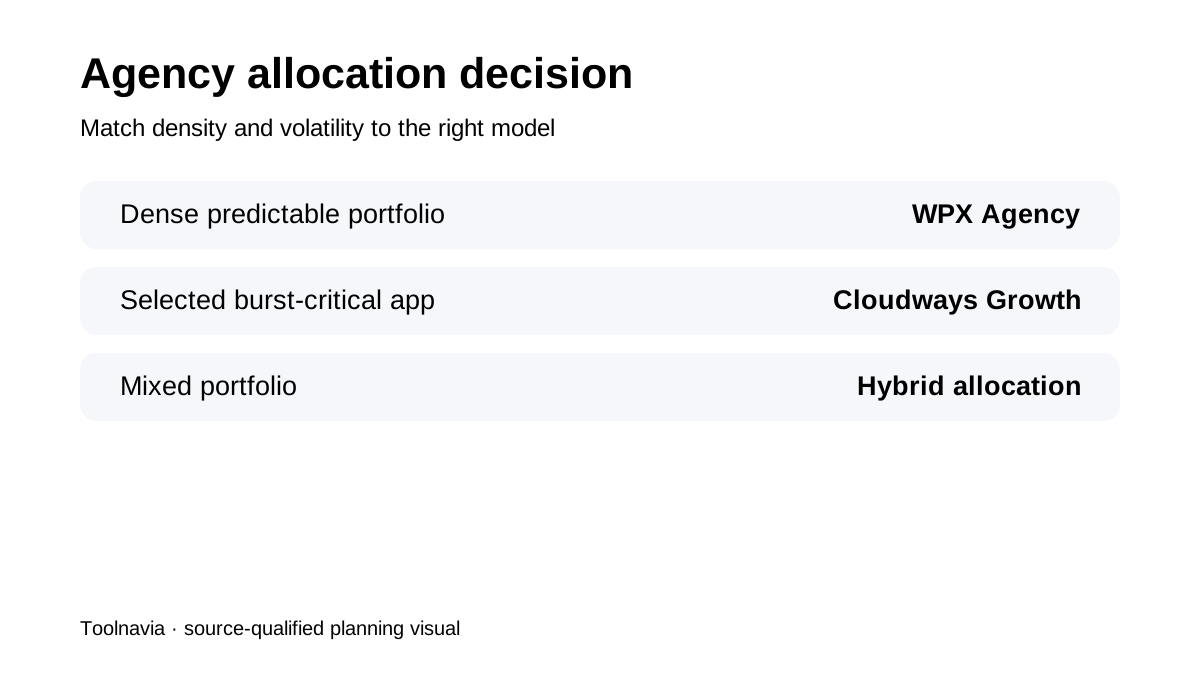
Use a hybrid allocation, not an all-or-nothing slogan
A 100-client agency might place 95 predictable sites on WPX Agency and reserve separate Growth plans for five launches, stores or membership platforms whose demand is genuinely volatile. That hybrid base would be the WPX commitment plus **$495/month** for the five Autonomous applications, before their variable charges.
The split should follow measured risk:
1. Put stable brochure, content and low-concurrency sites in the dense pool if aggregate WPX limits leave headroom. 2. Give a separate Growth plan only to applications where a traffic spike could cause measurable revenue or service loss. 3. Revisit sites whose extra-server hours stay high; a higher Autonomous tier or another architecture may be more efficient. 4. Keep independent backups and an exit plan for both platforms.
Included operations change staffing economics
WPX lists site and email migrations, custom CDN, SSL, daily backups, malware scanning/removal, business email and 24/7 support as included Agency features.
Cloudways Autonomous includes the managed Kubernetes layer, Cloudflare Enterprise, caching, backups and application-level autoscaling. Its base does not turn every WordPress or business operation into an unlimited support obligation.
These included services are plan features, not coupons. They can reduce agency labor, but buyers should map each provider's actual support scope to their maintenance contracts rather than assign an invented dollar value.
**Billing and renewal caution**
WPX allows customers to change billing cycles in the account, and its public materials show monthly, annual and multi-year choices. An official campaign terms page states Agency regular prices of **$599.99 monthly** and **$5,999.90 annually**, while the current five-year checkout shows **$399.99/month equivalent**.
Because the regular-price evidence is partly campaign-specific, this article does **not** claim that every five-year Agency purchase automatically renews into one particular cycle. Confirm the renewal cycle, next invoice amount, tax and cancellation timing in the live checkout or with WPX support before paying.
Cloudways Growth avoids a multi-year prepayment, but its $99 base is not an all-in ceiling. Autoscaling thresholds can cap extra compute; disk and bandwidth charges may still continue.
Three buying scenarios
**Four high-value volatile apps:** four Growth plans total $396/month before extras, slightly under WPX's five-year equivalent. Cloudways may be rational if each app needs isolation and elasticity and you reject a five-year commitment.
**Five to thirty ordinary client sites:** separate Growth subscriptions cross above WPX's effective base at the fifth active app. WPX usually has the stronger base economics if the sites fit the shared pool and the prepayment is acceptable.
**Fifty to 200 mixed sites:** WPX's per-site arithmetic improves as utilization rises, but capacity risk rises too. Put only measured burst-critical sites on Autonomous; do not pay $99 for every quiet installation.
Checkout checklist and final decision
For **WPX Agency**, confirm the exact **$23,999.60 five-year charge**, current monthly or annual alternatives, renewal cycle, 200-site limit, shared 300GB storage, 100GB RAM, six cores, 300 workers and refund/cancellation terms.
For **Cloudways Growth**, count applications—not accounts. Confirm **$99 per active app**, hourly base rate, 20GB disk, 150GB bandwidth, $0.07 extra-server hour, both overage rates and an autoscaling budget with adequate headroom.
**Bottom line:** WPX Agency is the density purchase; Cloudways Growth is the volatility purchase. Use WPX when portfolio economics and predictable aggregate demand dominate. Use Growth selectively when one application's burst risk is valuable enough to justify its own subscription and variable bill.