TOOLNAVIA / BUYING GUIDE
ScalaHosting Entry Cloud: 72% Discount, 2GB RAM or Build #1?
The short answer
Entry Cloud suits a light workload needing managed hosting without Build #1's larger memory allocation. Check whether your site fits 2GB before choosing between a smaller first payment and three years prepaid.
At a glance
- Best for
- Measured light sites moving to managed cloud
- Price model
- $11.21/mo on12m; $134.52 initial arithmetic; renewal$39.95/mo
- Check first
- 2GB is aggregate; long prepayment and refund eligibility need review
The extra money mainly changes the starting memory
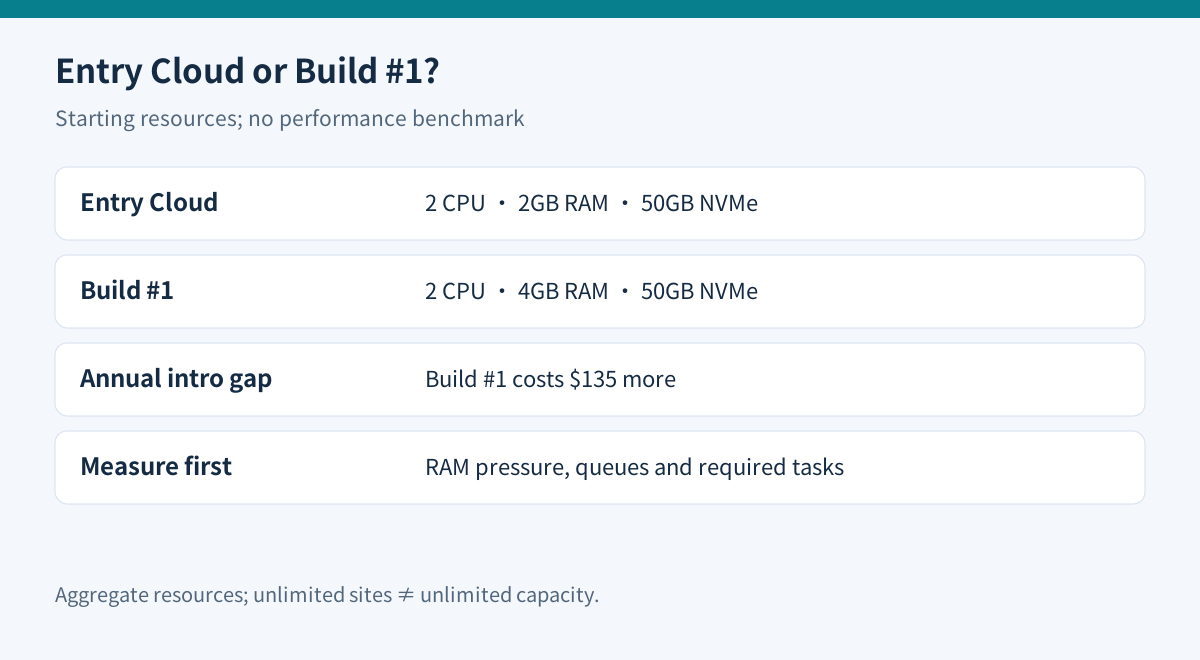
| Published configuration | Entry Cloud | Build #1 | |---|---|---| | CPU cores |2|2| | RAM |2GB|4GB| | NVMe starting storage |50GB|50GB|
These are server-plan figures, not a fresh allocation for each website. Entry Cloud's current small-business page also lists SPanel, a dedicated IP, priority support, assisted website/email migration and offsite backups. Build #1 belongs to the more configurable managed-cloud range. Do not infer identical upgrade procedures or root privileges merely because both use the word cloud.
At the current annual promotion, Build #1 costs $269.52 by arithmetic versus Entry Cloud's $134.52: an additional $135 for the first year. At the displayed renewal references, the difference is $180 per year. That comparison buys a starting configuration with more RAM; it is not evidence of double the application speed.
Treat 2GB as a workload budget, not a website count
A brochure site with useful caching and a store performing uncached searches can make very different demands despite similar traffic totals. WordPress documentation separates hosting capacity, plugin behavior and caching. Reusing static responses can reduce repeated application work, while dynamic content needs its own assessment.
PHP's memory_limit concerns an individual script's allocation. It does not reserve that amount for every visitor, nor does changing it create physical server RAM. Its current documentation also describes version-dependent soft and hard limits, so a simple limit-times-workers multiplication is only a rough planning idea, never an exact capacity proof.
MySQL's InnoDB buffer pool uses memory for cached tables and indexes and must leave room for other server processes. This explains why the full advertised 2GB cannot safely be assigned to one application's PHP tasks. Confirm the actual database engine, service overhead and available metrics rather than copying a database-only tuning percentage.
Request a sizing discussion using your busiest necessary actions: checkout, product search, imports and scheduled work. Record repeated memory pressure, process exits, queueing and response failures where monitoring exposes them. If these occur on a comparable configuration, investigate the application and ask whether 4GB addresses the measured constraint. A quiet homepage test alone is weak evidence.
Compare the first payment separately from three-year cost
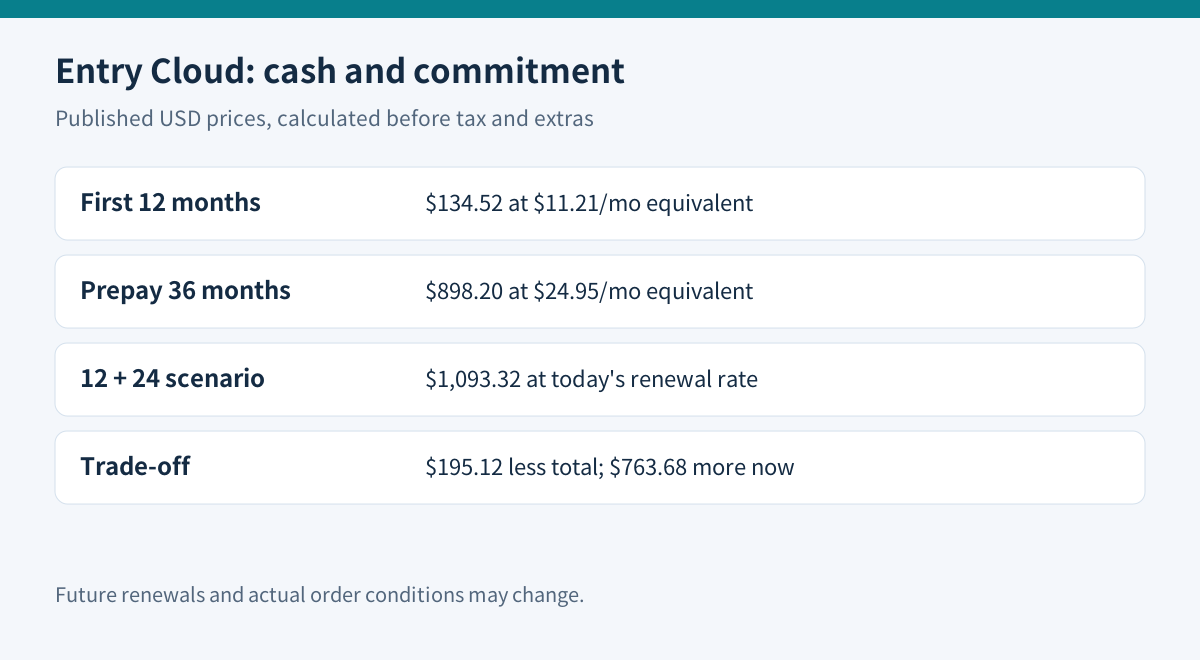
The official campaign distinguishes Entry Cloud's 12-month offer at $11.21/month equivalent from its 36-month offer at $24.95. The standard reference is $39.95/month. The 12-month badge is 72%; the 36-month badge is 38%. No coupon code is required.
| Entry Cloud decision | Calculation before tax/extras | |---|---| | First annual payment |$11.21 ×12 = $134.52| | Three years prepaid |$24.95 ×36 = $898.20| | One promotional year plus 24 months at today's standard rate |$134.52 + $958.80 = $1,093.32|
The three-year scenario is $195.12 cheaper over the same duration but asks for $763.68 more at the start. Our inference is that an uncertain project can reasonably prefer the smaller commitment even when the longer scenario has the lower total. Future rates, upgrades and actual billing dates can change that comparison. These are calculations from published prices, not captured invoices or a financial return forecast.
Four useful inclusions, with practical boundaries
SPanel can simplify routine account administration without adding a separate SPanel license line to the advertised bundle. Assisted migration can reduce manual transfer work. Priority support can improve access to help. Offsite backups add a recovery route. Each matters only when its scope matches your workflow.
Ask about panel compatibility, the exact source accounts included in migration, support escalation and backup retention. Priority does not establish a guaranteed resolution time. An included backup should be tested against your recovery needs and supplemented with an independent copy. The terms require customer backups and describe limits on application-development assistance.
Promotion eligibility and refund eligibility are different
The current campaign includes qualifying new plans and upgrades, including purchases by existing customers, but excludes ordinary renewals. Its stated sale period is October 19 to December 1, 2026; the reviewed material does not settle the exact closing time or timezone. Confirm eligibility in the order.
The terms separately restrict money-back eligibility to new clients, exclude domain and other listed charges, and require cancellation through the client dashboard. A returning customer can therefore qualify for a promotional price without qualifying for the refund program. Do not repurchase the same site merely to evade renewal pricing.
Choose Entry Cloud when the workload fits and its management bundle is useful. Request Build #1 or a specific configuration when measured requirements justify it. Before migrating production, confirm order totals, resource allocation, restoration and a representative customer action.
Affiliate disclosure: Toolnavia may earn a commission from qualifying purchases. Our approved general ScalaHosting link opens its homepage; select Entry Cloud and the intended term yourself. The provider's current campaign permits this promotion, while commission eligibility remains subject to its affiliate terms.
Method: primary-document analysis and price arithmetic; no account provisioning, workload benchmark or completed purchase.