TOOLNAVIA / BUYING GUIDE
Railway Hosting Pricing: Why $5 Is a Minimum, Not Your Maximum Bill
The short answer
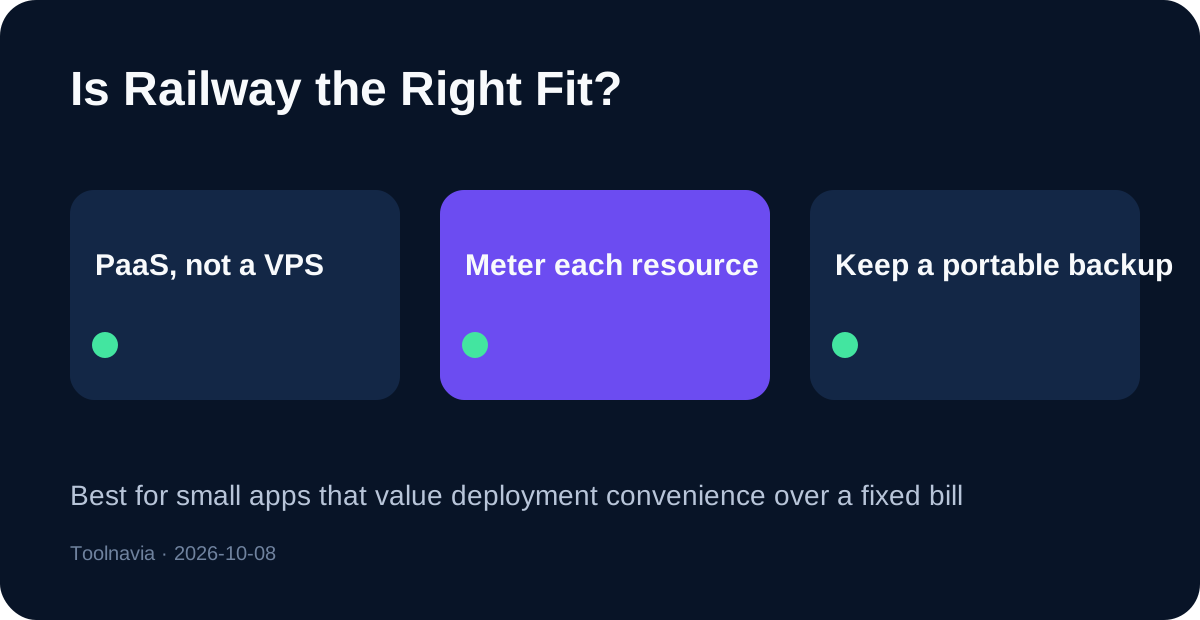
Railway Hobby is worth considering for a small app when you want Git or Docker deployment, private service networking, and usage-based scaling without administering a VPS. The key buying fact is that $5 is the monthly minimum and includes $5 of resource usage; it is not a flat-price server and not a maximum bill.
Affiliate disclosure: Railway has an open cash affiliate program, but Toolnavia has not applied for or confirmed the exact offer. Commercial tracking and calls to buy therefore remain hidden.
At a glance
- Best for
- Small applications that value Git/Docker deployment and private service networking over a fixed VPS bill.
- Price model
- Hobby $5 minimum including $5 usage; Pro $20 including $20 usage; additional metered use billed
- Check first
- The $5 figure is a minimum, not a cap; hard limits can take workloads offline and volume backups are not portable offsite copies.
Four benefits that can justify Railway
Deploy an app instead of building a server
Railway can deploy from a GitHub repository, Docker image, local repository, or custom Dockerfile. For a developer shipping an API, worker, or database-backed project, that replaces much of the operating-system setup required by a self-managed VPS. The boundary is responsibility: Railway manages the platform, while you still own application configuration, secrets, data design, and production readiness.
Pay for measured resources
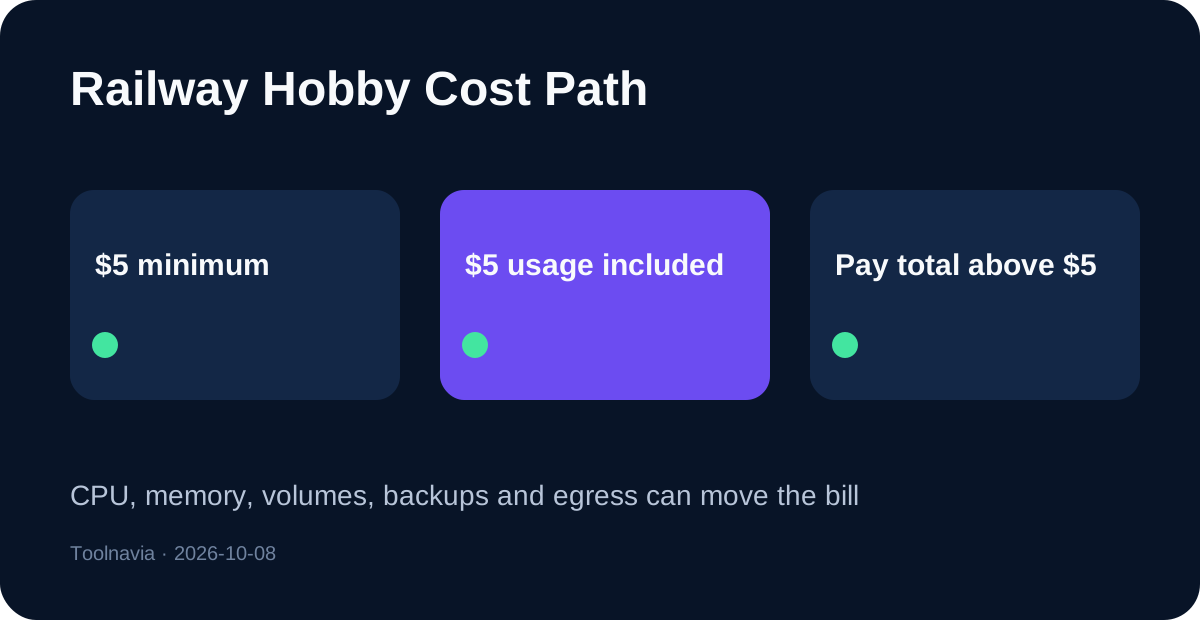
Memory, CPU, volume storage, and service egress are metered. Current rates are $0.00000386 per GB-second for memory, $0.00000772 per vCPU-second, $0.00000006 per GB-second for volumes, and $0.05 per GB of service egress. The Hobby minimum buys the first $5 of monthly usage; if usage totals $7, the total bill is $7, not $12.
This model can favor quiet or bursty services, especially when serverless sleep stops idle compute. It is less predictable for always-on databases, workers, or traffic spikes. Sleep also brings cold-start and connection considerations, so do not budget on an ideal idle state without observing a representative month.
Keep internal traffic off the public meter
Private networking connects services inside a Railway project and can avoid unnecessary public egress. For an app talking to its database, using the private connection string can reduce both exposure and billable public traffic. This benefit is project-local; traffic to users or external services can still incur egress.
Add volume backups without pretending they are offsite copies
Railway supports manual and scheduled volume backups. Daily, weekly, and monthly schedules retain snapshots for 6, 27, and 89 days. This helps with routine rollback, but backups are incremental and billed at the volume rate. Wiping a volume deletes its backups, and restores stay in the same project and environment. Keep a separate portable export when deletion or provider-level recovery matters.
What the $5 headline can become
A light Hobby workload at or below $5 of metered resources still costs $5. Railway's invoice guide explains how plan subscription and metered services appear on the bill. Above that point, the included credit simply offsets the first $5. CPU and memory are the largest recurring meters for an always-on service; volumes, backups, and public egress add separate usage.
Set email alerts before setting a hard limit. Railway's hard limit controls cost by taking workloads offline after the threshold is reached. Replica limits can also crash a service if set too low. These controls prevent further spend, but they are operational trade-offs, not risk-free budget caps.
Is Railway a VPS?
No. Railway is a platform-as-a-service for deploying containers and services. It can host workloads that could run on a VPS, but you do not buy a fixed virtual machine with bundled transfer and root-level server administration. Buyers comparing “Railway VPS” should decide whether deployment convenience is worth a variable meter and narrower infrastructure control.
What to do next
Choose Hobby for one developer and a small app whose measured monthly usage can stay near the $5 credit. Move to Pro when team access, higher limits, support, or production features justify the $20 minimum. Before paying, estimate CPU, memory, storage, backups, and egress separately; then set alerts, observe a full billing cycle, and keep a portable backup outside the volume you are protecting.