TOOLNAVIA / BUYING GUIDE
WPX Agency Resource Limits: Can 200 Sites Share 300 PHP Workers?
The short answer
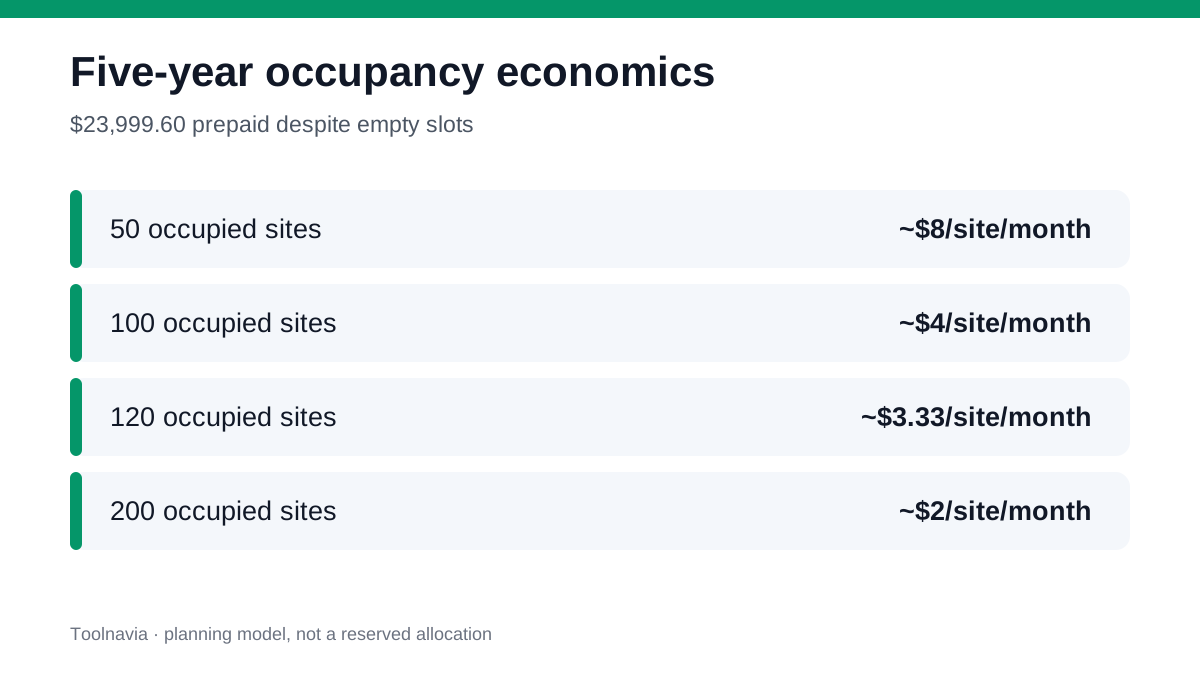
**Quick answer:** WPX Agency puts **up to 200 websites, 300GB storage, 100GB RAM, 6 CPU cores and 300 PHP workers** inside one account. It can simplify a large portfolio, but it is not 200 isolated plans. The displayed five-year offer is **$23,999.60 prepaid**—$399.99 per month equivalent—and the “about $2 per client site” claim assumes all 200 slots stay occupied for all 60 months. Buy it only after measuring combined uncached peaks, not from the site-count headline.
At a glance
- Best for
- A stable, mostly cacheable, standardized portfolio whose peak dynamic workload and five-year occupancy have been measured.
- Price model
- $599.99 monthly or $23,999.60 prepaid for five years / $399.99 equivalent
- Check first
- Portfolios needing contractual isolation, dedicated per-site resources, independent failure domains, uncertain occupancy or sustained heavy uncached concurrency.
The $2-per-site headline has an occupancy condition
The cash outlay does not shrink when slots are empty. Dividing the current five-year subtotal by occupied sites produces planning costs of about **$8/site/month at 50 sites**, **$4 at 100**, **$3.33 at 120**, and **$2 at 200**. Those are Toolnavia calculations, not separate WPX prices.
Model paying client count in months 1, 12, 36 and 60. If the portfolio may remain underused, compare Elite accounts, staged migration or another provider before locking nearly $24,000 into one vendor. The published 30-day guarantee has qualifying conditions; renewals and excluded services are not refundable. It is a short validation window, not a five-year performance warranty.
300 workers do not mean 1.5 guaranteed workers per site
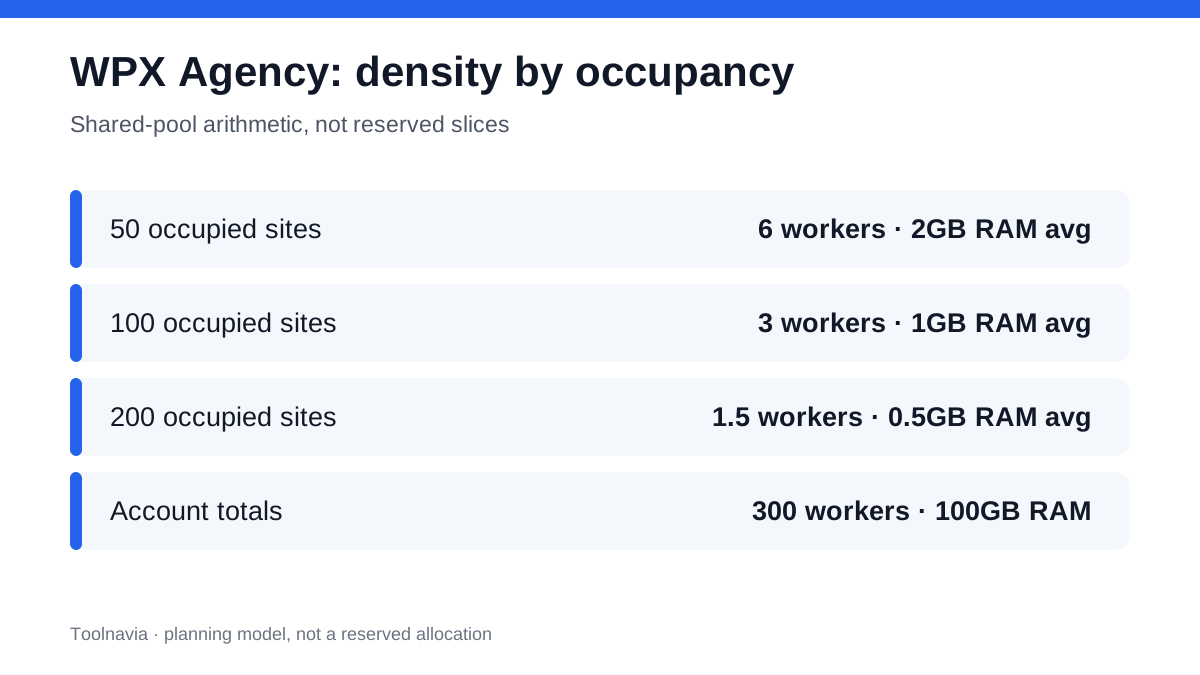
At full occupancy, simple division gives **1.5 PHP workers, 0.03 CPU core, 0.5GB RAM and 1.5GB storage per site**. These ratios are density warnings only. WPX publishes account totals and does not promise an isolated slice to each site.
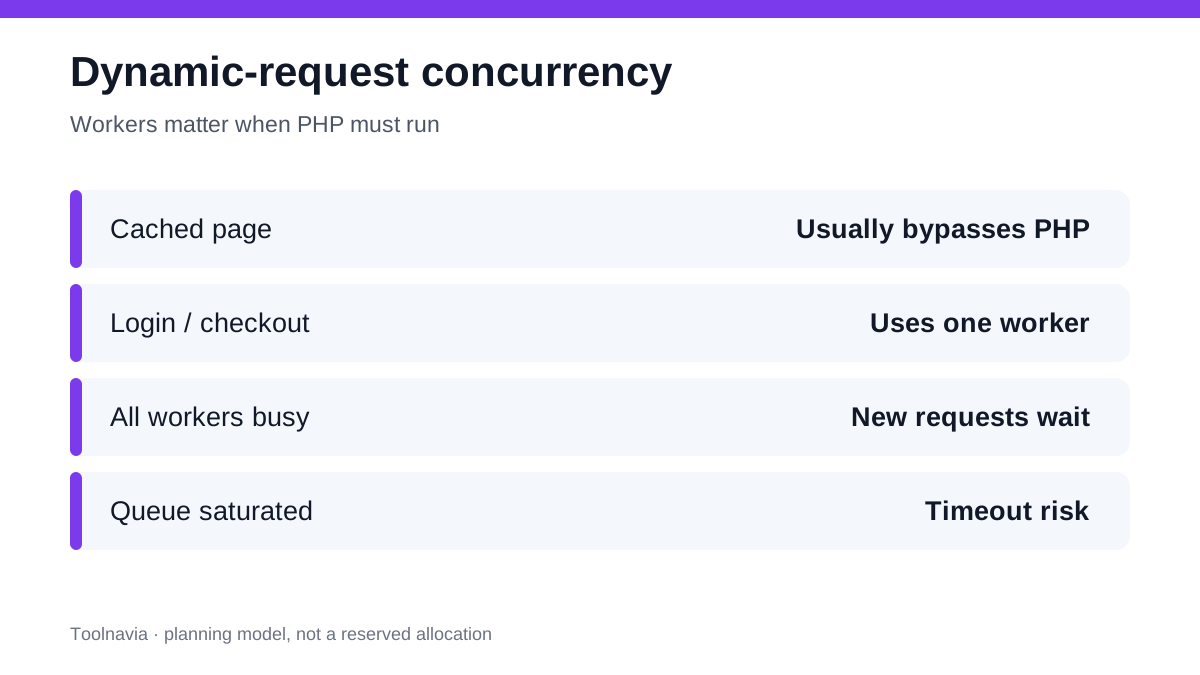
A PHP worker handles one dynamic request at a time. When workers are busy, more uncached requests wait; prolonged saturation can create timeouts. Cached pages usually bypass PHP processing, so two portfolios with the same traffic can need very different worker capacity. Brochure sites are not equivalent to WooCommerce, membership, LMS or busy admin workloads.
The useful question is not “Is 300 greater than 200?” It is “How many uncached requests arrive at the same moment, and how long does each request hold a worker?”
Six CPU cores may become the real shared ceiling
More workers cannot manufacture CPU. WPX lists six cores and describes monitoring account consumption; sustained heavy use can require optimization and support. Other platform documentation reaches the same operational lesson: database work, uncached PHP, backups and store checkouts are CPU-intensive, while cached brochure traffic is much cheaper.
A 200-site portfolio can spike when many sites run cron, backups, scans, imports or campaigns together. Stagger jobs. Separate the heaviest stores. Record CPU, response latency, cache-hit ratio and worker saturation during the busiest hour—not only monthly visits.
Unlimited visitors do not remove concurrency planning
WPX labels visitors and bandwidth unlimited. That removes a simple visitor-meter cliff, but finite compute, storage and fair-use boundaries remain. Before consolidation, collect a week of peak data for important sites: uncached requests per minute, p95 response time, cache-hit ratio, checkout/login/API activity, cron and backup schedules, database size and prior saturation events.
If these measurements are unavailable, migrate in waves instead of moving 200 sites at once.
Site slots and resource use are different
A slot is an administrative count, not a performance unit. WPX says subfolders do not add a slot, and some aliases in one multisite installation may avoid another slot, but all work still shares account resources. Do not use slot rules to infer free capacity.
Ask support in writing whether each staging environment consumes a slot, how the 4,000-database figure is enforced, whether migration copies count, and whether workers are one account-wide pool or governed per environment. The plan table is clear about totals but not every topology question.
Three realistic portfolio scenarios
**Fifty mixed sites:** arithmetic is six workers, 2GB RAM and 6GB storage per site. Headroom may be comfortable, but effective cost is about $8 per occupied site/month.
**One hundred mostly cached sites:** arithmetic is three workers, 1GB RAM and 3GB storage per site. This may fit if dynamic peaks are measured and maintenance is staggered; effective cost is about $4/site/month.
**Two hundred active sites:** the plan reaches the $2/site headline, but arithmetic falls to 1.5 workers and 0.03 CPU core per site. Cached sites can still be light, yet a few heavy properties can dominate the pool. Acceptance testing is mandatory.
When to split instead of consolidate
Keep clients outside the account when they need contractual isolation, separate failure domains, unusually large databases, predictable reserved compute, independent billing ownership or sustained uncached concurrency. GridPane recommends spreading risk across smaller servers for many portfolios, although its architecture differs from WPX. The principle remains useful: one dashboard should not turn one incident into an agency-wide event.
Four gates before paying $23,999.60
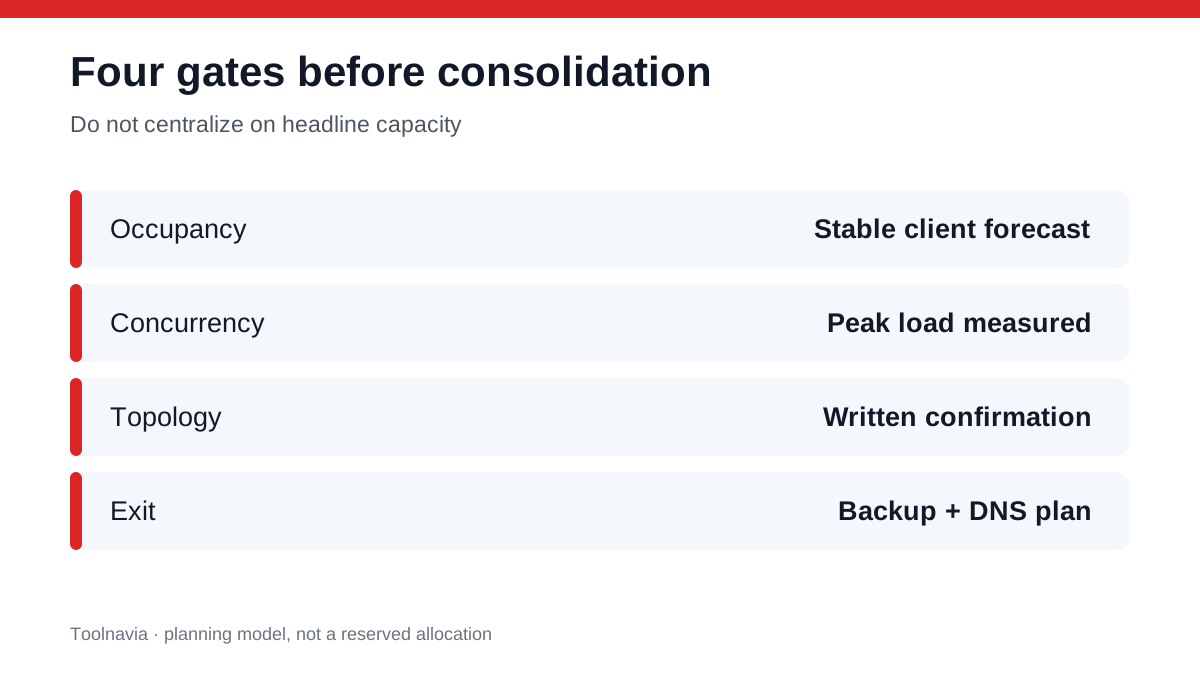
1. **Occupancy:** conservative projections keep enough paying sites on the plan. 2. **Concurrency:** peak uncached work has been measured. 3. **Topology:** WPX support confirms site, staging, database and worker rules. 4. **Exit:** every client has independent backup, DNS inventory and migration path.
**Verdict:** WPX Agency can suit a measured, cache-friendly portfolio that will use much of its 200-site capacity. The 300-worker headline is not a promise of 1.5 reserved workers per site, and $2/site is not the low-occupancy price. Validate representative sites and obtain written support answers inside the refund window before centralizing the portfolio.