TOOLNAVIA / BUYING GUIDE
BigScoots Essential 75 Cache Stack: CDN, Boost and Object Cache
The short answer
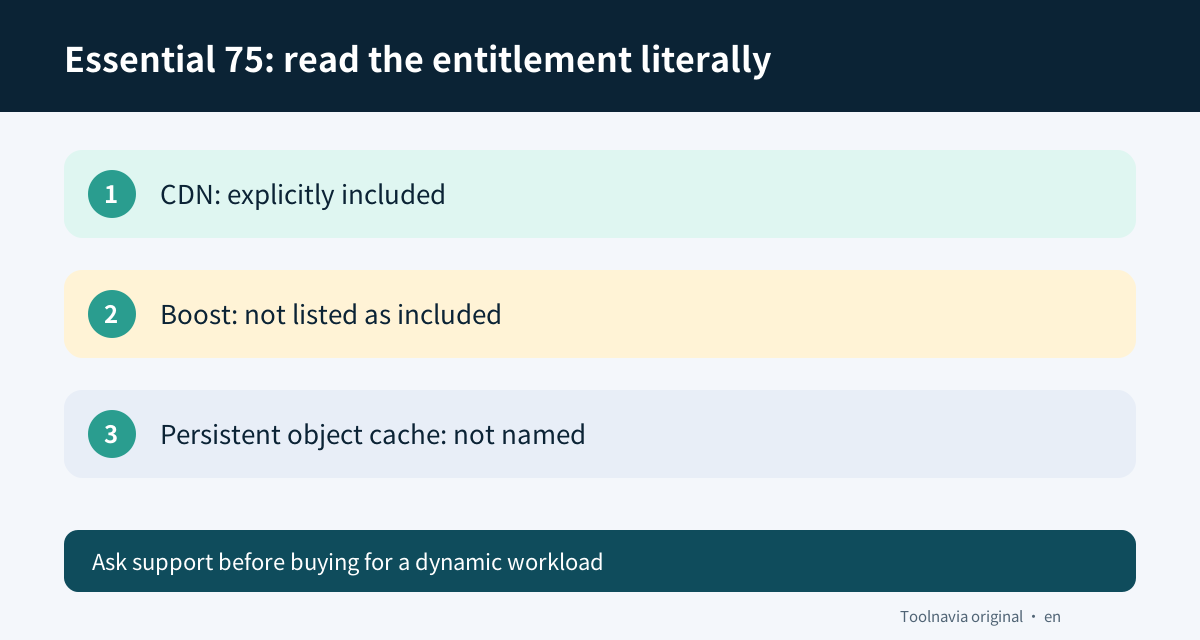
BigScoots Essential 75 includes a Cloudflare-powered CDN, but that does **not** prove that Boost or a persistent object cache is included. Those are three different layers with different jobs. The current public plan lists Essential 75 at **$35 monthly** or **$350 annually**, with one WordPress site, 75,000 monthly visitors, 10 GB storage, 150 GB bandwidth and CDN included. In the same matrix, Boost first appears as an included license on Essential 125. The public Essential 75 material does not name Redis, Memcached or another persistent object-cache service.
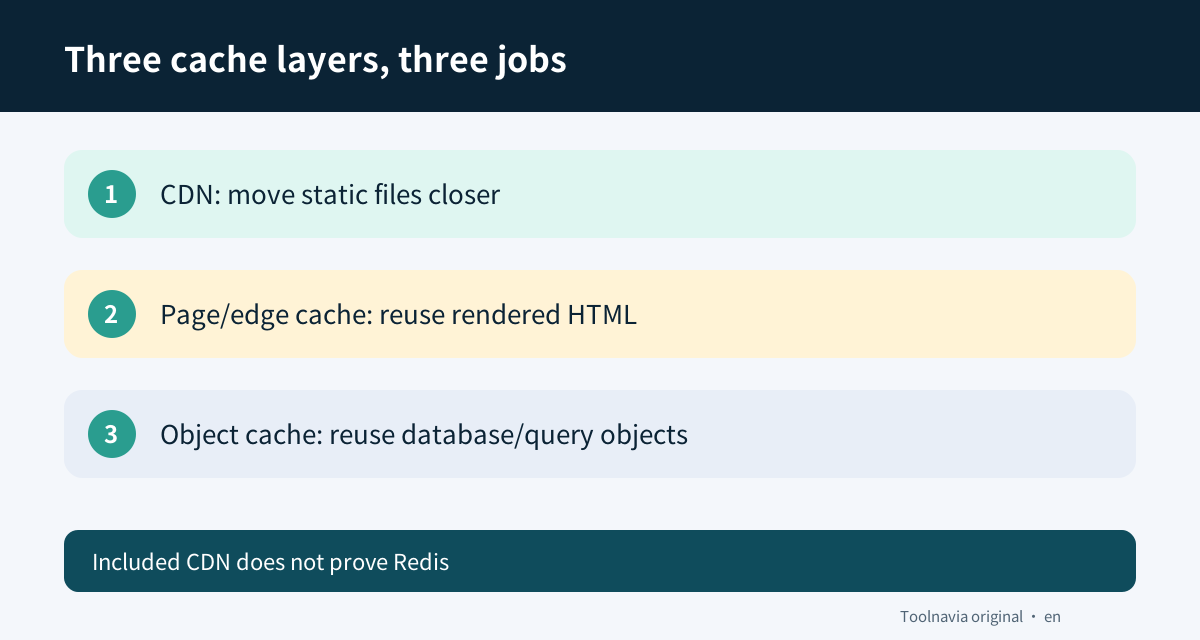
That distinction matters most for WooCommerce, membership and logged-in sites. A CDN can reduce delivery distance for static assets; a page or edge cache can reuse rendered HTML; a persistent object cache can reuse database-query objects across requests. Buying one label and assuming all three is a planning error.
At a glance
- Best for
- One mostly cacheable WordPress site whose buyer will verify dynamic cache requirements.
- Price model
- Public reference: $35/month or $350/year; optional Boost price omitted and final tax treatment requires confirmation.
- Check first
- Boost is not listed as included on Essential 75, persistent object cache is not publicly named, and tax wording conflicts.
The short answer
Choose Essential 75 when you have one mostly cacheable site and its published traffic, storage and bandwidth envelope fits. Do **not** buy it on the assumption that “CDN included” means “Boost included” or “Redis included.” BigScoots describes Boost as a combination of a bespoke Cloudflare Enterprise configuration and its cache plugin; its getting-started guide also says logged-in caching is disabled by default. That is an edge/page-cache decision, not proof of persistent object caching.
For a dynamic store or membership site, ask support to state in writing: whether a persistent object cache is available on Essential 75, which backend is used, whether it is included or an add-on, how it is enabled, what memory or eviction boundary applies, and whether staging is separate. If the answer is “no,” decide from measurements whether the database work actually justifies an add-on or a higher plan.
CDN, page cache and object cache solve different work
A CDN primarily places static files closer to visitors. BigScoots explicitly lists CDN for Essential 75. Its cache documentation describes CDN-level page caching and image optimization, while the Boost guide describes full-page edge delivery, WebP/image work and security features. These can make anonymous pages faster, but they do not turn every request into a cache hit.
WordPress defines its default object cache as request-local and non-persistent. Persistence requires an object-cache drop-in backed by a service such as Redis or Memcached. WooCommerce explains why this can matter: frequently used options and query results otherwise keep returning to the database. Kinsta documents Redis as a separately enabled persistent service, while WP Engine likewise documents page cache and object cache as separate controls. These competitor references define the layer but do not create a BigScoots entitlement.
That is why “BigScoots Cache,” “Boost,” and “Redis” cannot be treated as synonyms. BigScoots' public pages establish the first two product layers; they do not establish the third for Essential 75.
What the Essential 75 entitlement actually proves
The plan page proves a current public package: one WordPress site, 75,000 monthly visitors, 10 GB storage, 150 GB bandwidth, CDN, migration and staging. It does not list an included Boost license on Essential 75. Essential 125 does list one Boost license, which is a strong reason to read the row literally instead of importing benefits downward.
It also does not publish a Redis entitlement, persistent-object-cache memory allowance, eviction policy or account switch for Essential 75. Absence from the public page is not proof that support can never provide it; it means a buyer should not budget or architect around it without an exact answer. We did not inspect a paid account and did not run a benchmark.
The pricing FAQ says displayed hosting prices include tax, while section 6.6 of the terms says applicable taxes are payable in addition to amounts due. Those official statements conflict. Treat $35 monthly and $350 annually as the verified public plan prices, but confirm the final invoice for your location.
Dynamic sites need a request map, not one speed score
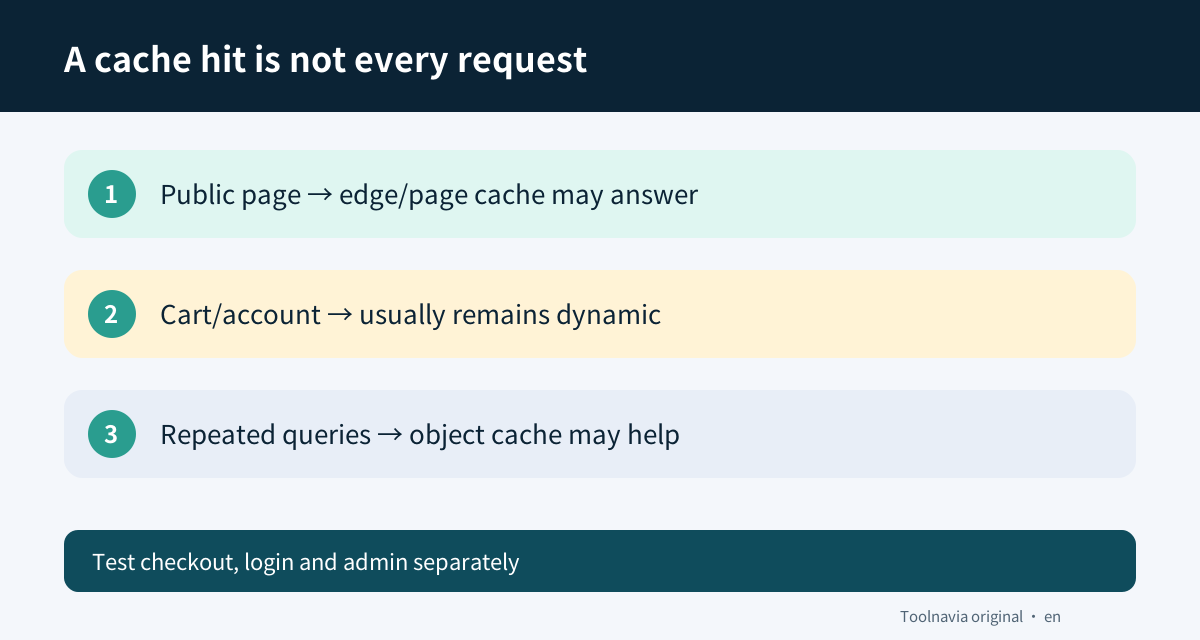
Start by separating request classes. Anonymous product and editorial pages may benefit substantially from edge/page caching. Cart, checkout, account, search, personalized pricing and many logged-in requests are usually dynamic or deliberately excluded. Admin and scheduled work create another workload. BigScoots' Boost guide explicitly notes that logged-in caching is disabled by default, which is sensible for safety but leaves those requests for the application stack.
Then measure: cache hit ratio for public pages, uncached response time, slow queries, database CPU, PHP time, external API latency, cart/checkout errors and admin responsiveness. A persistent object cache may reduce repeated database work, but it cannot fix a slow payment gateway, an oversized autoload set, expensive uncached PHP or a bad query. WooCommerce recommends inspecting the options table rather than assuming one cache is the cure.
Use a representative test window and protect real customers. Never infer that a larger plan or another cache layer will deliver a fixed speedup without workload evidence.
Questions to send BigScoots before checkout
1. Is a persistent WordPress object cache available on Essential 75 today? 2. Is the backend Redis, Memcached or something else, and is it isolated per customer/site? 3. Is it included, separately billed or available only with another plan or service? 4. Who installs and maintains the object-cache drop-in, and how is health verified? 5. What memory, eviction, flush and support boundaries apply? 6. Does staging receive its own cache namespace and service? 7. Which URL classes does CDN/page caching bypass for WooCommerce and logged-in users? 8. If Boost is offered separately, what exact recurring price and cancellation term will appear on the invoice?
The last question matters because the public Essential 75 row does not include Boost and the direct checkout price was not available for reliable verification during this review. We therefore do not quote an optional Boost price.
Buying decision
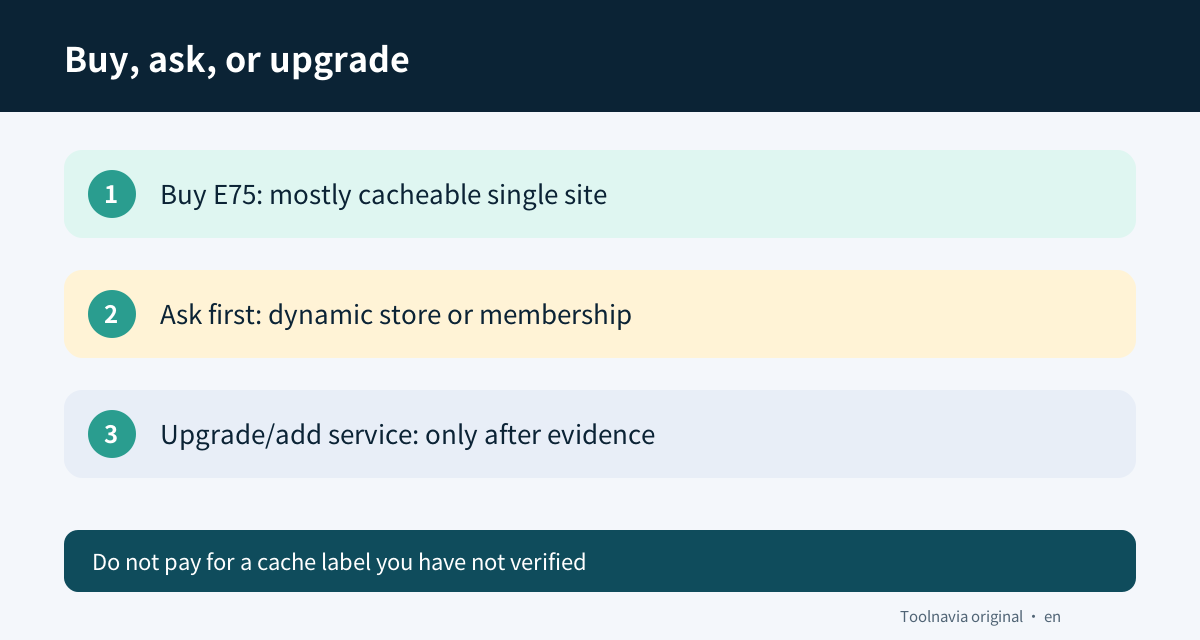
Essential 75 is a defensible buy for one mostly cacheable WordPress site when the published capacity fits and the included CDN is the layer you actually need. Annual billing is $350 versus $420 for twelve monthly payments, a $70 arithmetic difference before resolving the tax-language conflict.
Ask first when revenue depends on uncached WooCommerce, membership, search or personalized requests. Upgrade or add a service only after support confirms the exact entitlement and measurements show the missing layer is the bottleneck. If your current host already provides a verified persistent object cache and stable dynamic performance, migration is not automatically justified.
Toolnavia may earn a commission if you buy through the [verified BigScoots Essential 75 referral link](https://www.bigscoots.com/portal/aff.php?aff=4082), at no extra cost to you. The link is the approved direct owner-issued URL for this exact offer. Prices and entitlements were checked on November 11, 2026; confirm the final invoice and written cache scope before purchase.